Monday, 16 January 2017

Travels in Southern Bessarabia

Southern Bessarabia had fascinated me long before I ever went there. A sliver of land south-west of Odessa, sandwiched between Moldova to the north, Romania to the west, and the Black Sea to the south. Located on the Danube delta, its marshlands are among the richest wildlife havens in Europe. But Bessarabia is also notable for the diversity of its population, formed by migrations and the vicissitudes of international politics and warfare over the preceding two centuries. This piece of territory in southern Ukraine is only part of historic Bessarabia, the majority of which today forms the Republic of Moldova to the north. Southern Bessarabia is also known as Budjak, a name that derives from the Turkish word for borderland. Its character was forged in the repeated shifting of borders between the medieval principality of Moldavia, the Ottoman and Russian empires, Romania, the Soviet Union and independent Ukraine.

Southern Bessarabia is linked with the rest of Ukraine by just two roads at either end of the delta, or ‘liman’ in Ukrainian and Russian, of the Dniester river. The route to the north passes briefly through Moldovan territory. As you leave Ukraine, if you are transiting through to southern Bessarabia and not planning to enter Moldova, you are handed a chit by a border guard, which notes the time and the number of people in the vehicle. You are then supposed to drive straight through, without stopping. When you re-enter Ukraine, the border guard checks the time on the chit to verify this. The southern route goes along the seashore, crossing a bridge over the entrance of the liman at the seaside resort of Zatoka. Neither route has a high capacity, and at Zatoka the bridge over the liman opens every so often to let ships pass, closing it to traffic for half-an-hour at a time. During the summer season, Zatoka is choked with tourists, slowing traffic on this southern route to a crawl. As a result, Southern Bessarabia feels isolated from the rest of Ukraine. The main road through the region had been notoriously bad until former Georgian President Mikheil Saakashvili, during his controversial stint as Odessa regional governor in 2015-16, pressed for repairs. There was also talk of a new bridge across the liman, to link Odessa with Romania to the west by a new highway.


Bilhorod-Dnistrovskyi fortress

On my first visit to Bessarabia in November 2015, I went to Bilhorod-Dnistrovskyi, on the western side of the liman. The town is notable for its massive fortress. There had been a fort here for centuries, a strategic hilltop position overlooking the liman. Much of what can be seen today dates from the Ottoman period, which finally ended in 1812, although Russian forces had captured the town more than once in the preceding decades. A striking memento of the Ottoman period is a minaret in the castle grounds, which once formed part of the Bayezid Veli mosque. A stone tablet nearby recalls that an Orthodox church had stood on the site before the Ottoman conquest. Today, Bilhorod-Dnistroskyi has a Ukrainian majority, but historically it was more diverse. Before the Second World War, when southern Bessarabia was part of Romania, the town contained significant Jewish and German populations, as well as Romanians (or Moldovans), Ukrainians, Russians, Bulgarians and Greeks. There is also an old Armenian church.

Bessarabia’s Jews were mostly victims of the Nazi holocaust. The Germans were deported by Stalin to Central Asia. But southern Bessarabia nevertheless retains its diversity, a fascinating patchwork of nationalities. None forms an overall majority. In some districts, such as Bilhorod-Dnistrovskyi and Tatarbunary, Ukrainians predominate. Elsewhere, notably Bolhrad, it is Bulgarians. In Reni, in the far south-west, it is Moldovans. Gagauz, Orthodox Christians who speak a Turkish dialect, are also a significant presence in several areas, especially in the south-western districts of Bolhrad and Reni. Russians are found in significant numbers in several districts, including Izmail, southern Bessarabia’s most important town. There are also smaller groups. Roma are present in many areas, and often face the same kind of disadvantages and discrimination that they experience in so much of central and eastern Europe. Perhaps most surprising of all is the small Albanian community in the village of Karakurt, close to Bolhrad.


Izmail, with statue of Suvorov

Unusually in southern Ukraine, Izmail retains its Ottoman-era name. One of the Ottoman Empire’s most important fortresses was on this site. The fort was first built in the 12th century by the Genoese, who dominated much of the trade in the Black Sea region during the golden era of the Silk Road. In the 15th century, the region was conquered by the Ottomans. The fortress at Izmail was strategically one of the most important in the Empire. Having been briefly captured by the Russians in 1770, it was heavily refortified by the Ottomans, and was supposed to be impregnable. When the great Russian general, Alexander Suvorov, attacked it again in 1790, the Sultan ordered the Ottoman defenders to stand their ground and on no account surrender. Suvorov’s successful storming of the fort in December that year is commemorated at the diorama, a three-dimensional model of the assault on the fortress. It was a terribly bloody affair, and most of the Ottoman defenders were slaughtered. Suvorov later reported that he wept following the victory.


Izmail, surviving mosque

The diorama is located in the only surviving building from the Ottoman period, a small mosque that had stood next to the fortress wall, on the bank of the Danube. The fortress itself was later razed to the ground, and all that can be seen of its once massive fortifications are the remains of ditches that once stood before the ramparts. A statue of Suvorov on horseback stands in the town centre, and one of the town’s many well-preserved 19th-century houses contains a museum with exhibits about Suvorov, and about the great battle for the fortress.

The symbolism of statues is particularly significant in Izmail, as elsewhere in Ukraine. When I first visited the town in November 2015, a huge statue of Lenin dominated the square in front of the administration building. However, here as all over Ukraine in the coming months, in compliance with a new law requiring the removal of all symbols of Communism and Nazism, the statue was taken down. The law caused division and anguish in many places in Odessa Region, as many people mourned the removal of ‘dedushka’, ‘grandfather’ Lenin. But removing Lenin from Izmail proved tricky. The base of the statue was so solid, that when I visited in April 2016 heavy machinery had been brought in methodically to smash it. By that August, the statue had been replaced by a flowerbed, and another smaller Lenin statue had also disappeared without trace. A city government official explained that they decided it was better to erase Lenin altogether than to put up another statue in the place where he had stood.


Izmail, with Lenin

Izmail is an attractive town, its old buildings in good condition, its flowerbeds well-maintained. In this it is a marked contrast to the shabbiness of Odessa. The mayor, a former KGB man, won with more than 90 per cent of the vote in local elections in 2015. Such an outlandish margin invites scepticism, yet even the mayor’s critics among journalist and NGO workers in Izmail acknowledged, when I asked them, that he did a good job, and was genuinely popular. He typifies Ukrainian politics, a chameleon who changes his party affiliation with each change of the political wind direction, and maintains his grip on power. But as an effective advocate for the town, and a successful administrator, his support remains strong. No doubt Izmail’s success is also down to the presence of money. The port is an important employer, and many locals work as sailors, a well-paid profession.

The port in the nearby town of Reni, further up the estuary, is in a less healthy state. When I visited in April 2016, the port was quiet, buildings mainly empty, equipment idle. A manager from the port told us that in Soviet times a larger part of the port’s activity was connected with Yugoslavia. For example, Soviet cars were transported along the Danube to Belgrade. But all that had come to an end. The small amount of activity at the port today is mainly grain from Moldova. The port at Reni is a beautiful spot, especially at sunset, walking along the east bank of the Danube, while the sky blazes red on the opposite, Romanian side of the river. We once had a barbecue on the river bank, grilled trout washed down with red wine from the Shabo winery, close to Zatoka, while the sun gently sank beneath the horizon.

I enjoyed Bulgarian hospitality on several occasions in Bessarabia. The region is renowned for its fine sheep’s cheese, ‘bryndza’, and for lamb, which does not generally feature prominently elsewhere in Ukrainian cooking. On a visit in November 2015 to the town of Artsyz, where Bulgarians are the most numerous ethnic group, two prominent local Bulgarians entertained us to lunch and local wine, toasting us with the words “peace to the world, and money to the Bulgarians.” It was in a way a fitting motto for Bessarabia. While war raged elsewhere in Ukraine, here the various different nationalities continued to live peacefully alongside each other, getting along with their lives. There had been attempts to stir up trouble in 2014, when nearby Odessa teetered on the brink of open conflict, its streets a battleground between pro-Russian forces and Ukrainian nationalists. Leaflets appeared; a Russian flag was painted on the road outside Bolhrad; there was online propaganda. Amid the fear that conflict engenders, scared people in multi-ethnic lands can all too easily be persuaded to draw in on themselves, to band together to confront the feared other. But it didn’t work in Bessarabia. True, most members of minority ethnic communities there did not identify with the Ukrainian nationalism that exploded into revolution in Kyiv. The sympathies of some were undoubtedly with Russia. Yet they continued to rub along together much as before.

Bessarabia’s Bulgarians appeared content to be left in peace. Politically, they dominate in the areas where they are concentrated. In Artsyz, I met a local Bulgarian priest. Full of energy and enthusiasm, his big project was the construction of a large basilica, its architectural style inspired by an ancient church in Bulgaria. I visited it in November 2015. It had been under construction for four years already. He had found investors, and the basilica was being built partly by volunteers. While we were there, a football team from the nearby ethnic-Bulgarian village of Zorya were working on the site. We later heard they were champions of an amateur Ukrainian league. A few months later, in July 2016, I met this indefatigable priest again. This time his attention was focused on building a new clock tower on the town square, where until recently a statue of Lenin had stood, to mark the upcoming 200th anniversary of the town. Behind such projects lay an irresistible optimism, that despite the country’s problems, in Artsyz they could make their lives better.

Bessarabia’s Bulgarians came to the region in the early 19th century, invited by Imperial Russia to fill the empty spaces left by the Muslim population that had departed following its capture from the Ottoman Empire. In many villages, people knew exactly where in Bulgaria their ancestors had come from, which at that time was still under Ottoman rule. A local official in Zorya told me the village had been established in 1830, and had originally been called Kamchik after a river in Bulgaria from where the original inhabitants had migrated. There had already been a village on the site, but it had been abandoned by its Muslim inhabitants. At the beginning, there had been 34 families, and almost all the village’s inhabitants are descended from them. There is a small Bulgarian ethnographic museum in Zorya. The director had originally come from Russia, and had married a local man.

While Zorya’s population is almost entirely Bulgarian, its churches reflect the diverse past of the region. In addition to the Orthodox Church, there are three protestant churches. These had only appeared since the end of the Soviet Union, the museum director told me, but she thought Protestantism may have had deeper roots. Nearby Sarata had been a German-inhabited town until the Second World War, and their influence may have spread to Zorya.

The region’s Bulgarians have close connections with Bulgaria. Many villagers have Bulgarian citizenship, the local official in Zorya told me, giving them the possibility of working in the EU. Many also go to university in Bulgaria. In the village of Kubei, close to Bolhrad, I was told they have a Bulgarian-language school on Sundays. Bulgaria supplies textbooks, as well as funds for traditional costumes and musical instruments.

Holding dual nationality appeared to be a matter of pragmatism for Bessarabia’s Bulgarians. But for the Moldovans it was more controversial. Bessarabia, including present-day Moldova, had been part of Romania in the 1920s and 30s. The Romanian and Moldovan languages are virtually identical, and some in Moldova openly express hopes for reunification. Some see Romania’s offer of passports to Moldovans as an irredentist ploy to take back the territory lost in World war II. Crossing the border into Ukraine from Moldova near the town of Mayaki, an advertisement gave a phone number people could ring to enquire about Romanian citizenship. A local official in an ethnic-Moldovan village near Reni insisted that Romania’s offer was illegal, and that despite the attractions of an EU passport, local Moldovans would not sacrifice their Moldovan identity. A representative of the Moldovan community in Odessa insisted to me that Moldova had its own separate historical identity, and was worried about the influence of Romania in Moldova and in Ukrainian Bessarabia, promoting the idea that all are Romanians. But a shopkeeper in the village close to Reni expressed ambivalence as to whether they were Moldovan or Romanian. More importantly, they were poor. Many would take Romanian citizenship in order to be able to work in the EU, she said. But it was expensive, and few could afford it.

Visiting several ethnic-Gagauz villages in February and September 2016, there was plenty of discontent in evidence, as well as worry about the future. But everyone I spoke to, whether officials or members of the public, said they had no interest in any supposed Gagauz autonomy in Bessarabia, or link-up with the Gagauz autonomous republic across the border in Moldova. Bessarabia is multi-ethnic, they said, with different national groups in neighbouring villages. Such notions about Gagauz autonomy were attempts by outsiders to stir things up. Much of the discontent was economic in origin. A group of farmers in one Gagauz village told me they feared the village was dying. In Soviet times, they had produced a variety of agricultural products. But now they felt isolated from potential markets, unable to compete. People were leaving the village, many of them going abroad, to Turkey and elsewhere. Houses in the village were being abandoned.


Bulgarian-Gagauz village of Kubei, Bolhrad district

There is pro-Russian feeling in Bessarabia, for sure, and evidence of the influence of Russian propaganda. An official in one Gagauz village told me he blamed the EU for interfering in Ukraine, and the United States for funding those behind the Maidan revolution. He said force should have been used to stop them. Either the EU should accept Ukraine as an equal partner, or let them go with Russia, he said. He believed Ukraine had been destabilised by western interference, but that the EU would not accept Ukraine, as it falls short of western standards and is too corrupt. There had been agitation in some Gagauz villages in 2014 about young men being drafted to go to fight in eastern Ukraine. An official in one village told me the military commissioner there had wisely not pressurised people to join the army. But in some villages, he told me, where the military commissioners had been more forceful, there had been conflicts. In another village, a Gagauz official told me people from that village would not go to fight in the east. They had relatives on the other side, he said, so why would they shoot at them?

In one mixed Gagauz-Bulgarian village, a school teacher acknowledged that there was pro-Russian sentiment in the village. They could not forget that two centuries earlier, Russia had given their ancestors sanctuary. But most people kept such feelings to themselves now, he said. That probably summed up the widely held view among Bulgarians and Gagauz, especially the latter. They might harbour pro-Russian feelings, and they might be antagonistic to the Maidan revolution, but as they had no possibility of influencing events, it was wisest just to keep their heads down and carry on trying to live as best they could. Thus had it ever been in Bessarabia. Borders changed, states and empires came and went, but the people who lived there had no say in the matter.

Much the same could be said for the Russian population. I visited the picturesque little town of Vilkovo three times during 2016. The majority of Vilkovo’s population are Russian Old Believers, a breakaway sect from the Russian Orthodox Church following a 17th century schism. Built on marshland on the Danube estuary, and criss-crossed by canals, Vilkovo is somewhat exaggeratedly known as the Ukrainian Venice.


Vilkovo

On a glorious late-summer weekend that September, I took a boat trip through the canals from Vilkovo to the outer edge of the Danube littoral. Among the willow trees and the reed beds, here and there are weekend homes with jetties, moored boats, gardens with fruit trees, and men fishing. The farthest point of the delta is known as ‘Zero Kilometre’, the mouth of the Danube. A map shows how, over the decades, the ‘0 Km’ shoreline that marks the end of the delta has gradually extended out into the Black Sea, as sediment carried down the great river gradually creates new land. As the waters open up at this furthest point, a profusion of birds take advantage of the rich fishing, including swans, herons and pelicans. Later I ate a tasty meal of freshwater fish at a riverside restaurant. My evening meal was accompanied by the croaking of frogs, a particular speciality in the area of Vilkovo and nearby Kiliya. I enjoyed eating them on several occasions, especially cooked in a garlic sauce.

Persecuted in the Russian heartlands, the Old Believers had settled in the outer-reaches of the empire, in places like Bessarabia. There are three churches in Vilkovo, one of them a regular Ukrainian Orthodox Church (Moscow Patriarchate), and two others Old Believer. The director of the privately-owned museum in Vilkovo, not himself an Old Believer, told me the town had been established in 1746, while the region was still under Ottoman rule. It had been settled both by Russian Old Believers and by Ukrainian Cossacks from the Zaporizhian Sich, the semi-autonomous Cossack realm which many Ukrainians regard as an antecedent of the modern Ukrainian state. The Sich was dismantled on the orders of Catherine the Great in 1775. Ukrainian settlement of Bessarabia began under Ottoman rule, when the Sultan offered Cossacks from the Zaporizhian Sich refuge in his realm.

In June 2016, we visited one of the Old Believer churches in Vilkovo, and spoke with an elderly lady who was cleaning the church. The priest was not there, she said, and would soon be leaving to join his wife in Italy. They were looking for a new priest, but it was not easy. She clearly asserted that she was Russian, but said the Old Believer community had no problems with the Ukrainian inhabitants in the town. Old Believers who had been called up to go to fight in the east had refused to go she said. If everyone in Ukraine had done likewise, there would be no war, she added. A local official told us the Old Believers had preserved their religious beliefs more faithfully than other religious communities under communist rule. But struggling to replace their priests, how well they would survive the post-Soviet era is another question.

Another endangered minority in southern Bessarabia is the Albanian community. In February 2016, I visited the village of Karakurt, and met local officials and teachers from the village school. They told us the village had been founded in 1811 by migrants from a village close to Varna, on the Black Sea coast in present-day Bulgaria. They said there were around 1,300 Albanians in the village, about half of the population. As with the Bulgarians and Gagauz who came to Bessarabia at that time, they were Orthodox Christians who had accepted Russia’s invitation to settle the newly conquered lands.

The people I met were proud of their Albanian heritage, and determined to preserve it. But it was evidently challenging. Until Soviet times, they said, people did not marry out of the Albanian community. But now there were many mixed marriages, and in such marriages, the children did not generally grow up speaking their native language. The children playing on the school playground, I noted, were speaking Russian. Still, efforts were being stepped up to preserve their language. Following a visit by an Albanian-embassy official, one of the school teachers had spent a month in Tirana, learning how to teach modern, standard Albanian. Now they were planning to include Albanian language as a subject in the curriculum of the village school. However, they acknowledged that their dialect was quite different from the standard Albanian spoken in Albania. The teacher who had visited Tirana had been inspired by her trip, but she had found it hard to understand the language spoken there. She reckoned only half of the vocabulary in their village dialect was the same as in standard Albanian. Lacking words for modern appliances and technologies, they borrowed words from Russian or Bulgarian. But, they noted, standard Albanian also included many foreign borrowings.

I wondered what chance they had of preserving their Albanian heritage among such a small population, many of whom had only a limited grasp of the language, and felt more comfortable in Russian? Not only were there many mixed marriages, but many young people were leaving for nearby towns such as Izmail and Odessa. And if they studied standard Albanian at school, what then of their unique dialect, presumably a lost remnant of the rich profusion of Albanian dialects once spoken around the Balkans, in present-day Bulgaria and Greece as well as the heartland of the language in Albania and neighbouring regions?

The hardship and dislocation that had afflicted all of Ukraine following the breakup of the Soviet Union had hit Southern Bessarabia acutely. Collective farms that had employed thousands had been replaced by modern agricultural enterprises that needed few workers. People are leaving the land, and many villages are dying. What hope then for the intricate fabric of this diverse land, if its people leave?

On top of that are the pressures to conform to the mores of the Ukrainian nation amid a determined surge to homogenise and build a more avowedly Ukrainian state. Among the multiplicity of nations of Bessarabia, Russian has long been the lingua franca. But reforms being introduced since the Maidan revolution seek to promote, even impose, Ukrainian. This policy, perhaps understandable given Russia’s assault on Ukraine since 2014, has introduced new strains. Bulgarian and Gagauz officials and teachers told me in early 2017 that they had no objections in principle to the use of Ukrainian in official documents, or to the switch to Ukrainian as the language of instruction in the region’s schools. Ukrainian is, after all, the state language. But why the rush? There were not enough teachers able to teach in Ukrainian, they said. For them Russian was already their second language, and Ukrainian their third, or even fourth. Such rapid change was simply too demanding. They expressed fears that teachers might under proposed new laws be punished for speaking to children in Russian. One teacher noted that under Romanian rule in the 1920s and ’30s, people had been punished for speaking languages other than Romanian in public. Such heavy-handed attempts to impose linguistic conformity brought back unhappy memories in multi-national Bessarabia.

Southern Bessarabia’s longer-term economic prospects may be better than appear now. The marvels of the Danube delta, the profusion of wildlife, will surely bring tourists. Some already come. Danube cruises bring people down the river from Germany and Hungary. Beach resorts are popular with holidaymakers from Moldova. And the national parks of the Danube delta, around Tuzli and Vilkovo, already bring tourists. In 2016, I twice visited the picturesque ethnic-Moldovan village of Orlivka, near Reni. The energetic head of the village council had big plans for the development of tourism. He was cooperating with a town across the river, in Romania, to boost tourism. Supported by a leading member of the regional administration, a Gagauz, they were planning to establish a ferry crossing. He was pinning his hopes on ecological tourism. He planned to build bird-watching towers, and a hotel complex and sanatorium. Most exotically, he was introducing water buffalo, which, apart from being an attraction in themselves, would, by eating vegetation in the water, improve irrigation and make Orlivka’s streams and lakes cleaner. He also envisaged milk and cheese production.

Many of Bessarabia’s people stand to benefit from such enterprise. However, adaptation is proving difficult. The Tuzli Liman national park has seen violent clashed between the park authorities and local fishermen who claim their traditional rights are being trampled. The future is probably brighter than these disgruntled locals appreciate now, although it may be that not everyone will benefit equally. Southern Bessarabia’s isolation may soon come to an end. What that will do for the delicate ethnic balance of this rich and beautiful land remains to be seen.

Tuesday, 20 December 2016

Life in Separatist Luhansk

I first visited Luhansk at the end of September 2014. Luhansk was the capital of one of the two separatist-held territories in the eastern Ukrainian Donbas region, the Luhansk People’s Republic (LNR). Although there was still artillery fire across the contact line every day, the intensive fighting of the summer had ended, and Luhansk itself was no longer a target. We had crossed the contact line at Fashchivka, west of Luhansk, where, on the Ukrainian side, we met the pugnacious ‘Baloo’, the commander at the Ukrainian frontline position on the road from Debaltseve. On the other side, the opposing Cossack soldiers were amiable. They gave us apples. They called themselves Cossacks, and wore the distinctive round Cossack hats, but they were local men, several of them coal miners. Now they seemed cheerful enough. But despite their uniforms and weapons, these were not experienced soldiers. We continued into LNR-held territory. At the small town of Krasnyi Kut, we were stopped by a group of people in Cossack apparel who were initially reluctant to let us pass. One female soldier in particular was hostile and obstructive. However, once we got out of the car and started chatting with them, their reserve melted and their natural friendliness broke through. After a few minutes, we were on our way again.

Approaching Luhansk from the southwest, we stopped in the town of Lutuhyne. We had not had any lunch, and were hoping to find a shop where we could buy some food. We were also interested to see how well stocked the local shops were after the past months of warfare. Lutuhyne had been under Ukrainian-army control for several weeks in the summer, and there had been heavy fighting in the eastern outskirts of the town, as attested by the ruined buildings we saw, and the burned-out tanks strewn about. When we parked outside a shop, people quickly emerged from buildings, wanting to tell us about what they had experienced, about the conditions they lived in. We were probably the first foreigners to have visited the town since before the conflict. The local administration was functioning, they told us, but they were particularly perturbed by the suspension of banking services. They could not access their accounts, and pensioners could not receive their pensions. This was to be a persistent complaint in LNR-controlled territory in the coming months.


Luhansk city centre

Later in the afternoon, we reached Luhansk. The first impression was of quiet. There were few vehicles on the roads, few pedestrians. The city had been emptied of much of its population. We did not intend to stay long. The days were getting shorter, and we wanted to be back across the contact line before darkness. We sped back towards Severodonetsk by the most direct route, along the main highway to Lysychansk. A couple of weeks later, this road would become impassable, as LNR forces surrounded and pushed out the Ukrainian-held checkpoints along much of its length. Brutally contested during the following weeks, it would be churned up by shellfire, strewn with debris, and in places blocked with landmines. But now it was a good, straight road. We expected to be back in time for supper. However, a Russian soldier at one of the LNR checkpoints had other ideas. Our local interpreter could tell he was Russian by his accent. But his bearing, his crisp, brusque manner told us that this was a very different type of figure to the amiable Cossacks we had met earlier in the day. This was a professional soldier. He was not impolite, but he was firm. We would not be proceeding down that road today. We could only speculate as to the reason. Normally this road was open. Perhaps they were moving military equipment and did not want us to see it.

Now we had a choice to make. Twilight was approaching. Did we want to attempt to cross the contact line further east, across the bridge at Stanytsia Luhanska, in failing light, when miscalculations could easily be made by either side, our identity mistaken? The safest option was to return to Luhansk and spend the night there. Arriving back in Luhansk, the city was closing down. The few shops that were open were shutting for the night. With nightfall, the city was completely dark. No street lights shone, no lights emanated from the buildings lining the ghostly streets. There was hardly a soul about.

We looked for a hotel. At one, we were told they could provide us with a meal, but that there was neither electricity nor water. Another said they could not provide food, but that they did have water, albeit cold water. They had a generator which they could turn on for a while, giving us some light. We decided that having water was the winning argument, and stayed there. In normal times, this was supposed to be the best hotel in Luhansk. We had heard that so-called “little green men”, Russian soldiers without their insignia who had first appeared during the crisis in Crimea earlier in the year, were staying at this hotel, as well as a handful of foreign journalists.

I was very much interested as to what we were going to do about food. In principle, I knew that, when travelling in a place under such conditions, it was wise to be prepared for any eventuality, and to have a small stock of food in my grab bag. I had not heeded this advice, except for a small snack bar. Thankfully I did have plenty of bottled water. But a Bulgarian ex-soldier among our number told us not to worry. We would have food. I was wondering where this food was going to come from? There were no restaurants open in the city, we were told. But as we sat down and began to light candles in the hotel lobby, our Bulgarian friend opened his rucksack. It seemed like the feeding of the 5,000. There were biscuits and sausages, and, the final triumph, a bottle of home-made Bulgarian grape brandy, made from grapes pressed by his wife’s own feet. And there was music as well, from his portable system. As promised, the lighting came on for a little while. But we enjoyed our impromptu little candle-lit party. The hotel rooms were comfortable, notwithstanding the cold water.


After the fire: Luhansk market place

The next morning, we set out to have a look around Luhansk. It was a sunny day in early autumn, and the town looked less bleak than the previous night. In the centre, guards stood outside the regional administration building, now the centre of the LNR government. The building, and many surrounding it, had been damaged, pockmarked by shrapnel. In June, a government air strike had damaged the building and killed several people. Much of the nearby market had been wrecked by fire in one of the attacks, rows of metal stores charred and twisted by the blaze. Yet part of the market was open, and the hardy Luhansk residents who had remained in the city pottered among its sparsely supplied stalls, buying essentials. Though the town’s restaurants and cafes, deprived of their power supply, were still shut, in the market were a couple of stores selling shaslik grilled on open fires. A couple of them also sold beakers of instant coffee. Life was starting to pick up in the war-torn city.

By the time I next visited Luhansk about a month later, at the beginning of November 2014, the situation had considerably improved. The water supply had been reconnected, and there was electricity much of the time. Shops and the city market which had been poorly supplied a month earlier, were now well stocked. Food products, we were told, were being supplied from a variety of sources, including from other parts of Ukraine. The Ukrainian government had not yet imposed its economic blockade on the separatist-held areas. Many restaurants and cafes had reopened. I ate several times at a very good city-centre restaurant, serving traditional Ukrainian fare. It was a favourite haunt for foreign journalists and for LNR officials. I especially liked the Cossack Borsch, a thick soup served with garlic-rolls and salo, a tasty pork-lard paste. In daytime, the streets were busy, with plenty of traffic on the roads. But at night the city was still dark and largely unlit. Few people were to be found out and about. The walk along unlit streets from the hotel to the restaurant was a slightly nervous experience, my pulse rate rising a little each time a figure emerged from the shadows.

Some of the people who had left the city at the height of the conflict were returning. A city education official told us that while most schools had opened late for the start of the new school year, by October most were open. Shell damage was being repaired, and the numbers of pupils attending were picking up. A semblance of normality was returning. Traffic police were working at some of the main intersections.

Shelling could frequently be heard in the distance. The city was only 15 or so kilometres from the frontline. But the town itself had not been targeted for some time. During the conflict in the summer, Ukrainian forces had come close to the city. One local told me Ukrainian troops had even been seen in the outskirts. He could not understand, he sighed regretfully, why they had not simply taken the city. If Luhansk had been retaken for Ukraine, it would have dealt a severe blow to the separatists, he said. Not all Luhansk’s residents were happy to see their city under separatist control.


Election poster: the ruling triumvirate

But now that the period of intensive fighting was over, and that the Ukrainian forces had been pushed back, the LNR authorities were setting about establishing the institutions of their putative state. On 2 November, elections had been held. They were, of course, a sham. There was no genuine political competition. The trappings of an election were there, including campaign posters. But the LNR leaders were simply confirmed in office. Prominent individuals were included on the lists that notionally contested the election. One who had been put on the list of the head of the LNR, Igor Plotnitsky, and whose picture was on campaign posters in the town, told me she had not sought to be included, but had been approached. Nevertheless, she said she was now a ‘separatist’. Some told me that the turnout had been significant, as evidenced by the long queues at polling stations. But the explanation for that was straightforward. As an LNR minister told me, many fewer polling stations had opened than had been the case in Ukrainian elections.

For many officials, the new reality presented an acute dilemma. I spoke with one local official who found himself in an impossible position. Whatever he did, he told me, he would be condemned by one side or the other. He had been appointed under Ukrainian law, but now the reality was that others were in control. He told me he felt afraid for his own safety. He had reason to be afraid. In separatist-held territory, during the summer and autumn of 2014, people had been disappearing, nobody knew where, or who had taken them. Many were held in basements, without any process or accountability, their families not knowing what had become of them. If this official were suspected of being loyal to Ukraine, that could be what awaited him. Yet if he stayed in his place, and continued carrying out his functions, many on the Ukrainian side could regard him as a traitor. There was little appreciation or sympathy for the dilemmas such people faced. After all, many officials had left separatist territory and moved to the government-held side. What else could it mean if someone chose to stay put? This was a man approaching retirement. Throughout his career he had always done what was expected of him. He had towed the party line, whether that was the Communist Party or the Party of Regions of ousted President Yanukovich. Now there were competing demands for his loyalty, and he was in an unimaginably uncomfortable position. He asked us not to visit him again. While he was happy we were there, and he was sure we were nice people, he was afraid that his talking to us might be misconstrued.

Such dilemmas faced many others, torn between what they felt was their duty to continue to ensure the provision of services to the population and the anxiety that in Ukraine they would be condemned. The water supply was a critical problem for the city, and even more so for many other parts of LNR-controlled territory. Pumping stations and pipelines had been damaged, and an already decrepit infrastructure was collapsing altogether in some areas. The LNR’s particular problem was that while most of the water supply came from government-held areas, the majority of the region’s population were in separatist-held territory. Water supplies to separatist-held towns were drastically cut. During 2015, hundreds of thousands had no mains water supply at all for extended periods. The authorities on the Ukrainian-controlled side used their control of the water supply as a weapon.

I met the director of the public water company in Luhansk a couple of times. He saw himself as responsible for the water supply for the whole region, on both sides of the contact line. He tried to maintain contacts with officials on the government-controlled side. There was a degree of cooperation to maintain essential infrastructure, including the water supply and electric power cables. Local cease-fires were agreed to enable repair work. But it was limited. The water supply company director was treading a fine line. The last I heard of him, he had crossed into government-held territory, and had promptly been arrested.

The Ukrainian authorities took an increasingly harsh attitude towards the civilian population in rebel-held territory. Towards the end of 2014, they began to implement an economic blockade. Not only were pensions no longer paid, but traffic across the contact line was drastically restricted. This caused unbearable strains for many people. Families found themselves cut off from each other. Pensioners who had been able to cross the contact line to draw their pensions were now stuck. The blockade also brought shortages of many goods. In the early weeks of 2015, Ukrainian products gradually disappeared from shops in Luhansk. Prices soared, often double or more the prices of the same products on the government-controlled side. Some people went hungry. Medicines were not supposed to be included in the blockade, but too often they could not be found. I brought drugs across the contact line for one elderly woman with an ailing heart. A local official told me, his face racked with pain and sadness, that his mother was dying of cancer, and the medicines she needed were not available.


Rally in Luhansk

At the end of December 2014, I attended a rally in central Luhansk, a protest against the blockade. It was in a city centre square, next to the war memorial and the eternal flame. Flanking the square are two First World War vintage tanks, abandoned by the British force that had intervened on the side of the Whites in the revolutionary war. It was a largish crowd for Luhansk, up to 3,000 people, I estimated. They waved flags of the LNR and of Plotnitsky’s ‘Peace for Luhansk’ party. One could suppose that many of those present were state-sector workers who had been told to attend. Speakers included the leading triumvirate of the LNR, Plotnitsky, the prime minister, Gennadiy Tsipkalov, and the speaker of the LNR parliament, Aleksey Karyakin, as well as the mayor of Luhansk and representatives of veterans’ and women’s organisations. There was much emotive language, accusing the Ukrainian authorities of genocide and of a new ‘holodomor’, a reference to the mass starvation in Ukraine in the 1930s. The non-payment of pensions was raised time and again. While people were not being paid the pensions they had earned, money was instead being spent on arms to attack them. One speaker said that if the Ukrainian government considered Luhansk region to be part of Ukraine, it should pay people their pensions. But if not, it should say so plainly.

Anger at the Ukrainian authorities was widespread, even among people who did not support separation from Ukraine. How could our president do this to us, I heard time and again? There may have been a certain logic to the blockade. The territory was out of the government’s control, and, Moscow’s denials notwithstanding, ultimately controlled by Russia. For Kyiv, this was occupied territory, and it was the occupying power, Russia, that was obliged to provide for the population. But the Ukrainian government’s approach did nothing to encourage people to see for themselves a future in Ukraine. For many people in separatist-held territory, the situation seemed clear. Ukraine had abandoned them, denied them their salaries and pensions, blockaded them, shelled them. For some, the realisation of their situation was tinged with sadness. I asked a villager close to Luhansk whether she could see a future within Ukraine? She replied that unfortunately she thought people in the rest of Ukraine had a negative attitude to the people of Donbas now.


Christmas in Luhansk

Yet amid the hardship, the city authorities tried to restore a semblance of normality. As 2014 came to an end, Christmas lights were hung in the city centre, and a large Christmas tree was raised in a central square, in front of the statue of Lenin. Children played, and little electric toy cars were hired out for them to ride in. And then, perhaps the most important symbol of normal life returning, the city centre’s street lights were switched back on for New Year. A stage was erected in the city centre, and there was a pop concert. Celebrating New Year in our hotel, not far from the city centre, we listened to the fireworks. Not shells that evening, but fireworks.

Early in 2015, the sense of returning normality was for a few weeks broken. Our movements were restricted. We were mostly not allowed to leave the city, and when we were, it was only under strict coordination with the LNR authorities. We had a fairly good idea what was happening. Things were being moved along the roads of the LNR that we were not supposed to see. In the second half of January, the shelling started to pick up along the contact line. Thankfully it was mostly not aimed at Luhansk itself, although one shell did fall less than a kilometre from our hotel. The boom boom boom of shells, and the whoosh of rocket launches punctuated the nights, disturbing my sleep. To the west of us, a battle was going on for the strategic town of Debaltseve, which would fall to the Russian-backed separatists in February.

The fall of Debaltseve was a severe blow to Ukraine. Once again, the inability of its army to withstand a determined offensive by the Russian-backed separatist forces had been demonstrated. In the aftermath, an uneasy normality resumed in Luhansk. Shelling continued up and down the frontline. But life in the city carried on. The shops, denuded of many products due to the Ukrainian blockade for several weeks, were gradually restocked with Russian replacements. More restaurants opened. Public sector salaries began to be paid, as well as pensions. They were low, lower than in government-held territory, but it made things easier. They were paid in Roubles, indicating where the money was coming from. The Rouble was now introduced as an official currency, along with the Ukrainian Hryvnia, the US Dollar and the Euro. In practice, the Rouble quickly supplanted the Hryvnia as the main currency, unsurprisingly given that people were being paid in Roubles.

Strolling through the bustling streets of central Luhansk that spring and summer, life could almost have been normal. Students crowded around the university during breaks from their lessons. The American-style diner was full of youngsters enjoying burgers, pizzas and Tex-Mex. Smart cafes served capuchinos and delicious cakes and pastries. On my last weekend before leaving Luhansk in September 2015, there was a fair in the city centre. Folklore dance groups from around the LNR performed. Stalls sold local products. One had been set up by the town’s Greek community. Youngsters posed in front of e newly-erected sign saying ‘I love Luhansk’. Plotnitsky paid a visit, inspecting the stalls, chatting amiably. It was a sunny day, and the atmosphere was festive.

Yet all was not normal in Luhansk. While city life may have appeared normal on the surface, many faced severe hardship, deprived of earnings, facing high prices in the shops, dependent on humanitarian assistance. Only a few kilometres away, across the contact line, for all Ukraine’s chronic problems and its crumpled economy, conditions were nevertheless incomparably better than in separatist-held territory. Whatever the show of normality and optimism put on by the separatist authorities, Luhansk existed in a kind of limbo. Locals again and again expressed disbelief about the region’s long-term separation from Ukraine. One local journalist told me there had been a lot of excitement in the spring of 2014, that many thought they would soon, like the people of Crimea, enjoy Russian-level salaries and pensions, higher than in Ukraine. But it had not happened. A year later, many had concluded that Russia did not want them, and that all the pain and suffering was for nothing.

Monday, 5 December 2016

Along the frontline in Donbas

I arrived in Severodonetsk on a sunny afternoon in September 2014. We drove through broad tree-lined avenues somewhat overgrown with greenery, unkempt, the trees partially obscuring the shabby, decaying Soviet-era apartment buildings. Only at the central square, dominated by the large, neo-classical House of Culture, was there much sign of life; a market and some fairground games. It was not long after the signing of the first Minsk peace agreement that was supposed to have brought an end to the intense fighting over the summer. Severodonetsk had been under the control of pro-Russian separatists. Local self-proclaimed Cossacks had abducted four international monitors there at the end of May, and held them as their ‘guests’ for a month. But at the end of July, Ukrainian forces, temporarily in the ascendency, had swept into Severodonetsk, and then pushed further south, across the Severny Donets River to Lysychansk, Popasna and Hirske.

The rapid success with which Ukrainian forces carved up the separatist territories in Luhansk and Donetsk regions during the summer of 2014 had not lasted long. During August, Russian troops and armour poured into Ukraine’s eastern Donbas region to rescue their separatist clients. The Ukrainian forces were pushed back from much of the territory they had retaken over the preceding weeks around Luhansk and Donetsk. With Russian support, the separatists seized new territory in the south of Donetsk region, on the Sea of Azov, threatening the important city of Mariupol. But further north, the Ukrainians held the territory they had taken, including Severodonetsk.

Severodonetsk had few scars from the fighting. A bridge had been wrecked, and one wing of the hotel where we stayed had a gaping shell hole. But the town was relatively unscathed, and life appeared generally pretty normal. Restaurants were open, and the large central market was bustling and well stocked with all manner of goods.


Peace protest, Severodonetsk, September 2014

On my second day, I went along to a peace rally on the main square. A couple of hundred people had showed up, the majority of them women. There was much waving of Ukrainian flags, and several of the younger people had painted the blue and yellow Ukrainian colours on their faces. There were shouts of ‘Glory to Ukraine’, ‘Glory to the Heroes’, and ‘Heroes never die’. After a minute’s silence for the fallen, the Ukrainian national anthem was sung. One group of young men shouted more belligerently, including some colourful language against the Russian president, Putin. But for the most part it was good natured. One speaker called on those present to remember their brothers in Russia who were also demonstrating for peace that day. But it was clear, this space was owned by the Ukrainian patriots. The town was firmly under Ukrainian control.

By no means all the population felt that way. Many had voted in the unrecognised May 2014 referendum on separation from Ukraine. Few in this region had supported the Euromaidan protests in Kyiv a few months earlier that had brought down the pro-Russian Yanukovich government. Mistrust and resentment towards the new Kyiv authorities was widespread, if mostly kept buttoned up in public. The surface was calm in Severodonetsk that autumn, but beneath the façade tension was palpable.

A few evenings later I saw an illustration of the divisions in the town at, of all places, a Karaoke bar. Among the Russian pop tunes, some of those present also chose patriotic songs, some of them Ukrainian, others Russian. Some sang with enthusiasm a patriotic Russian song, with the words adjusted to be about Ukrainian heroes, not Russian. There was to-ing and fro-ing between the supporters of the two sides. Then someone chose the Ukrainian national anthem. Some stood up and sang with gusto, hands on hearts. Others stayed stony-faced in their seats.

In towns around the region, on the Ukrainian government-controlled side, Ukrainian flags flew. Fences were painted in Ukrainian colours. On the surface, there was no sign of dissent. Some, for sure, were committed to the Ukrainian cause, without reservations. In a garage in Severodonetsk where I went for car repairs was a poster of Putin in front of a Russian flag, redesigned to include a swastika in the middle, with the words ‘Putin Khuilo’ (‘Putin dickhead’), a favourite slogan popularised by Ukrainian football fans.

But every now and then the uncertainty and ambiguity felt by many about the conflict became apparent. There was the lady in Hirske, a village close to the frontline that from time to time came under shelling. Complaining about delays in the payment of salaries, she pointed out that the Ukrainian flag flew in the village. They would be Ukrainian patriots, she said, but the Ukrainian state should take care of them, and pay their salaries. Her loyalty appeared distinctly conditional. On a later occasion in Hirske, an old lady at a bus stop quietly, nervously, told us that she was for the separatist LNR, the Luhansk People’s Republic. Ukrainian forces, she told us, were firing artillery pieces from the village. Hirske had been under separatist control in the summer. A young man told us he had been with the separatists, manning a checkpoint, gun in hand. Now he was nervous. He had lost his passport, but did not dare leave the village to apply for a new one, as that would mean crossing Ukrainian army checkpoints, whose personnel had lists of people who had been with the separatists, and who should be detained.


Lysychansk, October 2014

Nearby Lysychansk, a largish town of over 100,000 people, bore some scars from the conflict. An apartment block on the southern outskirts of town had been hit, the walls blasted away and the rooms on several floors blackened by fire and exposed to the elements. But in the town centre, life went on much as normal, the market bustled, pizzarias were packed with customers. But people were divided in Lysychansk. That autumn, pro-Ukrainian civil-society activists told us they were not satisfied with the town council, whose members they believed were tainted by having cooperated with the separatists when they controlled the town. At that same meeting, one lady expressed a different view, saying most people in the region felt close to Russia, did not trust the current Ukrainian authorities, and did not want to be imposed upon by western Ukraine. Nevertheless, she objected strongly when the pro-Maidan activists accused her of being a separatist. She was not for separation from Ukraine, she insisted, before storming off angrily.

The following May in Lysyschansk, a vote was held in the city council on declaring Russia an external aggressor, and the LNR and DNR (the rebel para-state in Donetsk region) terrorist organisations. This was one of several such votes in town councils in the region around that time, part of a concerted effort to force local politicians off the fence, to declare themselves unambiguously for the Ukrainian side. The vote failed to pass, many of the councillors feeling uncomfortable about being forced into taking such a stand. Amid the shifting sands and shifting frontlines in Luhansk region, on the fence was for many the safest place to be. During the council session, civil-society activists gathered outside, holding Ukrainian flags. Some of them brought a rubbish bin, with the word ‘lustration’ written on it, threatening to throw some of the councillors in. The previous autumn there had been a spate of such attacks elsewhere in Ukraine, carried out by far-right activists. In a divided region such as Luhansk, such threats could only exacerbate tensions. But in the event the threat was not carried out.

On the Ukrainian-government controlled side of the frontline it was rare to find people who would openly express support for the separatists. But dissatisfaction with the Ukrainian military was widespread. My first visit to the frontline, in September 2014, was to the small government-controlled town of Stanytsia Luhanska, less than 20 kilometres from Luhansk, on the north side of the Severny Donets river. We went to the last Ukrainian army position before the bridge across the river. Around the checkpoint was a scene of devastation, houses smashed, their roofs staved in by shells. To one side of the checkpoint was a wrecked car. A couple of civilians had been killed there a few days before, when the car had driven over a landmine. There were mines along the grass verges, in front of people’s houses. Desperate elderly people came to talk to us. Why, they pleaded, did the army have to put its checkpoint in a built-up area, a target for the other side, just across the bridge? Prodded by us, the checkpoint commander had detailed some of his men to help repair damaged roofs. He seemed to get the point. The soldiers were not winning the hearts of these people. But he was powerless to do anything about the position of the checkpoint.

A couple of days later, I visited Trokhizbenka, a frontline village on the Ukrainian side of the Severny Donets river. We visited a couple of the frontline positions. At one of them, the soldiers invited us to share their lunch. Welcome to our kitchen, said one of the soldiers ironically, as he led us to a patch of damp grass next to an open fire. But the food was quite palatable.

Nearby one of the checkpoints, out of earshot of the soldiers, I approached a couple of elderly men who were carrying out some work on a damaged tree. How were things in the village, I asked? They replied nervously, speaking quietly. It appeared that something was troubling them. Something was not right. The secretary of the village council had been abducted by soldiers, they told me. They did not know which soldiers, or where she was being held. They suggested that we talk to the village priest. We went back into the centre of the village, where we came across the priest walking hurriedly towards his church. A small, middle aged man with a flowing robe and a long, sparse beard, he was evidently distressed. Not only the secretary of the village council, but the previous council head had also been taken, he said. He did not know which military unit was responsible, but he believed they might be held at the school on the outskirts of the village. So we made our way there.

Reaching the school, we were greeted by members of the Aidar Battalion, a notorious volunteer unit whose reputation was already well known. Amnesty International had published a report about them. Widespread stories told of their looting of homes and stealing of vehicles. This was my first encounter with them. In appearance, they struck me more as pirates than as soldiers. Unkempt, in a motley variety of uniforms, there was no sign of military bearing or discipline. They seemed suspicious of us, but their commander offered us tea and a tour of the school which they had taken over as their barracks. The place was a mess. But there was no sign of any detained persons there. No, he did not know anything about the abducted council members, the commander assured us. We exchanged telephone numbers, and told him we would follow up on what had happened to the missing councillors. If he did in fact know something about them, I wanted him to know that we would not let the matter rest. As we were driving away from the village, surprise, surprise, we received a phone call from the commander. The two councillors had been located. They would be freed. But it was nothing to do with him, he again repeated.

We returned to the village the next day. The council secretary had been released. Enormously grateful, she told us she and her fellow abductee had been held in a tent, in a field, but that he had been taken away, she knew not where. The village priest thanked us profusely, and blessed us for our efforts. But the wife of the still not released former council head was beside herself with worry for her husband. This was the reality of families living in the conflict zone. The small personal tragedies that are rarely told, which only affect those most directly involved. Thankfully, the next day we were told the remaining abductee was also released. The reasons were unclear. Perhaps it was because the council secretary had demanded that the school be returned to its intended purpose. It seemed she had also been under suspicion for having helped some soldiers who had deserted. She maintained she had merely given them directions, when asked.


Trokhizbenka bridge, April 2015

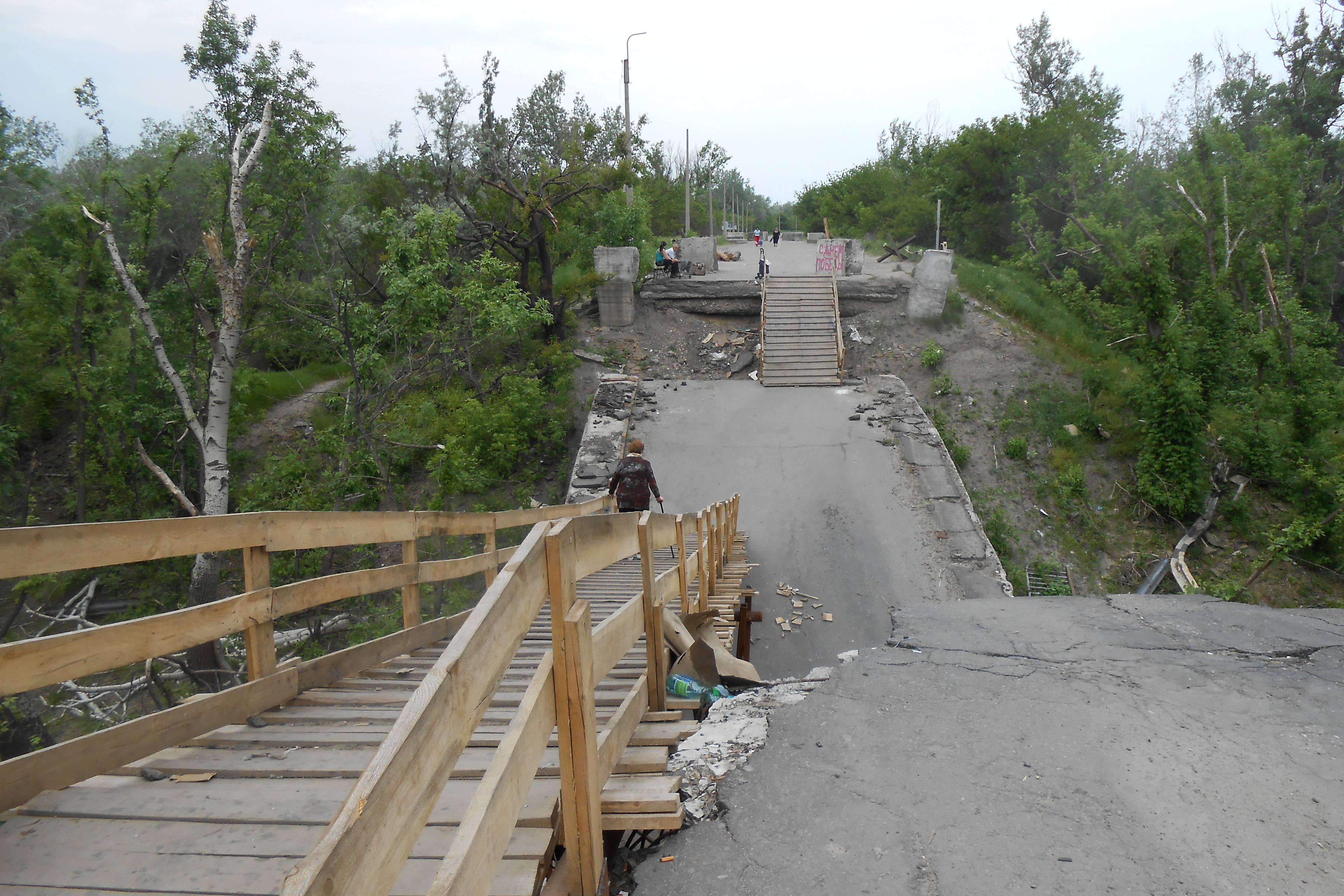
This was not the end of Trokhizbenka’s anguish. Visiting the village a few months later, there were several shell-damaged homes. Local people told us they had for a time been without electricity or water. Many of the locals worked across the river, at the hospital in Slovyanoserbsk, in LNR-controlled territory. As the frontline hardened under the government blockade, crossing the river became more difficult, so that many were no longer able to get to work. Tragically, we heard of at least one case of a man dying because he could not get to the hospital. In April 2015, I crossed the bridge. Broken at both ends, it was passable only on foot, and even then, avoiding getting wet involved precariously balancing along the side rail, the tarmac being inundated by the flow of the river.

Not long afterwards, we met an Aidar Battalion unit at Shchastya, another small frontline town. They were setting off down to the front, close to the bridge that crosses the river into LNR-controlled territory. It was an extraordinary sight. Many of them were drunk, possibly high on drugs in some cases. They were shouting and roaring. I spoke to one who was eating a pie as he bellowed at me, spitting food and boasting about how they would slaughter the separatists. We don’t take prisoners said another, we kill them all. One of them told me they were taking some new recruits down to the frontline for the first time. We don’t train them, he said, we just take them to the front and they learn under fire. This was not an army. This was a gang of cutthroats. I think it was questionable how much real fighting these Aidar volunteers did. The serious, sober, regular Ukrainian soldiers we met at so many other frontline positions were quite different.

Later, on the other side of the contact line, I met civilians who spoke of their experience when their town or village was under Ukrainian control in the summer weeks of 2014, before Russian forces rolled the Ukrainian military back. The outskirts of Lutuhyne, southwest of Luhansk, had seen heavy fighting. The first time I went there, in September 2014, at one crossroads on the edge of the town, there were burnt-out tanks strewn about, and buildings had been reduced to charred ruins. People told us that when the town had been under Ukrainian control, regular Ukrainian soldiers had behaved professionally, correctly. But the Aidar Battalion were just thieves and bandits. I heard a similar account from inhabitants of the village of Novosvitlivka, southeast of Luhansk, when I visited in December 2014. The village had also seen heavy fighting. This was as close as Ukrainian forces had got to Luhansk from that direction. It had sustained heavy damage. Destroyed tanks littered the village, among the ruined buildings. The House of Culture was wrecked, as were the village shops. Picturesquely, one destroyed tank on the main road bypassing the village had been decorated with flowers. Here too, locals contrasted the professional conduct of regular Ukrainian soldiers with the thuggery and thieving of the Aidar Battalion.


Novosvitlivka, December 2014

We repeatedly faced the shame of being confronted with people facing appalling suffering, about which we could do next to nothing. There was the old lady I met in Popasna in autumn 2014, on the government-controlled side of the frontline. She stood in front of her house which had been demolished by a rocket the previous day. She herself was slightly hurt, her face bandaged, but her husband had been badly injured, and was in hospital. From a brief conversation with her son, I understood the man’s chances of surviving were poor. The old woman was distraught, bewildered, not knowing what to do with herself. Her world had been destroyed in one cruel moment, and she seemed utterly uncomprehending.

Across the frontline, in LNR territory, only five kilometres or so from Popasna, is the town of Pervomaisk. Visiting there for the first time in January 2015, the scenes of destruction were shocking, much worse than anything I had seen in government-controlled territory. From Popasna, I had several times listened to the outgoing shelling from government-held positions towards Pervomaisk, so I was not surprised. Much like Severodonetsk, Pervomaisk is a rather charmless Soviet-era town of apartment blocks. Most of them had suffered shell damage. A collection of shell cases had been heaped up in front of the statue of Lenin, in the town square. The acting mayor of the town, dressed in military fatigues and a Cossack fur hat, took us to a basement where several families had been living for six months already. It was like the basement of an industrial building, with a concrete floor, and pipes along the walls. Beds were placed around the walls. There was no water here, or toilet facilities. For that, people had to go out into the snow. But there were makeshift wood stoves, for cooking and to provide heat. The conditions were desperate, yet mothers played with their children, attempting some semblance of normality.


Pervomaisk, February 2015

This was the sad fate of towns and villages that found themselves close to the frontline, a matter of chance that put them in the wrong place. Five kilometres away, they might have been unscathed. In October 2014, I twice visited the village of Krymske, just south of the Severny Donets river. In the initial weeks after the September Minsk agreement, the frontline was fuzzy and undefined in this area. A number of villages off the main roads had so far been bypassed by the fighting. Ukrainian forces held much of the main road from Lysychansk down towards Luhansk, but the villages to the north of the road, towards the Severny Donets, had largely been ignored. Then suddenly the LNR Cossacks started surrounding the exposed Ukrainian checkpoints along the road, forcing them back westwards. In response, the Ukrainian forces moved to take the high ground above the road, to the south of the river. I went to Krymske the day after the Ukrainian army took control. The village had until then been quite peaceful. Locals told me only a few LNR soldiers had been there, and they had stayed at the eastern end of the village. Now the Ukrainian army had arrived, the authorities moved quickly to show they were in control. The regional governor came in person to deliver pensions, which had not been paid the past few months. But people were nervous. The local water pump had been hit by a shell, cutting the water supply. Having been largely forgotten by the competing armies during the summer fighting, Krymske had now caught their attention. Now it was on the frontline, and its people’s problems were just beginning.

What a tragedy. Visiting Krymske for the second time in late-October 2014, there was a sense of foreboding about what was to come. I did not visit Krymske again, but I heard from others that the village was badly damaged by shelling over the following months, and that much of the population abandoned it. The following summer, in 2015, I visited the nearby village of Sokilnyky, three kilometres east of Krymske, which was under LNR control. On the same day that Ukrainian forces had taken control of Krymske, they had also entered Sokilnyky, but for some reason that I had never discovered, they had not stayed there, but had returned to Krymske. During my second visit to Krymske, in October 2014, local people had told me, nervously, that Ukrainian national guardsmen had murdered two villagers in Sokilnyky. This only fuelled the sense of apprehension in the village.

Now finding itself on the frontline, Sokilnyky suffered the same fate as Krymske, if anything worse. Two neighbouring villages, closely connected, whose people knew each other, now found themselves by sheer chance on opposite sides of the frontline, playing host to the soldiers who would lob shells at each other in a senseless battle in which the civilians came off worst. Arriving in Sokilnyky that summer in 2015, I found a scene of desolation. Every house had been hit at least once, some of them two or three times. Almost no one was left, just a couple of determined hold-outs among the inhabitants had stayed on to brave this misery. Otherwise, the only residents now were LNR soldiers. We drank tea with them in the yard of one of the broken-down houses. There were a couple of women who were cooking for them, and doing other chores. They too were rotated in and out, doing their bit for the LNR.

Further west, just to the south of the main road, was the small town of Donetski. I visited in March 2015. Occupied by LNR soldiers, the closest Ukrainian army position was close-by, on the by now ravaged main road. The road, which I had sped along from Luhansk to Lysychansk the previous autumn, was now impassable, pitted by shells and strewn with debris. Donetski was in a sorry state. Battered by shells, without electricity, heating or food supplies, most of its people had left. The few hundred remaining were living in desperate conditions, but spoke cheerfully with us nonetheless. They had recently received the first delivery of food and medical supplies from the Red Cross. Without power for their cookers, people had made little stoves out of bricks outside their apartment blocks. Metal pipes emerged from the windows of one of the blocks, makeshift chimneys from wood stoves inside. These were rooms taken over by LNR soldiers, I was told. The town had been largely abandoned. Yet at the entrances of some of the buildings residents had written defiantly, ‘Мы Живём’ (‘We Live’).

In late-January 2015, just as the second Minsk peace agreement was being negotiated, DNR and LNR forces, backed up by their Russian patrons, made a push for the town of Debaltseve, in Donetsk region, close to the boundary with Luhansk region. Debaltseve was in a salient, surrounded on three sides by separatist-held territory, that had remained in Ukrainian hands since the summer of 2014. This little piece of Ukrainian-held territory was coveted by the separatists for, among other reasons, the railway line that passed through it. They were determined to get their hands on it before the peace agreement went into effect.

I had passed through Debaltseve many times during the autumn and winter of 2014, on my way to the little town of Fashchivka. I met and chatted with the soldiers on both sides of the frontline. The first time, at the end of September 2014, we talked with the commander of the Ukrainian frontline position, to the sound of the regular boom boom of shells being fired at positions three or four kilometres either side of us. A larger-than-life bear of a man, nicknamed Baloo, he railed against the separatists and the international community in equal measure. A couple of weeks later, we learned that he had been killed in a skirmish during a reconnaissance operation. The commander on the other side told us they had temporarily buried Baloo, and were waiting for the arrangements to be made for the body to be taken across to the government-held side. He had received several phone calls from Baloo’s widow, he told us, desperate to receive the body of her husband. He said he felt huge sympathy for her, but until the necessary arrangements were made, there was nothing he could do.

At some places along the contact line, opposing commanders were in contact with each other. Ukrainian commanders were sometimes nervous about this, fearing they might be accused by their own side of treachery. But it was mainly for practical reasons, to avoid needless deaths or injuries due to mistakes or misunderstandings. One LNR commander told us that, if ordered, he was fully prepared to advance against the enemy. But in the meantime, while they were in static positions, there was no sense in putting lives at risk for nothing. I knew of at least one place where opposing commanders met for tea in no-man’s land. But the Cossack commander at Fashchivka told us he did not want to have direct contact with his opposite number. If he was ordered to attack, he would do so without question, and he did not wish to have to kill people he knew personally.

Crossing the frontline at Fashchivka in January 2015, we stopped to talk with the soldiers at the last Ukrainian position. There was a howling snow storm, the wind blowing the snow horizontally at us. It was almost impossible to talk. So the commander invited us into their dugout for tea. Inside it was warm and cosy. A wood stove burned. A makeshift table and benches had been set up. Further back were sleeping bags. Food was produced, soused herrings and ‘salo’ (strips of cured pork fat, a Ukrainian favourite), and then vodka. The food had been brought to them by local women, doing their bit to help Ukraine’s soldiers. Amid this happy little party, unbeknownst to us at the time, the days of this frontline position were numbered.


Road from Debaltseve, April 2015

In the fortnight or so leading up to the assault on Debaltseve, roads through much of LNR territory were closed to us. Of course, they were moving weapons up to the frontline, and did not want outsiders to see. One local Cossack commander told us he had received new consignments of weapons. Something was brewing. As the offensive got underway, the shelling picked up all along the front. In Luhansk, the noise was with us much of the time. Our sleep was disturbed. A few weeks after Debaltseve fell, in April 2015, I went back to Fashchivka. All was quiet now. The frontline Ukrainian position where we had enjoyed vodka and salo a few weeks before was now abandoned. The trees around about were badly damaged, branches stripped off, a sign of the intensity of the shelling. I wondered what had become of the men who had played host to us that cold January day, who I had met on so many occasions?

We visited the nearby village of Chornukhyne, which had now changed hands twice during the conflict. Like Debaltseve, during the summer of 2014 it had been in separatist hands for about three months, before being taken by Ukrainian forces in July. I had tried to go there in the autumn of 2014, but Ukrainian soldiers told us not to. It was too dangerous, they said. But now, the following spring, all was quiet in Chornukhyne. Much of the village was little damaged. This was a surprise to me, having heard the sound of shellfire from the direction of Chornukhyne during earlier visits to the front at Fashchivka. But on one side of the town, in the direction of Debaltseve, we drove down a long street, the length of which houses had been smashed. A burned out tractor and bits of a destroyed tank were strewn about. Local officials spoke with us, cautiously, pointedly referring to the recent ‘liberation’ of the village. In a village that kept changing hands, had these men changed their hats each time? These were the dilemmas facing so many in these frontline areas, trying to adapt to the changing winds, not knowing what was the safest course to follow.


Chornukhyne, April 2015

While chatting with an LNR Cossack soldier in Chornukhyne, we saw a young woman being led to their base by two soldiers. We asked him what it was about? Nothing to be concerned about, he said, just a whore who had been selling herself to the Ukrainian soldiers when the area had been under government control. My stomach immediately felt sick. I had seen at the Ukrainian position at Fashchivka that local women had helped the soldiers, bringing them food. Was this one such woman, someone who had wanted to do her bit for Ukraine by helping the soldiers? I could not be sure, but I doubted very much the slur that this vulgar soldier had cast against this woman, nervously being taken into custody. She was a married woman, the soldier acknowledged. Was this the fate of anyone who committed to the wrong side in the shifting sands of the war? The soldier assured us there was nothing to worry about. She would be questioned, that was all. I was not much reassured. We wanted to talk to her, but were rebuffed. We took the soldier’s phone number, and told him we would phone him the next day, to enquire what had happened with this woman, and that we would follow up on her case. The next day, he informed us that she had been released. This one woman had perhaps been more fortunate than some in that her detention had been observed by visiting foreigners. Who knows how many others were less lucky in those anxious places caught up in the ambiguity of a civil conflict?

The conflict damaged peoples’ lives, even when they did not live close to the frontline, their homes at risk of shellfire, their lives at risk. Families were divided. In the summer of 2014, hundreds of thousands had left separatist-held areas, whether for Ukrainian government-held territory, or for Russia. Many returned in the immediate aftermath of the intense fighting that summer, but not all. When I first arrived in the region, in the autumn of 2014, traffic passed to and fro across the contact line without much hindrance. Papers were checked, but mostly people were just allowed to pass. A Ukrainian soldier at Stanytsia Luhanska told me the document checks were about looking for people who had taken part in separatist activities, who should be detained, but that otherwise people were free to pass. That all changed at the end of the year, when the Ukrainian government imposed an economic blockade.

One result was that economic and social conditions in separatist-held areas quickly deteriorated. Since the summer, the Ukrainian banking system had ceased to function in separatist territory. People in separatist-controlled areas working for Ukrainian enterprises could no longer withdraw their salaries. Now all public officials in separatist areas were ordered to leave their posts. They were not to work for the separatist administration. This posed an acute dilemma to some, for example those working in the emergency services, having to choose between loyalty to Ukraine and the duty that many of them perceived to continue to provide vital services to the population. One striking example of the consequences was that prison officers were required by Kyiv to move to government-held territory, an impractical undertaking given that it would have meant transporting large numbers of convicted criminals across the frontline to prisons on the government-held side. For those public officials who chose to remain at their posts and in their homes, be they local government workers, teachers or hospital workers, Kyiv’s approach meant that they would no longer receive their salaries.

One group particularly harshly affected was pensioners, who would no longer be able to receive their state pensions. Some could get around this by registering their place of residence with relatives in government-held territory. But even for them, there was still the practical difficulty of actually collecting their pensions. If they still lived in separatist-controlled territory, they had either to cross to the government-controlled side themselves, or get someone else to do it for them. This problem presented a business opportunity to agents who would, for a fee, cross into government-held territory, most often via Russia, with piles of pensioners’ bank cards, and then bring back the cash to the needy elderly people. I often spoke to elderly people in separatist territory in the early months of 2015 whose distress at being left without means of providing for themselves was matched by their anger at being denied the pensions which they had worked their whole lives to earn. They complained that agents found at the border crossing with the bank cards of multiple people sometimes had them all confiscated by border guards, thus denying pensioners their last chance of receiving their entitlements.

And just as people were left without salaries or pensions, the economic blockade delivered another blow, as Ukrainian products disappeared from the shelves in the early weeks of 2015. After a period of shortages of many goods, Russian products started to appear in their place. But prices were significantly higher. Gradually some Ukrainian products started to reappear, thanks to smuggling across the frontline, but still the prices were higher. People were hit from two sides at once. Their earnings taken away, and prices increased. Teachers told us of school children being faint due to hunger.

A lifeline was provided for many by humanitarian assistance. The regular arrival of humanitarian convoys from Russia was highly controversial for Ukraine from the outset, amid accusations that military equipment may also have been brought in. Yet for thousands such assistance was a means of survival. In towns around the LNR, the Cossacks and local authorities established canteens at which people could receive free meals. Volunteers took food to elderly people unable to come to the towns. Further humanitarian supplies came from a foundation established by Ukraine’s most famous oligarch, Rinat Akhmetov, especially in towns where his enterprises were key employers. I visited a warehouse in Sverdlovsk, stacked high with food packages supplied by Akhmetov, awaiting distribution.

The blockade made crossing the contact line considerably more difficult for ordinary people. The Ukrainian authorities instituted a system whereby people could apply for special passes to cross the frontline. But they had to be in government-held territory in order to make the application, an obvious difficulty for those in separatist territory. Some living close to the contact line, who knew the local footpaths, managed to cross back and forwards unobtrusively. I once spoke with a woman in Hirske who was returning to her home in Pervomaisk after a short visit to relatives on the government-held side. It was such a short distance, just a few kilometres. But now it was difficult she said, especially for her small children. She would take a marshrutka (minibus) part of the way, but then she would have to walk across the frontline.

Further west, in Donestk region, there was an official crossing point close to Artemivsk, where vehicles lined for several kilometres to cross the contact line. I visited this crossing point just once. People waited all day, uncertain whether they would reach the front of the queue. For many, travelling between separatist and government-held areas via Russia was a simpler option.


Stanytsia Luhanska bridge, May 2015

On one occasion, in February 2015, close to the contact line at Pervomaisk, we saw a car hurriedly turning off a track onto the main road. Its boot was open, with great bundles of flowers inside. Perhaps he was planning to sell them on Valentine’s Day. But for most, crossing by car was no longer an option. The bridges across the Severny Donets River were either closed or wrecked. The bridge at Stanytsia Luhanska was first damaged, and then wrecked completely. Some wooden ramps were put in place making passage on foot possible, but for vehicles it was now closed. I visited the bridge from both sides in those early months of 2015. Crowds of desperate people waited for hours in the hope of being allowed across by the Ukrainian soldiers guarding the northern end. Sometimes they were lucky. It seemed random. An elderly lady I once encountered on the LNR side told me she would wait until the end of the day, when most people had given up and left. Sometimes the Ukrainian soldiers would let a few people pass then.

Among these crowds at the bridge, there were often pitiful stories, of divided families, personal tragedies. There was the man who wanted to cross into government-held territory to register the death of his father. This was a problem for many, as legal documents issued in separatist-held territory were not considered valid by the Ukrainian authorities. Births, marriages, deaths, property transactions all needed to be registered on the government-controlled side in order to be recognised. The recently bereaved man had explained his predicament to the Ukrainian soldiers, but they had remained implacable. He could not pass. This was the heartlessness of the war, which bore down so unnecessarily on so many people.

That people would endure such obstacles in order to ensure that important events such as births and deaths were properly registered under Ukrainian law indicated that for many in separatist territory there was no belief, no expectation that their long-term future would be outside of Ukraine. Indeed, I heard such scepticism again and again. More than once, when listening to people complaining about the actions of “our president”, I asked them which president did they mean, Ukrainian President Poroshenko or the head of the LNR, Igor Plotnitsky? Typically, they would look bewildered. Poroshenko, of course. That many young people went to government-controlled territory for the final year of their schooling was another indication. In order to continue their education in Ukraine, they needed Ukrainian-issued school certificates.

And then there were the people who quietly acknowledged that they were for Ukraine. This was a sentiment that could not be expressed openly, but the longer I stayed in LNR territory, the more I heard it. Chatting with locals in a frontline village at the beginning of 2015, two men, waiting until they were out of earshot of others, whispered “we are for Ukraine”. Smiles broadened on their faces after they had said it, as if in sheer pleasure at being thus able to unburden their hearts of their true feelings about the conflict. Then there was the lady in a House of Culture who told us she was for Ukraine. I asked her whether there were many in her town who felt that way. Everybody who works here does, she replied. And there was the cafĂ© where, following the capture of Debaltseve by separatist forces, I was asked anxiously whether it was true that the town had fallen. When I confirmed that it was, staff and customers alike were crestfallen. Here, it turned out, was a little meeting place where supporters of Ukraine came together.

The conflict in Donbas was full of ambiguities, and presented many of its people with impossible dilemmas. Most did not like the Euromaidan, and did not support the authorities in Kyiv that had taken power. Time and again people told me that when they had voted in the referendum in May 2014, they had wanted to make their voices heard, to register their opposition to what had happened in Kyiv. They had not voted for war. Most rejected the name ‘separatist’ that had been hurled at them, and even more so that they were ‘terrorists’. A young journalist from Luhansk who had moved to the government-controlled side told me that many in the spring of 2014 had been excited about the prospect of breaking with Ukraine. Following the annexation of Crimea, they thought they too could have higher Russian salaries and pensions. But after the outbreak of war, many were now regretful. The old ladies I spoke to in one village near Luhansk at the beginning of 2015 told me they did not expect to separate from Ukraine. Perhaps the special autonomy envisaged in the Minsk peace plan would be the best solution.

Now the people of Donbas found themselves caught up in a tragedy that few had wanted, thousands killed, lives ruined, families divided, and the economy in tatters. It was not what they had wanted, of course. But this is where the failure to find a common understanding of where post-Soviet Ukraine was heading had brought this country. Ever since independence more than 20 years before, this diverse, divided land had failed to agree even on the most fundamental questions of what kind of country Ukraine should be, whether part of Europe or continuing in the Russian orbit. In the end it was a failure of their leaders, but it was the people who suffered.