Showing posts with label Religion. Show all posts

Sunday, 1 September 2024

Life amid the terror of war in Odessa

I had last visited Odessa in the summer of 2022, just a few months after Russia’s full-scale invasion of Ukraine (see post of 2 August 2023). The city had felt half-empty, with little traffic, and many shops, restaurants and cafes closed. There had been checkpoints manned by armed men all over the place. Returning in June 2024, the city had somewhat revived. Some people, at least, had returned. And some of the gaps had been filled by people displaced from war-torn places further east. A bit more life had returned to the streets. The roadblocks had mostly gone. The seaside boulevard close to the Potemkin Steps, Odessa’s most celebrated landmark, was open to the public again. There was a greater air of normality. The agent from whom I rented a studio apartment told me there were even a few visitors from other parts or Ukraine, come to enjoy the summer season in Odessa, even in wartime.

The Potemkin Steps and the wrecked Hotel Odessa

But new scars had appeared on the city as a result of Russia’s terror strikes. The high-rise hotel at the end of a promontory at the bottom of the Potemkin Steps had been wrecked, as had the marine terminal next to it. It had been an ugly hotel, as even its owner acknowledged, and had been disused for several years, a dreadful blot on the view from the top of the famous steps. If its destruction would not be entirely mourned, the same could not be said of the strike on the Transfiguration, or Spaso-Preobrazhensky Cathedral in July 2023. During an attack that also saw strikes on residential buildings, a missile blew a hole in the cathedral’s roof, collapsing the altar. The shocked population came out to clear up the rubble caused by the explosion. In the afternoon, the Archbishop and the head priest of the cathedral led prayers outside the building. The city’s controversial mayor, who had been seen by many as pro-Russian, made an emotional statement, switching to Russian to speak directly to the Russian people, to tell them how much Odessans hated and despised them, calling them people without morals or values.

Damaged Transfiguration Cathedral, Odessa

In a dreadful irony, the cathedral belonged to the part of the Ukrainian Orthodox Church that had remained affiliated to the Moscow Patriarchate up until the 2022 full-scale invasion (a rival Orthodox Church of Ukraine, inaugurated in 2018 with the blessing of the Ecumenical Patriarch of Constantinople, unambiguously stood with Ukraine’s struggle for its survival). The original cathedral had been destroyed by the communist regime in the 1930s. Having been rebuilt in independent Ukraine, it was consecrated in 2010 by no less a figure than the Patriarch of the Russian Orthodox Church.

Despite the Ukrainian Orthodox Church having broken with Moscow in 2022, many Ukrainians still regarded it with suspicion, and some of its clergy had been accused of collaborating with the invaders. The Russian Orthodox Patriarch had given his forceful backing to Russia’s invasion of Ukraine. He blessed Russian troops and declared that those who died in battle would be cleansed of their sins. For his part, following the attack on the cathedral in Odessa, the head priest was unequivocal in denouncing the Moscow Patriarchate and the Patriarch himself. A year after the attack, the cathedral was closed, its windows boarded up. Renovation work was already under way. At the front of the cathedral, which had been undamaged by the blast, it was possible to step just inside the entrance. Notices outside the church were now in Ukrainian, no longer Russian.

Odessa’s Ukrainian identity had long been in question. Historically multiethnic, and with a large Jewish population, it was Russian speaking and, before the onset of Russia’s aggression in 2014, part of its population had identified as Russian. When I lived in Odessa in 2015-2016, one almost exclusively heard Russian in the streets of Odessa. Only in summer, when visitors from other parts of Ukraine flocked to the city, did one hear much Ukrainian. War had changed the character of the city, just as it had changed Ukrainian society in general. Under the onslaught of a brutal invader, few wanted to identify with Russia anymore. Waiters and waitresses, as well as shopkeepers, spoke to their customers in Ukrainian, as required by law. While Russian was still widely spoken, Ukrainian was now much more frequently heard in the streets. Shop signs were in Ukrainian.

Catherine the Great, off her pedestal

Outward symbols of the old Russian connection are also disappearing. The statue of Catherine the Great, the founder of the city, had been removed from its pedestal close to the Potemkin steps, replaced for the time-being by a Ukrainian flag. Little flags commemorating people who had been killed fighting for Ukraine had been placed around it. The bust of the great Russian poet, Pushkin, close to the city hall, was still there, as was the statue of Prince Mikhail Vorontsov, a governor of New Russia in the early 19th century, with his seat in Odessa, next to the Transfiguration Cathedral. Pushkin had lived in Odessa for a time, and reputedly had an affair with Vorontsov’s wife. But such associations with the city’s Russian history are out of favour now. Not all Odessans were happy with such attempts to re-write the city’s history, even among those who were 100 per cent loyal to Ukraine. A couple of my Odessa friends were sorry about the removal of the statue of Catherine. But in the present climate, such views tend not to be voiced publicly.

In the early weeks of the full-scale invasion, Odessa had been in Russia’s sights. But Russian forces had been beaten back before Mykolaiv, to the east of Odessa, and then pushed out of Kherson and across the Dnieper river in the autumn of 2022. A series of Ukrainian strikes against Russian warships, and on the naval base at Sevastopol, in Crimea, had effectively pushed the Russian navy away from the western side of the Black Sea. While Odessa, like everywhere else in Ukraine, was not safe from terror attacks by Russian missiles and drones, Russia’s attempts to capture the city had failed. Whatever its history, Odessa’s future is as a Ukrainian city.

Summertime in Odessa

Odessa in summer is always delightful, even in wartime. People sit in the city’s well-tended gardens, eating ice creams, listening to street musicians. Children play. Delivery cyclists flit about with their boxes of hot food on their backs. Yet the mood in 2024 had a sombre edge. As throughout much of Ukraine, there were power cuts, the result of Russian attacks on the country’s energy infrastructure. There were frequent air-raid alerts, ignored by many, but threatening nonetheless. Sitting with a friend on a café terrace one lunchtime, we were startled by a loud bang. It turned out it had come from the port city of Chornomorsk, more than 20 kilometres along the coast. It often surprised me how loud the bangs were from explosions quite some distance away. Many Ukrainians had become used to air raid sirens and loud bangs, even blasé about it. For others, it was a constant strain on the nerves. But after more than two years, it was becoming exhausting. The failure of the previous summer’s much heralded Ukrainian counter-offensive had dampened spirits. The prospect of a long-drawn out war, with the uncertainty of continued western support, was draining. The need for ever more recruits for Ukraine’s army was stretching the commitment of some.

At the beginning of the full-scale invasion, volunteers had flocked to the army. Young men queued up at recruiting offices. Techies used their expertise to send drones against the columns of Russian armour. Elderly ladies prepared Molotov cocktails and knitted socks for the soldiers. Two years on, all those who wanted to volunteer had done so. Now the army was having to draft people who did not want to go to fight. Walking in Ukrainian cities, one all too often passes men (and some women) walking with prosthetics, or with an arm missing, an all too vivid reminder of the dangers involved in going to war. In Odessa, I heard stories of men being pulled off the street and forced into the army. Most men between the ages of 18 and 60 were not allowed to leave the country. The age at which men could be drafted had recently been reduced from 27 to 25 (younger men could volunteer). But some had either bribed officials to let them cross the border, or slipped out of the country illegally. Close to the Moldovan border, one could see abandoned vehicles. I was told they were left by men who had sneaked across the frontier. I was also told of police officers offering to let men evade the draft if they paid a bribe, otherwise they would be sent to the army. Probably such tales of corruption were rare. But they were widely believed.

The impression that the sons of rich or influential families could escape the draft, that the longstanding poison of corruption continued to afflict the country, even in wartime, had a corrosive effect. There had been scandals concerning military procurement, of defence officials on the take, even at a time when the country was fighting for its very survival. A defence minister had been sacked, reportedly for having failed to get to grips with such shaming dishonesty. The sense of a united country, of shared sacrifice, had been degraded by such stories. The very fact that life in Odessa, even with the air raid alerts, the bangs, and the nightly curfew, appeared so normal was surreal. Was this really a country locked in an existential struggle? I had heard that many soldiers, returning on leave, were disturbed to see the extent to which normal life continued. President Zelensky, with his regular addresses to the population, tried to sustain a sense of purpose, of pride, and of optimism. But in a drawn-out war with little good news, it is not always easy.

Tuesday, 23 January 2024

The historic city of Chernihiv under Russian attack

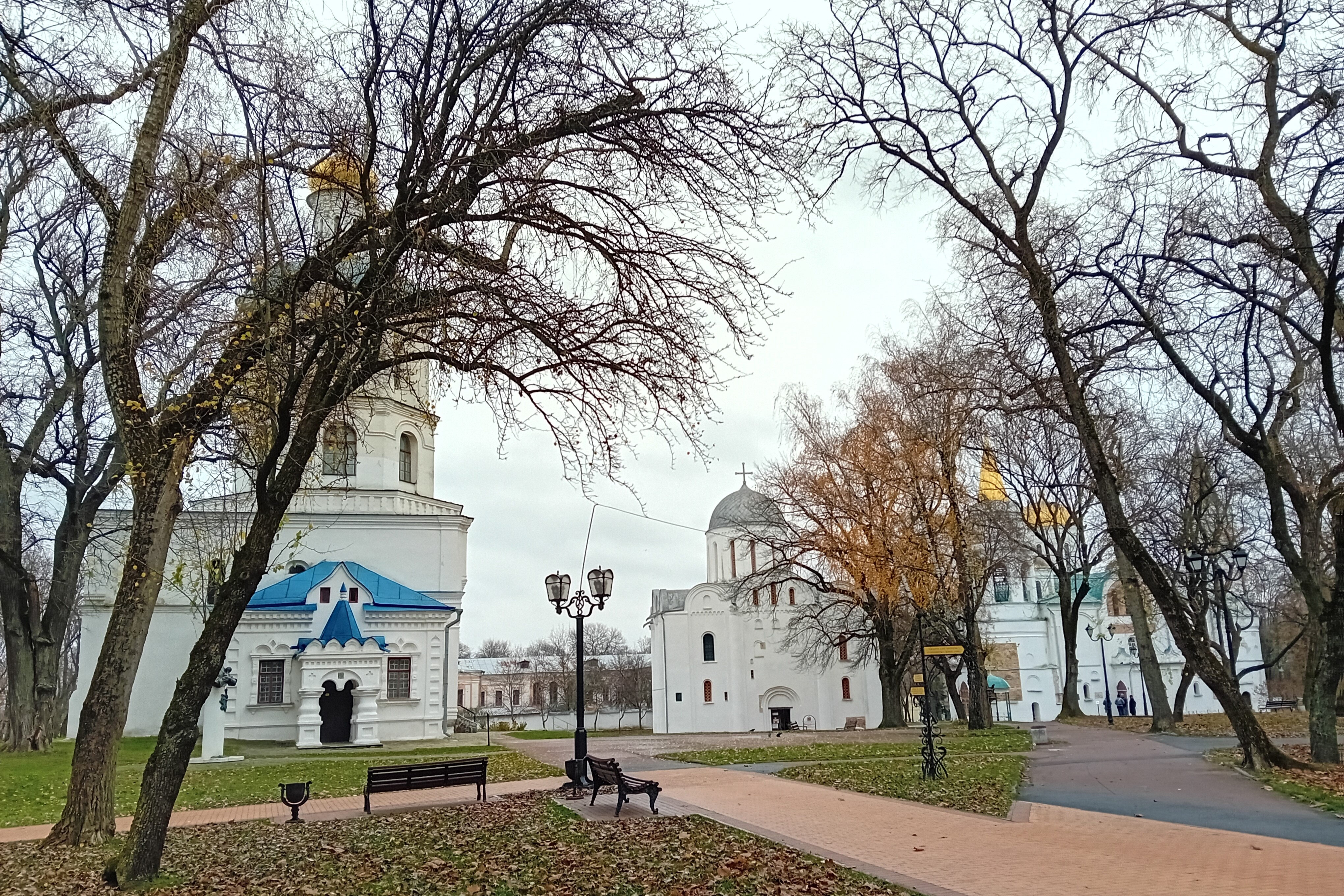
In mid-November 2023, following a few weeks in Kyiv, I travelled up for a weekend in Chernihiv, close to the borders with Belarus and Russia. Chernihiv, a fine city of churches and parks, is, together with Kyiv, one of the oldest in Ukraine, and was one of the most important centres in medieval Kyivan Rus. Among the many splendid churches in the city, the 11th century Transfiguration Church is thought to be the oldest in Ukraine, although it has suffered repeated damage during its history, from the Mongol invasion in the 13th century to an 18th-century fire. The current exterior is from the 19th century. Unfortunately the church was closed when I visited.

The Chernihiv Collegium, Cathedral of Saints Boris and Gleb,
and the Transfiguration Church

Next door to the Transfiguration Church is the Cathedral of Saints Boris and Gleb, which was originally built in the 12th century, but has also been frequently damaged, rebuilt and altered over the centuries. Under Polish rule, it had for a time been a Catholic Church. On the other side of the Cathedral is the 18th century Chernihiv Collegium, with its tall bell tower, in its day one of the most important educational establishments in Ukraine and Imperial Russia. The fine Piatnytska Church, also from the 12th century, has also been much restored over time. The Yeletsky Dormition Monastery, founded in the 11th century, is one of Ukraine’s oldest. It has also gone through alteration, its church sporting 17th century baroque cupolas.

Regimental Chancellery building

A more modest, but historically interesting building is the 17th century Regimental Chancellery Building, the administrative office of Chernihiv’s Cossack regiment at the time of the Cossack Hetmanate, until it was abolished during the reign of Catherine the Great. A simple, rectangular, single-story building, it belonged for a time to Ivan Mazepa, Hetman of the Zaporizhian Cossack Host at the end of the 17th and beginning of the 18th centuries. Mazepa joined Charles XII of Sweden in his fight against Peter the Great at the Battle of Poltava in 1709. The battle ended in cataclysmic defeat for Charles XII, and the majority of the Cossack host did not follow Mazepa, remaining loyal to the Russian Tsar. Despite this, Mazepa is a heroic figure in today’s Ukraine, while in Russia he has long been infamous for his perceived treachery. St Catherine’s church, situated at the end of a tree-lined avenue, which was dedicated in 1715, was erected in honour of the bravery of the Chernihiv Cossacks during the storming of the Ottomans’ Azov fortress.

Ukraine Hotel, Chernihiv

Chernihiv came under attack from the start of Russia’s full-scale invasion of Ukraine in February 2022. The city was surrounded and cut off for around a month, as fierce fighting went on in the surrounding region and in the outskirts of the city itself. The city was subjected to missile and rocket attacks that left many buildings, including residential buildings, damaged. While the damage had largely been cleared up, the city centre still bore the scars, and the windows of several buildings around the central Red Square were boarded up when I visited. The Ukraine Hotel had been particularly badly damaged, having taken a direct hit. Hundreds of people were killed, including many civilians, before Russian forces withdrew from much of northern Ukraine, their initial attempt to overwhelm the country having failed.

The full-scale war had been going on for nearly two years when I visited Chernihiv. Despite the damage, the city had largely returned to normal. Restaurants and cafes were doing a good trade, and tables were hard to come by that weekend in many places. Chernihiv, like Kharkiv and Kyiv and many other places, had survived. Ukrainians’ stout resistance had impressed and surprised many who had expected the country to fold in the face of Russia’s onslaught. What extraordinary times those were, as from day to day we prayed that Kyiv, Chernihiv and other cities could somehow hold out. And then suddenly the miracle, as it seemed, that columns of Russian tanks and armoured personnel carriers had been stopped, and were being destroyed by brave Ukrainian soldiers with shoulder-launched missiles and drones. And then the Russians were fleeing, leaving much of their equipment behind to be hauled off by triumphant Ukrainian farmers behind their tractors. Ukraine’s loss had been terrible. The discovery of the grisly evidence of the Russian occupiers’ barbarism in the towns and villages they had occupied was shocking. But Chernihiv and Ukraine had prevailed.

Tuesday, 18 July 2023

Travels in Moldova and Bucovina

It was a long, slow train journey from Bucharest to Bucovina, in the north-east of Romania, close to the border with Ukraine. I arrived late in the evening at the little railway station at Gura Humorului, to the west of the county capital, Suceava. My main purpose in coming to Gura Humorului was to visit a couple of the famous medieval painted monasteries nearby. Bucovina had been part of the principality of Moldavia since the 14th century, but in 1775 it was annexed to the Hapsburg Empire. The name Bucovina, or Buchenland in German, meant beech land, a reference to its rolling forested hills. In 1918, Bucovina was incorporated into the newly united Romanian state. However, in the second world war, the Soviet Union annexed the northern half of the region to the Ukrainian Soviet Republic. Northern Bucovina, officially known as Chernivtsi Region in Ukraine, remains part of Ukraine.

I set off in the morning under a hot sun to walk to the monastery of Voroneț (pronounced Voronets), about 3 or 4 kilometres south of the town. Founded in1488, its church is one of eight in the area that are now UN World Heritage sites. The idea of covering the exterior walls as well as the interior with frecoes is credited to the mid-16th century Orthodox Metropolitan of Moldavia, Grigore Roşca, to illustrate biblical stories for the benefit of the illiterate peasantry. Sitting amid wooded hills and protected by a walled stockade, it is a beautiful, peaceful place. The colours of the frescoes are in remarkably good condition given the passage of time, and the faces and features of the saints are still clear. From Voroneț, I headed back to Gura Humorului, and decided that, rather than walk, I would take the local bus to the Humor Monastery, about five kilometres away.


Voroneț Monastery, Bucovina

Built in 1530, the Humor Monastery church is architecturally similar to that at Voroneț, but it lacks a spire. There is, however, a tower a few metres away from the church. The frescoes at Humor have suffered more from weathering than those at Voroneț, especially on the side that is more exposed to direct sunlight. In the frecoes at the Humor monastery, the colouring is different from that at Voroneț. At Voroneț, a particulalrly vivid blue stands out, known as Voroneț blue. But the biblical stories they depict are much the same. I was particularly drawn to the depiction of the Last Judgement that covers the back walls of both monastery churches. As the figure of Christ presides, with the saints seated to either side, the dead rise from their graves, summoned by Angels blowing horns, while wild animals offer up the bones of those they have devoured, and a ship rises from the depths of the sea. While the righteous press to enter the garden of heaven, the damned are pushed by demons, themselves prodded by Angels with their lances, into a flaming river that takes them down to Hell. It is a very vivid scene, no doubt intended to be instructive and frightening to sinful believers.

The next morning I set off by minibus to the city of Iaşi (pronounced Yash), close to the border with the Republic of Moldova. Iaşi had been the capital of the principality of Moldavia from 1564 until 1859, and then of the United principalities of Moldavia and Wallachia until 1862, when Bucharest became the capital of the new, united Romanian state. Historic Moldavia had been much larger before the eastern half of the principality, Bessarabia, was ceded to Imperial Russia in 1812 by the Ottoman Empire, of which Moldavia was a vassal state. After the First World War, the Romanian state expanded to include Bessarabia, as well as Bucovina. But during the World War II, the Soviet Union took back Bessarabia, the majority of which today forms the independent Republic of Moldova, while southern Bessarabia was incorporated into Ukraine.


Church of the Three Hierarchs, Iaşi

Iaşi is known as an important cultural centre in Romania, and is home to the oldest Romanian university and theatre. It is an attractive town, with numerous fine churches and monasteries, as well as civic buildings and gardens which I found were generally better maintained than is the case in Bucharest. The historic theatre is especially beautiful, as is the remarkable Church of the Three Hierarchs. The church was built by one of Moldavia’s most famous rulers, Vasile Lupu (Basil the Wolf), who was of Albanian origin and ruled the principality for nearly 20 years in the 17th century. The outside of the building is decorated from top to bottom with strikingly original intricate stone lacery. Vasile Lupu also introduced Moldavia’s first printing press and its first codified law. He was a noted champion of Orthodox Christianity, hosting the Synod of Iaşi, which was convened by the Ecumenical Patriarch of Constantinople in 1642 to counter what were seen as Roman Catholic and Protestant doctrinal errors. The spirit of Vasile Lupu appears to live on. Apart from numerous churches, I don’t think I had ever before visited a town whose streets were so full of people in priestly garb. I visited the monasteries of Barboi and Golia, tranquil walled refuges in the heart of the city. There is also an Armenian church, indicating the widespread influence of the Armenian diaspora over centuries.

From Iaşi, I travelled by minibus across the border to Chişinău, capital city of the present-day independent Republic of Moldova. Chişinău was a small town when Bessarabia was annexed by the Russian Empire in 1812, but as the capital of Bessarabia province it was developed over the following decades, with broad avenues, a cathedral and a triumphal arch to mark the Russian victory in the Russo-Turkish war of 1828-29. Following Bessarabia’s unification with Romania after the First World War, in the 1920s a statue of Stephen the Great, medieval Moldavia’s most notable ruler, who reigned for nearly half a century from 1457-1504, was erected in the city centre. The statue has had an unsettled history, reflecting the shifting borders in the region. In 1940, it was moved to Vasliu, in Romania, days before the Soviet annexation of Bessarabia, then back to Chişinău in 1942, when Romania, allied with Nazi Germany, had recovered not only Bessarabia and northern Bucovina, but had expanded into Odessa region in Ukraine. In 1944, as Bessarabia was again occupied by the Soviets, it was moved back again to Romania, and then in 1945, as ordered by the Soviet authorities, it was returned to Chişinău. Finally, in 1989, it was restored to its original place in the city. 


Chişinău

When I visited, in the summer of 2022, Chişinău still had some of its Soviet-era monuments, among them an equestrian statue of Grigory Kotovsky, a notorious gangster turned Red Army commander during the civil war that followed the Bolshevik Revolution. He had a town named after him, Kotovsk, just across the border in Odessa region, in Ukraine. I had stayed there a few years previously. Kotovsky, who was murdered in 1925, was interred in a mausoleum in a Kotovsk park, and there was also a statue of him in front of the railway station, in a heroic pose with his sword pointing to the sky. In 2016, the town was renamed Podilsk, in line with a Ukrainian law forbidding place names or monuments commemorating communist figures.

Although Kotovsky was from Bessarabia, in today’s Moldova, he was of mixed Polish-Russian parentage, typical of the multi-ethnic makeup of the region. Like Odessa to the south, Chişinău had a significant Jewish population, nearly 50 per cent by the end of the 19th century. And like Odessa, the city’s Jews experienced murderous pogroms in the first years of the 20th century. During World War II, the Romanian regime of Ion Antonescu carried out the holocaust against the Jewish population in the territories it annexed from the Soviet Union, including Bessarabia.

In the early period of Soviet rule, Moldovans suffered the same trauma as other territories newly incorporated into the Soviet Union, in the Baltic states and western Ukraine, of mass executions and deportations. Despite that, and despite three decades of independence and the ongoing Russian occupation of a part of Moldova’s territory, Transnistria, a part of the population has maintained a pro-Russian stance, voting for pro-Russian parties. Moldova’s Soviet rulers attempted to separate a Moldovan identity from Romania, with its own language written in Cyrillic, unlike Romanian, which is written in the Latin script. Following independence, the country reverted to the Latin alphabet, and the declaration of independence referred to the country’s language as Romanian. However, the question of the country’s identity and language continued to be contentious. The 1994 constitution referred to the official language as Moldovan, while in 2013 the Constitutional Court ruled that the independence declaration took precedence, and that the country’s language was thus Romanian. My confusion during this, my first visit to Moldova, was compounded by the fact that Russian continued to be spoken by many in Chişinău. In the family-run hotel where I stayed, my hostess spoke Russian with her family members, although she informed me that she was Moldovan and could speak Moldovan.

Away from the avenues and squares, the park with its well-tended flower beds, Chişinău is a scrappy, uncared for city. The minibus I arrived on dropped me in the central market area, a mess of dirty streets, rubbish, greasy, broken pavements and evident poverty. By early evening these streets were largely deserted. Chişinău is certainly a far less impressive capital than Iaşi.

Moldova has had more than its share of troubles in recent years. Its development stunted by persistent meddling from Russia. Abused as a money-laundering centre by corrupt Russian and Ukrainian state officials and organised crime groups, a banking scandal in 2014 underlined the corruption and dysfunction of a state that has singly failed to meet the expectations of its citizens since independence. The Russian invasion of Ukraine has had a big impact on Moldova. Whether it can find a way to shake off the debilitating burden of Russian interference and affirm its identity as a European country, either independently, or reunified with Romania, remains to be seen. The opportunity is surely there.


Thursday, 30 June 2022

Ottoman Budapest

I first visited Budapest in the summer of 1991, travelling up from Belgrade to take a short break from the increasingly fraught atmosphere amid the gathering storm of war in former Yugoslavia. Hungary had only recently freed itself from the yoke of Soviet rule, and there were still Soviet soldiers in the city. Like many visitors, I was impressed by the grandeur of Budapest, by the splendid views along the Danube of the parliament building, the Chain Bridge and Buda castle stretched along the hill overlooking the river. I feasted on rich, spicey Hungarian food, and tipped the obligatory Romany musicians. Over the years I visited Budapest several more times. I spent over a week there in 1993, visiting the Yugoslav (Serbia and Montenegro) embassy on Heroes Square every day in a forlorn attempt to acquire a visa to go to Serbia. I went mushrooming with a friend’s family in the Buda hills, north of the city, and stayed in an ethnic-Slovak village, enjoying the local specialities of goat’s cheese and yoghurt. I visited the Serbian Orthodox churches and the art galleries in Szentendre, north of Budapest.

Spending nearly two months in Budapest in the spring of 2022, I searched out the city’s Ottoman heritage. The city’s separate parts, Buda and Pest, were united only in the 19th century. Buda, overlooking the Danube on the western side of the river, had been the medieval capital of Hungary before the cataclysmic defeat at the hands of the Ottoman Sultan Suleiman the Magnificent at Mohács in 1526, and the capture of Buda itself in 1541. The Ottomans held sway in Hungary for not quite 150 years before they were expelled by the Hapsburgs at the end of the 17th century. Their influence was shallower than in the Balkan lands to the south, where Ottoman rule lasted for several centuries. Most of Hungary’s population remained Christian, although many left and sought refuge in territory still under Christian rule. But as in the Balkans, towns became largely Muslim bastions surrounded by predominantly Christian inhabited countryside. So it was with Buda, where in the 16th and 17th centuries the view across the Danube was dominated by minarets, and the splendid Matthias church was converted into a mosque.


Rudas baths, Budapest

Not a lot remains of Ottoman Buda. But remnants can be found, notably in some fine Ottoman-era baths. Communal baths were important centres of urban Ottoman life. Architecturally beautiful, they were not just places for keeping clean, but for social gathering, where people could catch up with friends, with news, and with business. Buda is blessed with hot thermal springs that had first attracted the Romans to the area a millennium and a half before, when they built the city of Aquincum. After the Romans, Christian Europe largely lost the habit of cleanliness and of regular bathing. But the Ottomans revived the custom in the lands they conquered, and took full advantage of the hot springs in Buda.

I visited the Rudas baths one evening. Enclosed within a more modern building, nothing can be seen of the Ottoman building from the street. But inside it felt like I was entering a bygone world. The baths were built not long after the Ottoman conquest, and were rebuilt and used by the governor of Buda Vilayet, Sokollu Mustafa Pasha. The octagonal bath is surrounded by eight pillars supporting a cupola with small openings through which shine shafts of light. Around the central bath, in the corners of the room, are smaller baths with different water temperatures. Men wandered around (I went on a men-only day), many of them wearing skimpy loin cloths. They sat in the baths, relaxing, contemplating, chatting in soft tones, against the background of the gentle tinkling of falling water. It was all very relaxing. I could not know how it would have been in the bygone days of Ottoman Buda. No doubt there were customs, etiquette from that era which would have been unfamiliar to us today. But somehow I felt that the essence of the baths, as a place of rest, relaxation and social intercourse, was probably not so different. If the experience was not quite of a time warp, I had perhaps caught some inkling of a past age.


Király baths

Another of the Ottoman-era baths, the Király baths, tucked behind the foreign ministry, was closed to the public when I was there, but, unlike the Rudas baths, the low, stone building, with its green domes, can be seen from the street. The modern city has been built around it, leaving it a little forlorn and out of place, deprived of the context of the city it once inhabited. Yet its discreet presence reminds of the world that was once here.

Another such reminder, renovated with Turkish funds, is the Gül Baba türbe, or tomb, a steep walk up the hill overlooking the Margaret Bridge, not far from the Király baths. Gül Baba was a Bektashi dervish who died either during the Ottoman conquest of Buda, or shortly after it. He was declared the Wali, or patron saint of the city, and Suleiman the Magnificent was said to have been one of the coffin bearers at his funeral. The tomb became a place of Muslim pilgrimage, but after the reconquest of Buda by the Hapsburgs it was converted into a Christian chapel. Perhaps that is why it was one of the few buildings of Ottoman Buda to survive. By the late 19th century the building was in private hands, and was again accessible to Muslim pilgrims. The Ottoman government commissioned the restoration of the tomb, which was completed in 1914. Today the property of the Turkish state, the most recent renovation was completed in 2018, and the site was opened by the Hungarian prime minister and the Turkish president, a marker of the close ties between the two countries and their like-minded leaders. Like other such tombs in the Balkans, it is a simple, but elegant little building, nowadays shaded by trees and surrounded by rose gardens. Gül Baba was known as the “father of roses”.


Gül Baba türbe

While the visible legacy of Ottoman rule in central Europe may be slight, Hungarians acknowledge other enduring influences apart from the handful of buildings in Budapest and elsewhere. These include borrowings from the Turkish language, as well as dishes such as stuffed cabbage leaves and paprika, a key ingredient of Hungarian cuisine. It was also through the Ottomans that coffee was introduced to central Europe. For Christian Europeans of the sixteenth and seventeenth centuries, when the Sultan’s armies reached the gates of Vienna, the Ottomans represented an existential threat. Recovering Buda and the lands of central Europe at the end of the seventeenth century must have been a profound relief. Yet when we consider the legacy of the Ottomans, not only their aggressive expansionism, but also the fine architecture and the beautiful baths of Budapest, it is hard not to concede the rich contribution they made to European civilisation.


Wednesday, 12 February 2020

Nicosia, Cyprus's divided capital

I arrived in Cyprus’s divided capital of Nicosia by bus from Larnaca, on the south coast. I first spent a couple of days in the south of the city, the Greek-inhabited capital of the internationally recognised state, before crossing over to the north through the pedestrian Ledra Street crossing. The city is known in Greek by its older name, Lefkosia, and in Turkish as Lefkoşa, rather than the Frankish Nicosia.

The first crossing between the north and south of the island after the 1974 Turkish invasion was opened in 2003. Passing through the pedestrian Ledra Street crossing in the centre of the city is now a quick and painless affair. Very few people were crossing on the days that I passed to and from the north of the city, and I was through in minutes, with just cursory checks of my passport. On my first afternoon in the city, I saw a group of girls arriving in south Nicosia through the crossing, and being stopped by a Greek Cypriot policeman who asked, in English, where they were from? “Lefkoşa”, replied one of the girls. “You are Cyrpiot?” asked the policeman? “Yes”, they replied, and he waved them through without further fuss. An apparently normal occurrence, a group of Turkish Cypriot girls visiting the south of their city. Who knows what they planned to do? Perhaps some shopping. South Nicosia has the well-known western brands of clothes shops that are not found in the north.

Nicosia became the capital of Byzantine Cyprus in the 10th century, its relatively safe inland position preferred to coastal settlements such as the ancient city of Salamis, close to present-day Famagusta, which had been plagued by frequent Arab raids. The Frankish Lusignan dynasty, which ruled the island from the end of the 12th century, fortified the city, as well as building the gothic Cathedral of St Sophia and other Catholic churches and palaces. The impressive walls we see today, with their star shape and eleven bastions, were built by the Venetians, who ruled for nearly a hundred years from the late 15th century.


The Kyrenia Gate, then and now

As with Famagusta and Kyrenia, the Venetians substantially upgraded the city’s fortifications in preparation for an expected Ottoman attack. For the most part the walls are still intact, although in places they were breached in the 20th century to make way for modern roads into and out of the old city. The Kyrenia gate, in the north of the city, one of the three city gates built by the Venetians, now stands in a gap in the wall, with roads passing either side. A postcard from 1922 shows the walls linking up with the gate, with paths sloping up on to the walls on either side. The walls are better cared for in the south of the city. In the north they are overgrown with greenery and the ground level is higher, burying the lower part of the walls and diminishing their impressive bulk.

The efforts the Venetians put into building the walls were to no avail. When the Ottoman force invaded Cyprus in June 1520, the Venetians withdrew to their fortified towns, Nicosia, Kyrenia and Famagusta. The siege of Nicosia began in July, and lasted only seven weeks. The victorious Ottomans set about massacring the inhabitants, sparing only the women and children, who were sold into slavery. The city was ransacked, and St Sophia’s and other Catholic churches were converted into mosques. Nicosia remained the administrative seat of the island under the Ottomans, but it was devastated by the conquest, its population reduced to not much more than 1,000 from the 21,000 it had been under the Venetians.

The city recovered under Ottoman rule, unlike the coastal city of Famagusta, whose walled old town has a somewhat ghostly appearance, many of the buildings from the Venetian and Lusignan periods left to crumble, the empty spaces left empty, and relatively little new Ottoman construction. In Nicosia, by contrast, the Ottomans left their mark. The notable Ottoman-era architecture is more to be found on the northern side of the city. Long before the division of the city into Greek and Turkish halves in the 1960s, Muslims settled in greater numbers in the north of the city, where the seat of the governor of the island, the Konak or Saray was situated. The Saray, which had earlier been the palace of the Lusignan kings and Venetian governors, was demolished during the period of British rule, and replaced by law courts. The square is still known to locals as Sarayonu square, despite being officially named after Ataturk, the founder of the Turkish republic. In its centre stands a column which had been brought to the city by the Venetians from the ancient city of Salamis. The fine-looking law courts are typical of civic buildings from the British period, bright and open, with shady colonnaded terraces, a style appropriate for the Mediterranean, quite unlike architecture of the period in Britain. There are other, more familiar mementoes of British rule, notably the post boxes with the initials of British monarchs, now painted yellow in the south of the island.


Buyuk Han

Perhaps the loveliest building in Nicosia is the Buyuk Han, the Great Han, a caravanserai or inn built shortly after the Ottoman conquest. Its layout is fairly typical of caravanserais around the middle east and central Asia, a square two-story building around a large central courtyard, with colonnaded terraces off which there are rooms which on the ground floor were used for commerce and on the first floor as accommodation for travelling merchants. In the courtyard is a small mosque which was for the use of travellers. Under British rule the han was briefly a prison, and then reverted to its original purpose, as an inn and shops. For a while it served as accommodation for poor families. The building was beautifully restored in the 1990s, and now houses handicraft and souvenir shops, as well as cafes with terraces on the courtyard. It was particularly lovely in the late afternoons, when the January sunshine slanted on to the sandstone arches of the courtyard, while visitors sat and drank their tea or coffee.

Typically of Cyprus, many of the buildings of the Ottoman period were converted Lusignan churches. Nearby the Buyuk Han is the Buyuk Hammam, the Ottoman baths, which had previously been the Church of St George of the Latins. It appears lower than it would have been, as a result of the rising of the street level over time. Also nearby is the Selimiye Cami, Nicosia’s biggest mosque, once the Roman Catholic Cathedral of St Sophia. Its conversion to a mosque involved the building of two minarets either side of its entrance. Strung between them today are the flags of Turkey and the Turkish Republic of Northern Cyprus (TRNC), which is recognised only by Turkey. Like the converted Cathedral of St Nicholas in Famagusta, on the inside the gothic arches and vaulted ceiling of St Sophia’s have been whitewashed. The tombs of Lusignan kings lie beneath the carpeted floor whose lines point Muslims towards Mecca, its direction indicated by the ornate Mihrab on the side of the cathedral. In the southern, Greek part of the city is the Omeriye mosque, built on the site of the 14th century Church of St Mary, part of an Augustinian monastery. The church was badly damaged during the Ottoman siege, and was rebuilt as a mosque, with the addition of a minaret. However, the outline of the original church is clear to see, with its apse at the farthest end from the entrance, where the alter had once stood. On the outside, behind the minaret, a small rose window can be seen.


Selimiye Cami

Next to the Selimiye Cami is a partially ruined building that has been re-purposed multiple times over the centuries, the Bedestan, or covered market. This started out in the Byzantine period as an Orthodox Church. The Gothic entrance across from the Selimiye Cami dates from the Lusignan period, when it may have served as a Catholic church for a time. Under Ottoman rule it became the Bedestan. When the British took over in Cyprus in the 1870s, they wanted to convert it back into a church, but were unable to do so due to the Islamic prohibition on having a shrine of another religion close to a mosque. Having been recently renovated, it is now a cultural centre.

The south of the city was and is predominantly Greek, and includes the Archbishop’s residence and the Orthodox cathedral, as well as the residence of the Dragoman, a senior Greek official who was the link between the Ottoman authorities and the Greek Orthodox population. The present-day archbishop’s palace, which was built in the 1950s, is large, with spacious grounds. Perhaps this reflects the importance of the Orthodox Church in Cyprus’s history. Archbishop Kyprianos, whose bust stands outside the palace, founded the Pancyprian Gymnasium, the island’s first secondary school, in 1812, and was among more than 400 Greek Cypriots who were executed by the Ottomans in 1821, in response to the wide support of the Greek community for Greece’s independence struggle. Archbishop Makarios III held a leading position in the Greek Cypriot community as it struggled for independence from Britain in the 1950s, and became the country’s first president following independence in 1960. The Cathedral of St John the Theologian, in contrast to the archbishop’s place, is a small, modest building. Built on the site of a Benedictine monastery, it had been turned over to the Orthodox Church in the 15th century, and the church was rebuilt in the 17th. Its modest exterior was required by the Ottoman authorities, but on the inside the cathedral is fabulously ornate.

Not far from the cathedral and the archbishop’s palace is the residence of Cyprus’s most noted dragoman, Hadjigeorgakis Kornesios, who held office in the late 18th and early 19th centuries. The term dragoman literally means interpreter, but his duties were much more extensive, including collecting taxes from the Christian population on behalf of the Ottoman authorities. He was a powerful figure, and the opportunity to cream off his share of the taxes enabled him to accumulate great wealth. His fine house, now a museum, attests to that wealth, and is a fascinating insight into how a powerful Christian figure in Ottoman Cyprus could live. The reception room, with its ornate wood carvings and low divans around the walls, indicates that the Greek Cypriot elite in many ways lived in much the same style as their Turkish overlords. However, Hadjigeorgakis Kornesios’s power and the heavy taxes he collected were resented. He was executed in Istanbul in 1809.

Wandering the streets of Nicosia, there are many beautiful districts where the traditional buildings from the Ottoman period, with their covered balconies, have been preserved, and in many cases sensitively restored. This is particularly the case in the north of the city, perhaps because the relative economic stagnation of north Cyprus meant there was less new development in the old city than was the case in the south. The Arabahmet quarter, in the east of the city, close to the city walls just north of the green line, is particularly attractive. Many of the inhabitants of the district had been Armenian, clustered around their church. There had been an Armenian community in Cyprus for centuries, but during intercommunal violence in 1963-64, when the city was divided between its Turkish north and Greek south, the Armenian quarter found itself in the Turkish north, and the Armenians themselves were expelled. In subsequent decades much of the Abrahmet district and the Armenian church fell into decay and dereliction. More recently the quarter is gradually being renovated, the old houses beautifully restored. While the Armenians are gone, their church has been restored by the UN. It was open when I visited, but without its flock, its community, it was an empty and rather forlorn place.

Close by the Armenian church, right on the green line, next to the Paphos gate, and just beyond the barbed-wire-topped barrier, is a Roman Catholic Church. A little further south is the Maronite church. The Maronite community has existed for centuries in Cyprus, although their numbers have dwindled since the middle ages. They had mainly lived in a few villages in the north of the island, but following the Turkish invasion almost all of them moved to the south.

On the two sides of the city are museums which attest to the different versions of the history of this bitterly divided island. In the south of the city, close to the Orthodox Cathedral, is the National Struggle Museum, dedicated to the struggle against British rule from 1955-1959. It is uncomfortable viewing for a British visitor. The armed struggle had as its aim unification, Enosis, with Greece. It was led by Georgios Grivas, a Cypriot who had served for many years as an officer in Greece’s army, and who founded the EOKA guerrilla organisation. As well as weapons and other possessions of the EOKA fighters, the museum contains photos of killed EOKA members, some of them tortured or executed by the British. Some historians assert that claims of torture by the British were exaggerated and inflated by EOKA for propaganda purposes. Nevertheless, in 2012 the British Foreign Office released documents alleging torture and other abuses by British soldiers. In 2019 the British government agreed to pay £ 1 million to 33 Greek Cypriots who claimed they had been tortured, although without admitting liability.

It is not clear to me why the British government of the time felt it necessary to fight an ultimately unsuccessful four-year war to maintain its rule in Cyprus. De-colonisation was already well under way. A number of former British colonies had already become independent, and several more would follow over the next few years. It was surely clear that the era of colonialism had passed. Shortly before the start of the Cyprus insurgency Britain had announced its intention to move its military command in the eastern Mediterranean from Egypt to Cyprus. No doubt Cyprus appeared to be strategically vital. But Britain could surely have reached agreement with a newly independent Cyprus to retain its military bases, as indeed happened after independence in 1960. Yet at the time the British government maintained that decolonisation should not apply to Cyprus.

The war in Cyprus was a senseless waste, and worse than that, it had long-term damaging consequences, especially in exacerbating intercommunal tensions between the island’s Greeks and Turks. The island’s Turks vehemently opposed Enosis, and thousands of them were recruited by the British as auxiliary police in the struggle against EOKA. This inevitably inflamed tensions between the two communities, as Turks responded to Greek demands for Enosis with their own demand for Taksim, partition of the island. For its part, EOKA extended its attacks against the British to the Turkish community.

In the end, the Greek Cypriots did not achieve the desired Enosis with Greece, and had to settle for an independent state, under an agreement guaranteed by Britain, Greece and Turkey. Most Greek Cypriots were not satisfied, and continued to strive for Enosis, with disastrous consequences, as the coup in 1974 in the name of Enosis provoked the Turkish invasion of the island. On one of the bastions of the city wall is the Liberty Monument, which commemorates the release of EOKA fighters in 1959, prior to independence the following year, one of many monuments to EOKA men in southern Cyprus. But the aftermath of the violence that brought independence left a bitter hangover.

The independence war, with the intercommunal violence that it involved, soured the already strained relations between Greeks and Turks on the island. The baleful influence of both Greece and Turkey made matters worse. Greece’s military junta was behind the coup in favour of Enosis in July 1974 that prompted the Turkish invasion. The Turkish Cypriot minority looked upon the prospect of Enosis with terror, having seen the fate of the Cretan Muslim population who had been forced to leave Crete in 1923 as part of the population exchange between Greece and Turkey.

In the north of Nicosia, Cyprus’s Turks have their own National Struggle Museum. It tells a very different story to that of its counterpart a few hundred yards away in the south. In its telling, EOKA was a terrorist organisation aiming not only to drive out the British and achieve Enosis, but at the elimination of the Turkish community. The 1974 Turkish invasion is presented as a “peace operation” to provide “a peaceful environment for both communities.” The museum contains a memorial to those who died in “the struggle to preserve the Turkish existence in Cyprus.”

The Turkish Cypriot position is related even more vividly at the Museum of Barbarism, in the house of Dr Nihat Ilhan in the suburbs north of the old city. Intercommunal tension and violence had continued after independence in 1960, involving the displacement of Turkish Cypriots into enclaves. This reached a peak at the end of 1963. On the night of 24 December that year, while Dr Ilhan was on duty with Turkish Cypriot paramilitaries, Greek Cypriot irregulars came to his home and murdered his wife and three children, as well as a neighbour. Harrowing photographs in the house show the three children and their mother dead in the bath. There are also photographs depicting other atrocities against the Turkish community. The violence led to the deaths of 364 Turkish Cypriots and 174 Greek Cypriots, as well as the displacement of some 25,000 Turkish Cypriots.


The Green Line, Abrahmet quarter

Following the December 1963 violence, a British general commanding a joint peacekeeping force with Greece and Turkey (a precursor of the UN peacekeeping force) drew an agreed line in green along a map demarking a Turkish North and Greek south of the city. As a consequence of the Turkish invasion in 1974 this green line was extended across the whole island. The green line remains a scar across the city, of abandoned streets and derelict buildings, in what was once its bustling heart. It is easier to approach the line in the Turkish north than in the Greek south, where soldiers keep watch from guard posts painted in the blue and white stripes of Greece’s flag, warning people not to take photos. On the northern side, while there are signs warning that it is a forbidden zone, it is possible to peer into the ghostly dilapidated streets. To someone not used to it, it seems quite bizarre. Just a few yards from narrow old-city streets with bars and shops, you come upon walls topped with barbed wire, beyond them the abandoned ruins of the green line, and just a short distance further the Greek south of the city.

The best place to get a view over Nicosia is from the top floor viewing point of the Shacolas Tower, in the south of the city. From that vantage point, one gets perhaps the best view of the Selimiye Cami. Surrounded by the narrow streets of the old city, it is hard to get a proper view from close up. Looking east towards the Abrahmet district, you can see the Maronite church and the nearby Catholic Church on the green line. Just to the north is the Ledra Palace Hotel, once Nicosia’s finest. Now stranded on the green line, after 1974 it had for decades served as the headquarters of the UN mission. But in 2019 it was vacated due to inadequate health and safety measures. On a mountainside north of the city a vast, provocative TRNC flag has been painted. Alongside, on a painted flag of Turkey, is the famous quote from Ataturk, in Turkish, “How Happy is the One Who Says I am a Turk.” Many Cypriots still live in hope that such provocations, and the bad memories of strife and violence, could one day be put behind. That Cypriots from both communities now travel back and forth and have renewed mutual contacts may give cause for that hope. Younger Cypriots are perhaps less burdened by the tragedies of the past. The incentives to reunite are strong, especially for the north, internationally isolated and unable to fulfil its potential. But the persistent failure to find a solution indicates that the obstacles remain great.

Saturday, 8 February 2020

Kyrenia and Bellapais

Kyrenia, known as Girne in Turkish, is arguably the most attractive town in Cyprus. Situated on the island’s northern coast, its picturesque semi-circular harbour, with the vast bulk of its fortress at one end, is framed by craggy mountains to the south. Some of the restaurants around the harbour are converted warehouses previously used for storing carob seeds, once one of Cyprus’s main exports. The fortress dates back at least until Byzantine times, and was renovated by the medieval Frankish Lusignan dynasty and again by the Venetians, who strengthened its massive walls and adapted them for the age of canon. However, that did not help when the Ottomans invaded Cyprus in 1570. When the defenders heard of the fall of Nicosia and the massacre of its population, the Venetian commander of Kyrenia surrendered. It was said that when he was presented with the severed head of his counterpart in Nicosia, he immediately capitulated.

There is an attractive little 16th century mosque overlooking the harbour. The Orthodox church of the Archangel Michael, above the opposite end of the harbour, was built in 1860, when the island was still under Ottoman rule. The church bell was donated by a local Muslim, indicating that relations between the two communities in Cyprus were not always rancorous. The church is now an icon museum, but it was shut when I went there. On the outside it is a sad sight, its paintwork peeling off, its plaster crumbling.

The invading Turkish army landed close to Kyrenia in 1974, and the town was one of the first places to fall. As elsewhere in the north of the island, the Greek population of Kyrenia fled. A few tried to stay on, but they were moved out in 1975. Kyrenia had become a popular British retirement destination during and after the period of British rule. There is even an Anglican church close to the fortress. Most of the 2,500 or so British residents also gradually left after the Turkish invasion, although there has been a limited new wave of British retirees more recently. The departed Greeks and British were replaced by Turks displaced from the south of the island, as well as droves of incomers from Turkey.


Bellapais

In the hills above Kyrenia is the beautiful village of Bellapais. The medieval Benedictine abbey dominates the village. Standing on the side of a hill, its high walls are impressive as you approach from below. The flags of Turkey and the unrecognised Turkish Republic of Northern Cyprus fly from a tower at the entrance. The abbey is partly ruined now, having been abandoned after the Ottoman conquest. The church however survives, having been taken over by the Orthodox church, as do three sides of the cloisters and the refectory, with its little pulpit on one of the side walls, from which readings from scripture took place while the monks took their meals. Bellapais is also where the author Lawrence Durrell made his home from 1953-1956, an experience he described vividly in his book Bitter Lemons. I walked up to the house, which is rather unremarkable in itself. On the village square in front of the abbey, I ate the most delicious Gözleme, a kind of pancake filled with local cheese and herbs. Across the square was a café with an old red British telephone box outside, whose owner agreed to drive me back to Kyrenia.

I got talking to an elderly man on the village square, who I asked for directions to Durrell’s house. Several elderly men gathered there in the bright January sunshine to chat and while away the time. He had been born in a village in the south of the island, close to Limassol. He told me that following the Turkish invasion his family, as well as most of the rest of his village, had moved to Bellapais, while many of the Greek inhabitants of Bellapais had moved to his village, in a straight swap. He appeared to feel little resentment towards Greek Cypriots. He had taken Cypriot citizen, as had around 95 per cent of the Turkish Cypriot population, he estimated. One of his sons had married a Greek Cypriot and had lived in the south for ten years before his marriage broke down and he returned to Bellapais. Since travel between the two sides of the island had become possible, he had visited his former village, and even met the Greek family who now lived in his former home. They appeared to be good people, he told me. I asked him what language he had spoken with them. He replied that most Turkish Cypriots of his generation could speak both English and Greek, so communication was not a problem. By contrast, he was scathing about the more recent arrivals from the Turkish mainland, who he said now far outnumbered the native Turkish Cypriots. They came from the poorest regions of Turkey, he said, and were less well educated than Turkish Cypriots like him who had been educated in the British system. Their presence was also problematic as, unlike Turks who had been in Cyprus before the invasion, and their descendants, these more recent arrivals were not entitled to Cypriot citizenship. He told me that at this stage in his life he would not consider moving back to the village of his birth. He lived as part of a community in Bellapais, and was content.


St Hilarion castle

In the hills south of Kyrenia there are three ruined castles, built originally during the Byzantine period, as a defence against Arab raiders. I visited St Hilarion castle, west of Bellapais, the best preserved of the three. The castle was extended during the Lusignan period, when it is said to have been a royal residence. Built along the craggy rocks of a hilltop, it is a dramatic sight, and is said to have inspired Walt Disney among others. I spent more than an hour climbing up its battlements and towers, looking into the ruins of a Byzantine church, the royal apartments, kitchens and stables. One window is known as the Queen’s window, because it is said that Queen Eleanor of Aragon, who reigned in the 14th century, used to sit next to it. Queen Eleanor was one of the most notable of medieval Cyprus’s rulers. She ruled as regent when her husband, King Peter I, was away on crusade, and again on behalf of her son after Peter was murdered. She secretly invited the Genoese to invade the island, in a move apparently aimed against her two brothers-in-law, who had been suspected of Peter’s murder.

Saturday, 28 April 2018

Faded glory in Baalbek

I wanted to go to Baalbek, in northern Lebanon. Some of the most impressive Roman ruins anywhere are situated there. The modern town is interesting too, a stronghold of the Shia Hezbollah party and militia. But there was a lot of discouragement. The UK Foreign Office website recommended against going there, except on essential business. Baalbek is close to the Syrian frontier, and there had been fears that the civil war there might spread across the border. The annual Baalbek cultural festival had been moved elsewhere in 2013, due to the perceived security threat, although it had subsequently returned. I had hoped to travel directly from Tripoli, over the mountains. That proved impossible, as snowfall had blocked the mountain road. So instead I travelled south, along the coast, to Beirut, and then took a minivan up to Baalbek. The road from Beirut rises steeply up over Mount Lebanon, and then follows the Bekaa Valley, actually a high plateau to the east of the Mount Lebanon range. The region had been under Syrian occupation until 2005. Now Baalbek enjoys an uneasy peace while next-door Syria burns.


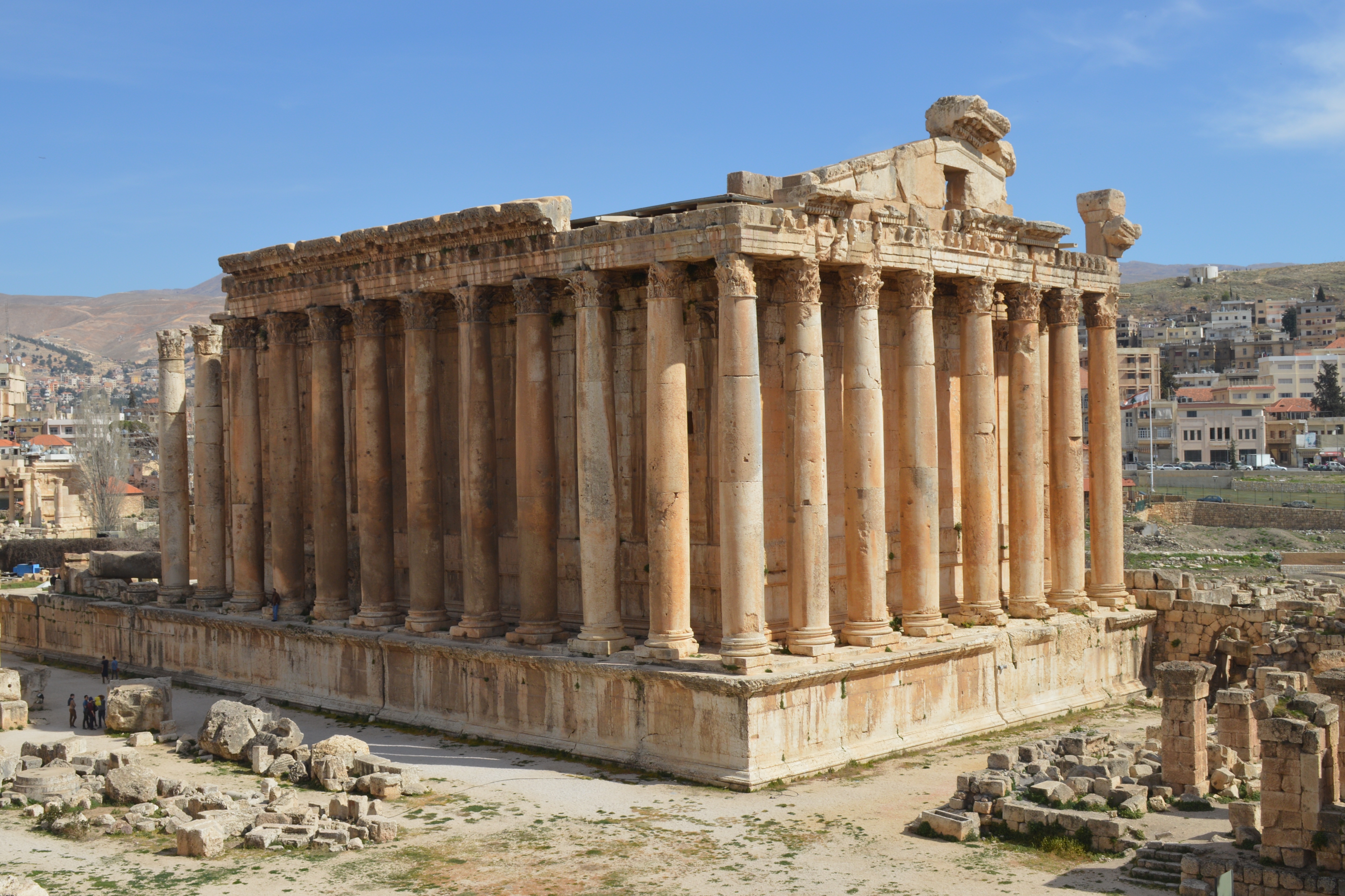
Temple of Bacchus, Baalbek

I arrived in Baalbek in the middle of a warm, sunny March day. Snow still capped the mountains to the west of the town. I quickly made for the Roman remains, which are indeed magnificent. The scale is astounding. The site of the Temple of Jupiter is vast, and must have awed visitors in its day. The smaller, but still immense Temple of Bacchus is much better preserved, and impresses also due to the exquisite detail of its craftmanship. I found it baffling that the Romans chose to build on such a vast scale, bigger by far than anything in Rome, and with such quality, in this of all places? What was it about this region that they felt the need to impress so?

Baalbek also boasts fine buildings of more recent provenance, including tall, square Ottoman-era buildings with high arched windows and balconies. But the greatest gem is the Palmyra Hotel. Built in the 1870s by a Greek merchant from Istanbul, The Palmyra has in its day hosted kings, presidents, writers, artists and musicians. Kaiser Wilhelm II of Germany visited in 1898, when he planned an excavation of the archaeological site. Other heads of state who visited included Ataturk, King Faisal of Iraq, King Abdullah I of Jordan and Charles de Gaulle. One of the staff showed me the room where de Gaulle stayed.


Inside the Palmyra Hotel, Baalbek

Today the hotel is a shadow of what it once was. The rooms are plain, the bathrooms shabby. It is no luxury hotel. But having been left largely alone, not renovated for decades, it preserves the atmosphere, the elegance of another era. In the chilly evenings (the temperature drops significantly in Baalbek in March, given its altitude), I sat in the upstairs vestibule, outside de Gaulle’s room, surrounded by period furniture, enjoying the warmth of the oil fire that an elderly staff member lit for me. Most of the rooms were unoccupied, and few staff remain. I was mostly looked after by two elderly gentlemen who had probably been there for decades. I had initially thought they were one man, for they looked like they might have been brothers. I spoke with one of them in French, and only realised they were two different men when the other, who spoke to me in English, informed me that he could not speak French. Probably the time will come when someone will renovate the place, and turn it into the luxury hotel it could be and which probably its pedigree merits. For myself, I was very happy to have stayed there in its current, slightly shabby but enormously atmospheric state. I don’t think I have ever stayed in a more special hotel.

Baalbek is a predominantly Shia town, although there are also Sunni and Christian minorities. It had been afflicted by war. During the 2006 Israeli invasion of Lebanon, Baalbek, as a Hezbollah stronghold, was bombed by the Israelis, destroying much important infrastructure. Israeli troops carried out a raid on the town, apparently in the belief that two captured Israeli soldiers were being held there.

With an election approaching, the town was filled with party political banners and flags. Hezbollah, the Party of God, is said to be dominant here, but I also saw many flags of Amal, a rival Shia outfit. Amal also formed one of the civil-war militias, but it is now in alliance with Hezbollah. Outside the entrance to the archaeological site, souvenir stalls offered Hezbollah T-shirts, featuring the Hezbollah flag, with a figure holding a rifle in the air. I chatted with a young Hezbollah-supporting shopkeeper. Times were hard, he said. Because of the conflict in Syria, few tourists were coming to Baalbek. He had been anxious about the close proximity of IS terrorists just a few kilometres away. But thankfully there had been no attacks in Baalbek.

Among the mosques in Baalbek is a relatively new Shia one, very much in the style of Hezbollah’s Iranian patron, with a wide entrance arch, and covered with blue and green tiles and Arabic calligraphy. The worrisome security situation is indicated by the metal fence surrounding the mosque, and the iron-girder tank traps. It was the only sign I saw in Baalbek that all was not quite normal. Otherwise, the atmosphere appeared reasonably relaxed. On a warm Sunday afternoon, at a park on the edge of town, people sat outside cafes and smoked hookahs, while children ate candyfloss and took rides in the toy motor cars.

That Sunday morning there was a political rally in the town, for Hezbollah and its allies. Chairs were set up before the Temple of Bacchus, surely the most dramatic backdrop for a rally I had ever seen. It was a polite affair, as people sat quietly and listened to the speeches. Particularly striking was that men and women were all jumbled up, not segregated, and that not all the women present were wearing hijab. I chatted with a couple of men who happily pointed out which parties the different banners belonged to. It all seemed very normal, apart from the backdrop, much like political rallies I have attended in many countries in Europe. The atmosphere was in stark contrast to the march I had seen in Tripoli, with its strict segregation of the sexes, the women all with billowing abayas, their faces covered.

I enjoyed my short stay in Baalbek. Everywhere I went, I was treated kindly, from the delightful staff at the Palmyra Hotel, to the pastry shopkeepers who would not accept payment for their delicious sweet cakes (I think it was normal to buy them by the dozen rather than singly). As in Beirut, I was struck by the resilience of people who have come through repeated wars, and yet carry on, surviving, and even smiling.