Monday, 15 July 2024

Kryvyi Rih, a city built on steel

I had visited Kryvyi Rih several times in 2006, when I spent two months as an election observer in Dnipropetrovsk (renamed Dnipro in 2016), the capital of the region to which Kryvyi Rih belongs. I found it an unprepossessing place, although I never really took the opportunity to get to know it. What struck me most was how spread out it was, with great distances from one part of town to another, and wide spaces in between. I hardly had any sense of a city centre. Most striking and most memorable was a row of four huge cooling towers at the giant Kryvorizhstal steelworks, as one drove down a road towards the industrial heart of the city. It was an impressive sight, which more than anything represented what Kryvyi Rih was, a town founded on the mining of iron ore and the production of steel. For me that cold winter, Kryvyi Rih was a place we visited quickly, had our meetings with local officials, grabbed a quick lunch, and then headed back to Dnipro. Even when I spent a couple of nights there, I never took the chance to get to know the city.
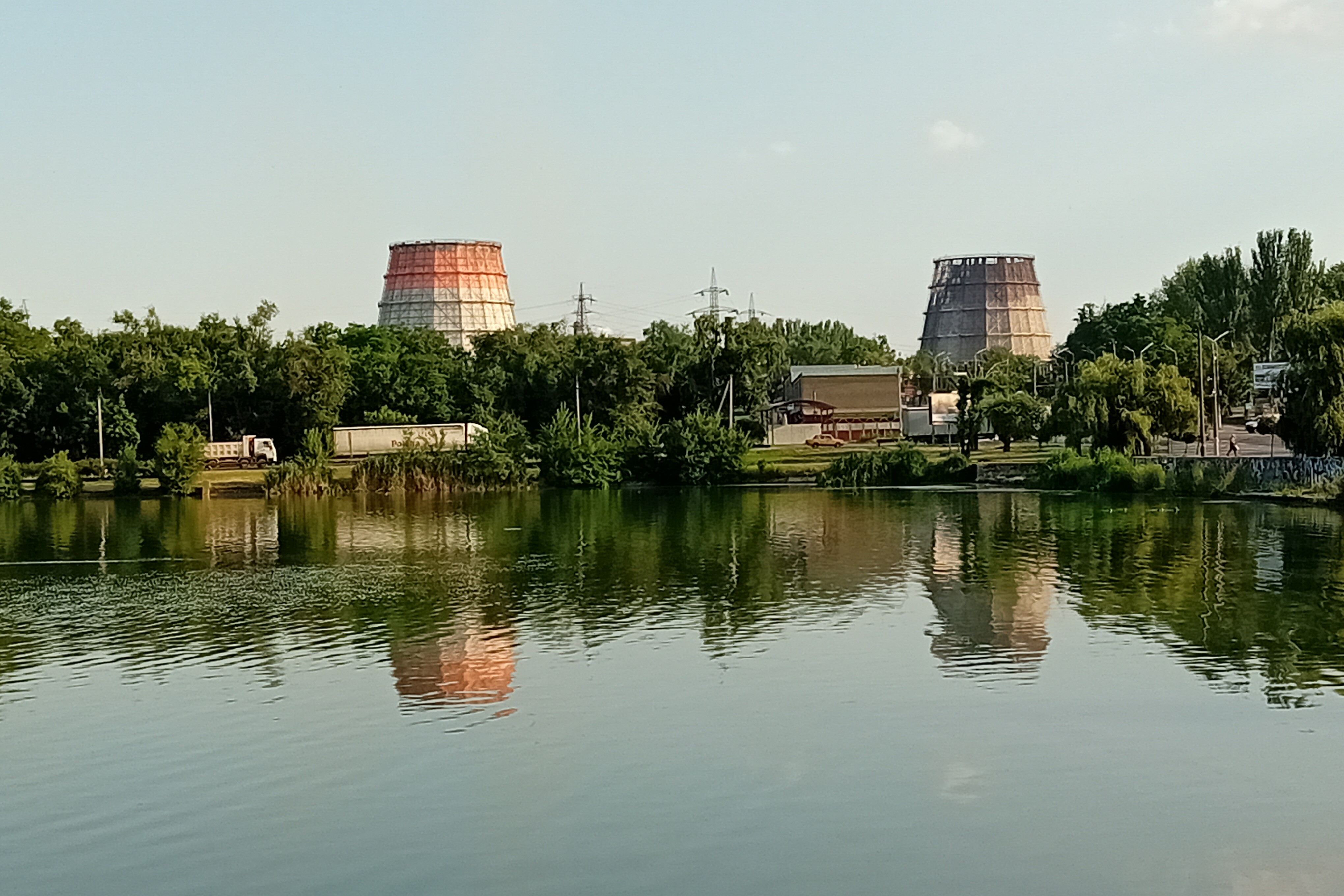

Kryvyi Rih vistas

Revisiting 18 years later, in the summer of 2024, did not greatly alter my earlier impressions. Two of the cooling towers that so impressed me before had gone. Kryvyi Rih does have a city centre, around the city council building and a large, well-kept city park. But the city does not seem to have been built with humans in mind. Spread out over a wide area, with large empty spaces in between districts, with its huge industrial zones it was built for steelmaking, with minimal consideration for the thousands of workers who troop in and out of the vast industrial plants each day. It is a typical Soviet city, whose success was measured in the quantities of pig iron and steel produced, not in the good life that it provided for its inhabitants. Kryvyi Rih is not a city for walking. The distances are too great, and it lacks the pleasant café and restaurant-lined streets that make many other Ukrainian city centres such delightful places.

For those interested in industrial landscapes, Kryvyi Rih is, however, a bit of a gem. I was particularly struck by the contrast between natural beauty and brutal industrialism. The scenes across placid lakes, with men fishing, children feeding the ducks, and youngsters bathing, and across the water, the steel plant belching out red smoke from its chimneys and cooling towers, flames shooting into the air. It seemed like a vision of heaven and hell all in one vista.

I visited the Kryvorizhstal steelworks, and had a guided tour of the company museum. In 2005, the steelworks was bought by Indian-owned Mittal Steel, which became ArcelorMittal the following year, when Mittal took over its international rival, Arcelor. The privatisation had been the subject of considerable controversy, with political overtones. The steelworks had initially been sold to a Ukrainian consortium in 2004 that included Viktor Pinchuk, the son-in-law of the country’s former president, Leonid Kuchma, as well as Rinat Akhmetov, reputedly Ukraine’s richest oligarch. The sale price was generally seen as far too low. To many this seemed like an egregious example of the kind of cronyism that had enriched a new class of well-connected business oligarchs after the demise of the Soviet Union. Following the 2004 Orange revolution, the new prime minister, Yulia Tymoshenko, invalidated the privatisation, and the company was re-sold to Mittal for six-times the original sale price. However, this reversal did not turn into a more general attack on the privileges and ill-gotten gains of Ukraine’s oligarchs, and in hindsight looked more like an act of revenge by Tymoshenko against the beneficiaries of the Kuchma regime.

The Kryvorizhstal steelworks

The story of the Kryvorizhstal steelworks told at the museum is largely the story of Kryvyi Rih itself. The city name, which means “crooked horn”, predates the foundation of the city, when it referred to the general area, a part of the Cossack Zaporizhzhia Sich. The growth of the town as a centre for the iron and steel industry began in the late 19th century, and took off during the Soviet period, as part of Stalin’s brutal, breakneck industrialisation.

I struggled to follow my guide’s explanations. Despite telling him that my Ukrainian language was very poor, and that I understood Russian much better, he gave the whole tour in Ukrainian. Perhaps because Ukrainians can invariably understand both languages, and routinely hold conversations in which one person speaks Ukrainian and the other Russian, he did not appreciate that, for many foreigners, being able to speak one did not necessarily mean being able to understand the other. That there has been a widespread move away from speaking Russian and towards Ukrainian since Russia’s full-scale invasion in 2022 is unsurprising and understandable. Kryvyi Rih, like other cities in eastern and southern Ukraine, had been predominantly Russian-speaking. Quite possibly my guide still spoke Russian with his family and friends. It is notable, for example, that frequently waiters, waitresses and shop assistants speak Ukrainian with customers, as required by law, but converse among themselves in Russian. No doubt Russian will continue to be widely spoken for some time to come. But a generational shift is taking place. The days when Russian-speaking foreigners could expect to get by in Ukraine with Russian are almost certainly numbered.

My guide presented a positive story of the steelworks and of the town. ArcelorMittal had invested considerable sums in the plant, and its future, he said, was bright. He proudly pointed to photographs of famous buildings and edifices built with Kryvorizhstal steel. These included the ArcelorMittal Orbit tower, built in east London for the 2012 Olympics, and largely financed by Lakshmi Mittal, the company’s chairman, as well as the Burj Khalifa tower in Dubai.

He did not mention the major industrial unrest at the plant in 2017 and 2018 over low wages and lack of investment in safety. In 2018, a roof collapse had killed a young worker at the plant. He also denied there had been any tension in 2014 between pro-Russian and pro-Ukrainian activists, when violent confrontations broke out in several towns across the east and south of the country, including Kryvyi Rih. As in most of eastern Ukraine, the Euromaidan revolution and the overthrow of President Yanukovych had aroused widespread antagonism in Kryvyi Rih. In April that year, a pro-Russian plan to hold protests and seize the city administration building was forestalled by a mass pro-Ukrainian counter-rally.

"Together to Victory!" Kryvyi Rih

Russia’s aggression was the last straw for most Ukrainians who had previously looked positively upon Russia and hoped for continued close ties. A striking example of this shift concerned one of Kryvyi Rih’s most prominent politicians, Oleksandr Vilkul. One of Yanukovych’s key lieutenants, Vilkul had served as governor of Dnipropetrovsk region and as a vice-prime minister under the disgraced president. Following Yanukovych’s ouster, he continued his political activity with the Opposition Bloc party, a successor to Yanukovych’s pro-Russian Party of Regions. Yet following Russia’s full-scale invasion in February 2022, Vilkul emerged as a staunch defender of Ukraine’s sovereignty. Three days after the invasion, he was appointed as head of the military administration of Kryvyi Rih. A few weeks later, Oleg Tsaryov, a Ukrainian politician who had taken the separatist side in 2014, addressing Vilkul as his “fellow party member”, called on him to surrender the city to the Russians, asserting that Vilkul had always been pro-Russian. Vilkul responded with a Facebook post telling Tsaryov “Fuck you, traitor, along with your masters.”

In the first month of Russia’s full-scale invasion, Kryvyi Rih was threatened by Russian forces pushing northwards from Kherson. An attempt to land paratroopers to secure the city’s airport was foiled, and columns of Russian vehicles were repulsed. Metinvest, one of Akhmetov’s companies, shut its open-cast iron ore mine and used its huge vehicles to block key roads. As in many places, such improvised defences, involving local companies and ordinary citizens, made an important contribution to the defence of the country during those fraught early weeks. As many other Ukrainian cities, Kryvyi Rih has repeatedly been struck by Russian missiles, damaging vital infrastructure and residential buildings. After a strike against a reservoir in September 2022, President Zelensky, a native of Kryvyi Rih, accused Russia of attempting to flood the city.

Sunday, 7 July 2024

Mykolaiv, "Hero City"

Travelling by marshrutka (minibus) from Odessa to Mykolaiv in June 2024 was a rather normal experience. Aside from a police checkpoint along the way, there was to all appearances little out of the ordinary. When I had been in Odessa two years previously, only a few months after the full-scale Russian invasion of Ukraine, the situation had been quite different. Mykolaiv was at that time a city close to the frontline. Eastern districts of Mykolaiv region were under Russian occupation, as was the nearby city of Kherson. As a result of damage to a water pipeline, Mykolaiv was reliant on water from the river Bug which was not suitable for drinking or cooking. Much of the population had fled. Volunteers were bringing drinking water to Mykolaiv from Odessa every day.

Mykolaiv nearly fell into Russian hands in the early days of the invasion. As Russian forces poured out of Crimea, inadequately prepared Ukrainian defences enabled them quickly to reach Kherson, and by the second day Russian troops were battling their way into Mykolaiv as well. There remain many questions about the poor initial performance of Ukrainian forces in the south of the country, which enabled the Russians to occupy so much territory so rapidly. One of the most important is why a key bridge out of Crimea was not destroyed? The Russians, not expecting strong Ukrainian resistance, had planned quickly to sweep across the south, and to reach Odessa and link up with Russian-occupied Transnistria, in Moldova, in just a few days. But despite repeated Russian assaults on Mykolaiv in the first two weeks of the invasion, the city’s defenders held firm and drove the Russians back.

The determined and effective leadership of General Dmytro Marchenko in organising the defence was no doubt crucial. But the resilience of civilians who piled tires in the streets and prepared Molotov cocktails was also important. As so often in war, the combination of a capable and charismatic commander and high morale among soldiers and civilians can make all the difference. Two weeks after the invaders had entered the town, the governor of Mykolaiv region, Vitaly Kim, announced that the Russians had been driven back 15-20 kilometres from the city.


Wrecked Regional State Administration building, Mykolaiv

On 29 March, a Russian missile struck the regional administration building in the centre of the city, killing and injuring dozens of people. The wrecked building now has a gaping whole in its façade. As in many towns in Ukraine now, there is a display of destroyed Russian tanks and armoured vehicles. In Mykolaiv, they are placed along the road leading up to the regional administration building, a testament to the fact that despite the Russian attempt to terrorise the city into submission, Mykolaiv had not yielded.


Destroyed Russian military vehicles, Mykolaiv

Another crucial battle took place in and around the small town of Voznesensk, north-west of Mykolaiv. The Russians’ rapid advance entailed military units bypassing towns, leaving others to try to capture them, and moving on to the next target. Thus a Russian force had pressed on to Voznesensk, a key objective, as there was a bridge over the Bug. If the Russians had captured Voznesensk, they could have closed off the whole south of the country, and the road to Odessa would have been open to them. Regular Ukrainian troops were joined by territorial defence forces, many of them ordinary local men who picked up a gun and headed off to face the Russian army. Local businesses were tasked by the town mayor with digging up the shores of the Mervovid river, a tributary of the Bug that flowed through the town, to prevent Russian vehicles fording it. Other businesses used their vehicles to block streets. Military engineers blew up the bridge. The defenders lacked tanks, but they made good use of artillery and US-supplied shoulder-launched Javelin missiles to drive back the Russian tanks and armoured personnel carriers. As in Mykolaiv, the strength of Ukrainian resistance surprised the Russians. As they fled, they left behind numerous dead, as well as tanks and armoured personnel carriers, several of which were salvaged by the Ukrainians. The battle for Voznesensk was an inspiring victory for Ukraine, particularly given the spirited involvement of local people who joined the fight for their town.

While the Russians had been driven back from Mykolaiv, they were not far away, and Mykolaiv continued to be menaced. A local government employee told me that eastern districts of the city continued to face artillery fire and suffered considerable damage. The situation changed for Mykolaiv when, in November 2022, under pressure from relentless Ukrainian attacks on their supply chains, the Russians withdrew from the western side of the Dnieper river. To the exuberant joy of its inhabitants, Kherson was liberated, as was almost the entirety of Mykolaiv region. While nowhere in Ukraine is safe from Russian missiles, the Russian withdrawal relieved the pressure on Mykolaiv, which was now no longer in range of Russian artillery.

Kherson was not so lucky. Before their departure, the Russians destroyed much of the critical infrastructure, water, heating, electricity. And the city, now finding itself on the frontline, faced Russian artillery attacks. Much of the population left. The local government employee in Mykolaiv told me that while the city’s population had almost recovered to its pre-war level, much of that was due to the arrival of people displaced from Kherson rather than the return of the original inhabitants.

Mykolaiv has been badly bruised, but it remains an attractive city, very much alive when I visited, its cafes and restaurants open and with plenty of customers. The water supply remained a problem. While there had been an improvement, and the water was reckoned to be fine for washing, it was still not fit for drinking or cooking. I noticed a chemically smell while I took my showers. In March 2022, President Zelensky named Mykolaiv a “hero city of Ukraine” in recognition of its resistance to Russia’s attacks.

Tuesday, 23 January 2024

The historic city of Chernihiv under Russian attack

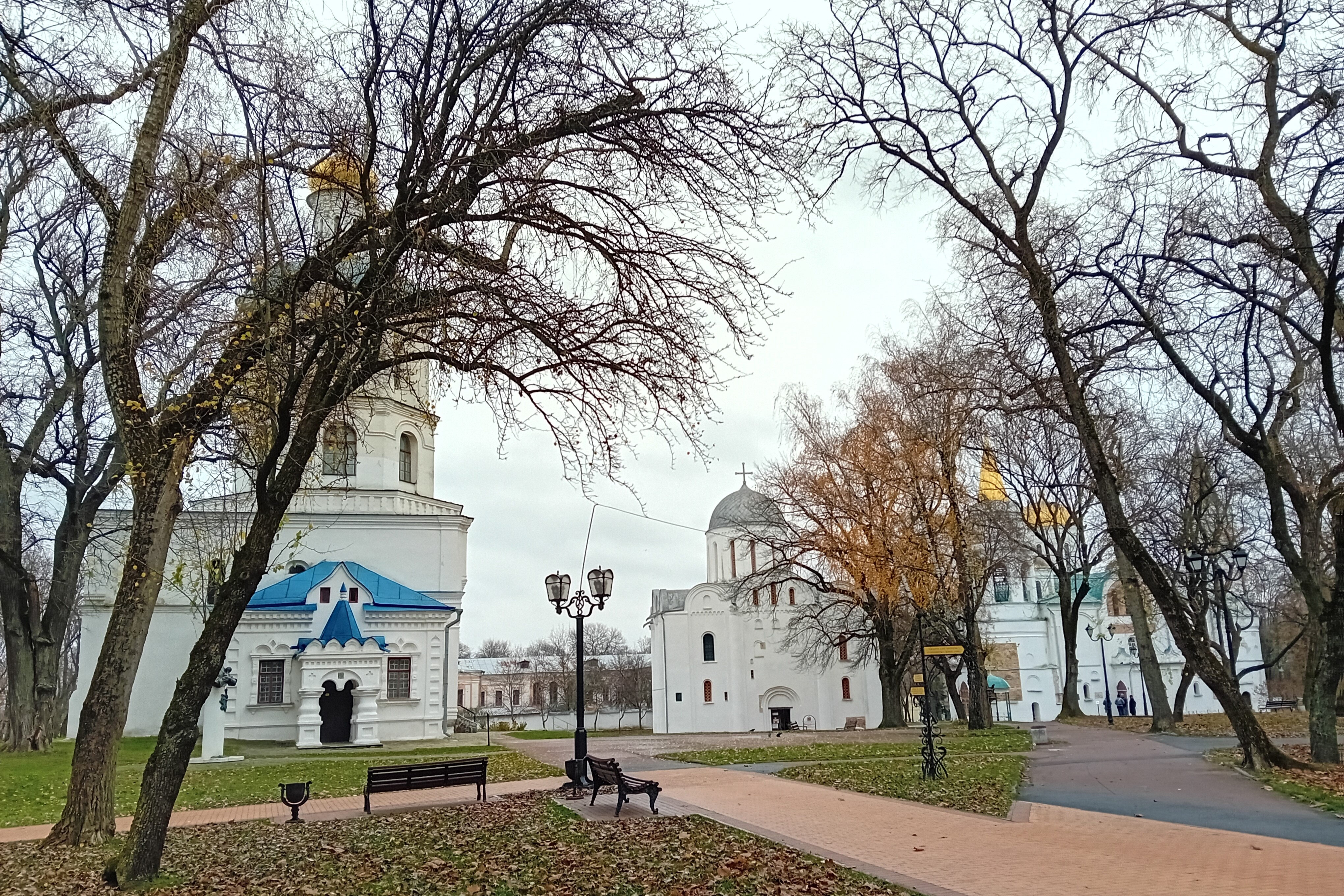
In mid-November 2023, following a few weeks in Kyiv, I travelled up for a weekend in Chernihiv, close to the borders with Belarus and Russia. Chernihiv, a fine city of churches and parks, is, together with Kyiv, one of the oldest in Ukraine, and was one of the most important centres in medieval Kyivan Rus. Among the many splendid churches in the city, the 11th century Transfiguration Church is thought to be the oldest in Ukraine, although it has suffered repeated damage during its history, from the Mongol invasion in the 13th century to an 18th-century fire. The current exterior is from the 19th century. Unfortunately the church was closed when I visited.

The Chernihiv Collegium, Cathedral of Saints Boris and Gleb,
and the Transfiguration Church

Next door to the Transfiguration Church is the Cathedral of Saints Boris and Gleb, which was originally built in the 12th century, but has also been frequently damaged, rebuilt and altered over the centuries. Under Polish rule, it had for a time been a Catholic Church. On the other side of the Cathedral is the 18th century Chernihiv Collegium, with its tall bell tower, in its day one of the most important educational establishments in Ukraine and Imperial Russia. The fine Piatnytska Church, also from the 12th century, has also been much restored over time. The Yeletsky Dormition Monastery, founded in the 11th century, is one of Ukraine’s oldest. It has also gone through alteration, its church sporting 17th century baroque cupolas.

Regimental Chancellery building

A more modest, but historically interesting building is the 17th century Regimental Chancellery Building, the administrative office of Chernihiv’s Cossack regiment at the time of the Cossack Hetmanate, until it was abolished during the reign of Catherine the Great. A simple, rectangular, single-story building, it belonged for a time to Ivan Mazepa, Hetman of the Zaporizhian Cossack Host at the end of the 17th and beginning of the 18th centuries. Mazepa joined Charles XII of Sweden in his fight against Peter the Great at the Battle of Poltava in 1709. The battle ended in cataclysmic defeat for Charles XII, and the majority of the Cossack host did not follow Mazepa, remaining loyal to the Russian Tsar. Despite this, Mazepa is a heroic figure in today’s Ukraine, while in Russia he has long been infamous for his perceived treachery. St Catherine’s church, situated at the end of a tree-lined avenue, which was dedicated in 1715, was erected in honour of the bravery of the Chernihiv Cossacks during the storming of the Ottomans’ Azov fortress.

Ukraine Hotel, Chernihiv

Chernihiv came under attack from the start of Russia’s full-scale invasion of Ukraine in February 2022. The city was surrounded and cut off for around a month, as fierce fighting went on in the surrounding region and in the outskirts of the city itself. The city was subjected to missile and rocket attacks that left many buildings, including residential buildings, damaged. While the damage had largely been cleared up, the city centre still bore the scars, and the windows of several buildings around the central Red Square were boarded up when I visited. The Ukraine Hotel had been particularly badly damaged, having taken a direct hit. Hundreds of people were killed, including many civilians, before Russian forces withdrew from much of northern Ukraine, their initial attempt to overwhelm the country having failed.

The full-scale war had been going on for nearly two years when I visited Chernihiv. Despite the damage, the city had largely returned to normal. Restaurants and cafes were doing a good trade, and tables were hard to come by that weekend in many places. Chernihiv, like Kharkiv and Kyiv and many other places, had survived. Ukrainians’ stout resistance had impressed and surprised many who had expected the country to fold in the face of Russia’s onslaught. What extraordinary times those were, as from day to day we prayed that Kyiv, Chernihiv and other cities could somehow hold out. And then suddenly the miracle, as it seemed, that columns of Russian tanks and armoured personnel carriers had been stopped, and were being destroyed by brave Ukrainian soldiers with shoulder-launched missiles and drones. And then the Russians were fleeing, leaving much of their equipment behind to be hauled off by triumphant Ukrainian farmers behind their tractors. Ukraine’s loss had been terrible. The discovery of the grisly evidence of the Russian occupiers’ barbarism in the towns and villages they had occupied was shocking. But Chernihiv and Ukraine had prevailed.

Sunday, 29 October 2023

The Bulgakov Museum, Kyiv

The Bulgakov museum, on Andriivskyi Descent, in the beautiful heart of old Kyiv, is situated in the apartment where Mikhail Bulgakov was brought up and lived as a young man. His famous literary works were written later, after he left this house. This was his family home, and he practiced medicine here. But the apartment is also significant because it was the model for the family home of the fictional Turbin family, the main characters of Bulgakov’s first novel, The White Guard. Bulgakov lived in Kyiv during part of the civil war that followed the Bolshevik revolution, and witnessed firsthand the tumultuous events as the various competing armies, White, Red, Ukrainian nationalist, German, came and went. The museum depicts the lives of two families that lived there, the Bulgakovs themselves and the fictional Turbins.

The Bulgakov Museum, Kyiv

Following the February Revolution, a Central Council of Ukraine had taken power in Kyiv, and declared Ukraine’s autonomy within Russia, which was later recognised by Russia’s Provisional Government. However, following the October Revolution, the Central Council denounced the Bolsheviks and declared an independent Ukrainian People’s Republic. The Central Council was in turn driven out by the Germans in April 2018, and was replaced by the pro-German Ukrainian State under Pavlo Skoropadskyi, a former general in the Imperial Russian Army, who styled himself Hetman, the title of the heads of the Zaporizhian Cossack host that had held sway in much of Ukraine between the 16th and 18th centuries. Following the German surrender in November 2018, Skoropadskyi’s rule swiftly collapsed as Ukrainian forces under Symon Petliura, the head of the Central Council’s military, approached the city. Skoropadskyi withdrew with the Germans.

The White Guard opens in late 1918, as the well-to-do Turbins, supporters of the Hetmanate, participate in the defence of the city against Petliura’s army. The novel depicts the chaos of the civil war, the euphoria of many Ukrainians as Petliura, who appears as a figure of almost legendary proportions, enters Kyiv, as well as the terror of those who, like the Turbins, had opposed Petliura. In one particularly heart-rending scene, an entirely innocent Jewish man is murdered by Petliura’s troops. As so often, the Jewish population were targeted for special cruelty.

The White Guard is in a fine tradition in Russian literature that includes Tolstoy’s War and Peace and Pasternak’s Dr Zhivago, that depicts tumultuous historical events through the lives and experiences of a group of people living through them. His take on those events was unsurprisingly controversial. The White Guard was first published in serial form in a Soviet-era journal in 1925, but it was shut down before reaching the end. A censored version was published in the Soviet Union in 1966, but the complete version was not published there until 1989. Nevertheless, Stalin was said to have enjoyed the stage adaptation of the novel, The Days of the Turbins, so much that he saw it multiple times.

Bulgakov has also been controversial in Ukraine more recently. In 2022, following the full-scale Russian invasion, there were calls from some quarters for the museum on Andriivskyi Descent to be closed, because Bulgakov, who though born in Kyiv was of a Russian family, could not be considered a Ukrainian writer, and because he was allegedly opposed to Ukrainian statehood. Since the onset of Russian aggression against Ukraine in 2014, there have been widespread calls to reject all Russian culture, to remove statues of Russian cultural figures and to rename streets named after them, all in the name of “cultural decolonisation”. Such calls have reached a new pitch since the full-scale invasion in February 2022. There is, for example, no longer a square named after Tolstoy in Kyiv, who admittedly had no connection with the city. It has been renamed the Square of Ukrainian Heroes. But the then minister of culture rejected the calls to close the Bulgakov museum. My guide assured me it would not be closed. Outside the museum, a statue of a seated Bulgakov has, like many other statues around Ukraine, been covered up for protection against potential missile attacks. So perhaps Bulgakov, a great figure of world literature and one of Kyiv’s most famous sons, might be safe.

Friday, 22 September 2023

Historical memory in Lviv

Lviv is a beautiful city in western Ukraine. In many ways it has a distinct spirit, reflecting its different historical heritage from the rest of the country. Lviv, together with the eastern Galicia region of which it is the most important city, had spent much less of its history under Russian or Soviet rule. As part of the partition of Poland in the 18th century, Lviv had been annexed to the Austrian Hapsburg Empire. After an attempt to establish an independent Ukrainian state at the end of the First World War, Lviv and the rest of western Ukraine was incorporated into the restored Polish state. But while Lviv itself had a predominantly Polish and Jewish population, with Ukrainians in a minority, in the surrounding territory of eastern Galicia Ukrainians were in the majority.

Dissatisfaction with Polish rule was strongly felt among the Ukrainian population, and radical nationalists of the Organisation of Ukrainian Nationalists (OUN) carried on a violent campaign of terrorist attacks targeting the Polish state as well as Ukrainians who they regarded as traitors or collaborators. The onset of the Second World War seemed to offer them another chance to establish an independent state under their exclusivist, totalitarian rule. After the invasion and dismemberment of Poland by Nazi Germany and the Soviet Union in the summer of 1939, most of the OUN leadership took refuge in the German occupied west of the country, where they established close ties with the Nazis. Following a split in the organisation, a more radical faction, the OUN-B, so-named after its leader, Stepan Bandera, made plans for a national revolution they hoped to carry out in Ukraine with Nazi support.

The OUN-B was a typical fascist organisation of its day, in its totalitarian ideology, its intolerance towards other nations in the territory it claimed, and its vicious antisemitism. Its members adopted the outstretched arm fascist salute, and drew inspiration from other fascist movements in Italy, Slovakia and Croatia, as well as Germany. Bandera, as “providnyk” (leader), throughout his life insisted upon the leadership principle (“führerprinzip” in German) of unswerving submission to the leader’s will.

When the Germans launched Operation Barbarossa in June 1941, they did not allow Bandera to cross into the newly occupied territory. But other OUN leaders were quick to take up the opportunity. When the German army reached Lviv, one of Bandera’s key subordinates, Yaroslav Stetsko, proclaimed a new Ukrainian state on 30 June. The arrival of the German army was followed by a bloody pogrom against the city’s Jewish population, in which a militia organised by the OUN-B took a prominent part.

Lviv’s brief experience of Soviet rule in 1939-41 had been brutally repressive. Tens of thousands of people were arrested, and frequently tortured, and hundreds of thousands were deported. Before the hasty Soviet withdrawal from the city in the face of the German advance, the NKVD secret police were ordered to shoot all remaining political prisoners. Thousands were murdered in NKVD prisons in Lviv.

Memorial to the victims of communist crimes, Lviv

I visited the National Museum - Memorial of the Victims of the Occupying Regimes “Prison on Lonsky Street”, located in one of the prisons where the NKVD murders took place. While the museum depicts the harsh prison regime during periods as a Polish, Soviet and Nazi gaol, its particular focus is on the NKVD murders, during which, according to the information provided, 1,681 were killed, or 41 per cent of the NKVD murders carried out in prisons in Lviv. However, as the historian John-Paul Himka has described, the museum gives an incomplete account of the bloody events at Lonsky prison in the days before and after the Soviet withdrawal from the city in June 1941.

Upon the arrival of the German army in the town, the bodies of the murdered prisoners were brought out into the prison yard, where shocked Lviv residents came to identify their loved ones. As the English-language text at the museum acknowledges, Jewish residents of Lviv were rounded up and forced to carry out the bodies, which were already decomposing in the summer heat. What the museum does not relate is how these Jews were savagely beaten and murdered, and how this developed into a full-scale pogrom, during which Jews were dragged from their homes, beaten and humiliated in the street, raped and murdered. This is a serious omission, made worse by the emphasis that during the Nazi occupation it was mainly Ukrainians, members of the OUN, who were victimised at the prison. Thus while the museum’s account glosses over the massacre of Jews that took place inside Lonsky Prison as well as elsewhere in the city, it presents the organisation whose members actively participated in that massacre as the primary victims of Nazi repression.

In line with typical Nazi propaganda, the OUN conflated Jews with communism. Supposed “Jewish Bolshevism” and the Jewish population were held responsible for the NKVD murders in Lviv, despite the fact that Jews were among the NKVD’s victims. Ukrainian newspapers at the time played up this association, whipping up passions against the city’s Jews. Of course, those newspapers were produced under the supervision of the German occupiers. But the conflation of Jews and communists and hostility to Jews as an enemy of the Ukrainian people were key aspects of OUN ideology.

The English-language text in the museum states that among its aims is “to encourage patriotism among the citizens of Ukraine.” As has been described by Himka, as well as by Grzegorz Rossoliński-Liebe and other historians, this is in line with a practice among OUN apologists in the Ukrainian diaspora and in western Ukraine to rewrite history so as to glorify the role of the OUN and to minimise, deny or ignore the fascist nature of the organisation, its collaboration with the Nazis and the terrible crimes its members perpetrated. It is a narrative which in recent years been pressed upon the rest of the country as well.

As it became clear that Nazi Germany would lose the war, the OUN tried to distance itself from its earlier fascist associations, and presented itself as resisting both Nazi and Soviet occupation. In fact the OUN-B’s initial overtures to the German occupiers in 1941 had been rebuffed, as the latter had no interest in supporting Ukrainian aspirations to establish an independent state. Several OUN-B members, including Bandera himself, were arrested by the Germans. Nevertheless, many members of the OUN-B militia joined the Ukrainian police force established by the Germans, which participated extensively in the holocaust. And when in 1942 the OUN-B established the Ukrainian Insurgent Army (UPA), many members of the Ukrainian police deserted to the new organisation. While the OUN-B tried to downplay its earlier fascism and Nazi collaboration, the UPA continued to murder Jews, as well as massacring tens of thousands of Poles in a genocidal campaign to cleanse the Eastern Galicia and Volhynia regions of Poles.

OUN apologists claim that the organisation was not responsible for the Lviv pogrom in July 1941, for which they blame the Germans and criminal elements in the Lviv population. But as numerous Jewish survivors attested, the OUN-B militia was extensively involved in rounding up the Jewish victims. Furthermore, photographs of the events taken by Germans show that many perpetrators were wearing the OUN-B militia’s armbands. The museum at the prison on Lonsky Street claims to bear witness to the terrible events that took place there. But its omission of the pogrom and silence about the role played by members of the OUN-B, whose members it presents as heroes and victims, is an unconscionable distortion of history.

Close by the Lonsky prison museum is a monument to the victims of communist crimes. It is marked by the Ukrainian trident, and does not indicate that there were also non-Ukrainian victims. However, elsewhere in the city, a monument to the NKVD murders commemorates Ukrainian, Polish and Jewish victims.

Rossoliński-Liebe’s book, “Stepan Bandera, the Life and Afterlife of a Ukrainian Nationalist: Fascism, Genocide and Cult”, describes how, as the Soviet Union collapsed, monuments glorifying the OUN and Bandera began to be erected in western Ukraine. A large statue of Bandera was unveiled in Lviv in 2007. The rehabilitation of Bandera and the OUN was stepped up during the presidency of Viktor Yushchenko, from 2005-10, who designated Bandera, as well as another leading OUN-B figure, Roman Shukhevych, as heroes of Ukraine. This move was reversed under Yushchenko’s successor, Viktor Yanukovych, but the rewriting of history to glorify the OUN as fighters for Ukrainian independence, while glossing over or denying their crimes and their Nazi collaboration has gathered pace since the onset of Russia’s aggression against Ukraine in 2014.

The designation of Bandera as a hero was denounced by the European Parliament as well as by the Simon Wiesenthal Center, a Jewish human rights organisation which promotes remembrance of the holocaust. The Simon Wiesenthal Center also sharply condemned the decision of the Ukrainian parliament in 2018 to mark Bandera’s birthday on 1 January. The glorification of Bandera and the OUN is also widely denounced in Poland. The noted historian of the holocaust and of Ukraine, Timothy Snyder, in an article in the New York Review of Books in February 2010, described Yushchenko’s rehabilitation of Bandera as ethically unsound and as casting a shadow on his political legacy.

None of this deters the OUN’s Ukrainian apologists. There is a widely held perception today in Ukraine that their history has too long been seen through a Russian or Soviet lens, and that they should now tell their own story. There is considerable justification for this view. In the Soviet Union, the OUN and Bandera were denounced as Nazi collaborators and criminals, but the immense crimes of the Soviet regime, its savage repression of resistance to Soviet rule in western Ukraine, and the mass executions and deportations, were covered up. In response to any who criticise the glorification of Bandera and the OUN or denounce their record, a stock reply from Ukrainian OUN apologists is to claim that they are spreading Soviet and Russian propaganda. However, such inferences do not hold weight in light of the clear historical record of the fascist nature of the OUN, its Nazi collaboration and the horrendous crimes committed by many of its adherents.

I also visited the Memorial Museum of Totalitarian Regimes “Territory of Terror”, which is located in what was during World War II Lviv’s Jewish ghetto. This was also the location of a Soviet transit camp from 1944-1955, for deportations to the east. The museum’s exhibits and accompanying texts commemorate the mass murder of Lviv’s Jewish residents, both in the city’s ghetto and at the Janowska slave labour camp on the outskirts of the city, as well as the deportations by the Soviet regime. In general, it gives a much fuller account of the horrors inflicted by both the Nazi and Soviet regimes than is the case at the Lonsky prison museum. That said, it does not document the crimes committed by the OUN and the UPA, whose members are depicted as victims. Notably, a series of displays in front of the museum when I visited, about individual victims, mostly concern Ukrainian victims rather than Jews, many of them OUN and UPA, or members of their families.

This troubling lionisation of people with such an unsavoury record is likely to continue to stain the country’s reputation. Ukraine has rightly received enormous international support for its heroic struggle against Russian aggression. Yet key allies, notably Poland, are among the countries that are particularly offended by such historical revisionism. What is especially baffling is that modern Ukraine, a democratic state aspiring to membership of the European Union, with a Jewish president and a Crimean Tatar defence minister, has nothing to do with the intolerant, totalitarian fascism espoused by Bandera and the OUN. Yet it is very hard to find Ukrainians who are willing to push back against the nationalist narrative, at least in public. In recent decades much has been done to uncover Ukraine’s painful history of Soviet repression. A more serious, honest and frank discussion of other aspects of the country’s difficult 20th century history is also needed.


Wednesday, 6 September 2023

A visit to Kharkiv

On the long train journey from Warsaw to Kyiv, one of my travelling companions was a teenage girl from Kharkiv who had with her mother taken refuge from the war in a small town in Cornwall. Her home in Kharkiv was in the centre of the city, and she had heard the blast when a missile struck the central Freedom Square on 1 March 2022. In the early days of the invasion, Russian forces had briefly entered the northern suburbs of Kharkiv, and the city had been subjected to heavy shelling and missile strikes. Numerous buildings had been damaged, and civilians killed and wounded. Unsurprisingly, many had left. But as most men under the age of 60 were not allowed to leave the country, my fellow passenger’s father had stayed behind. This was the first time she had been back to visit him.

By May 2022, the Russian invaders had been pushed back from Kharkiv, relieving much of the pressure, although, like towns and cities throughout Ukraine, it continued to face missile and drone attacks. Ukraine’s counter-attack in September 2022 had liberated most of occupied Kharkiv region. People had started to return to the city.

My travelling companion appeared to have settled in well in Cornwall. She liked the elderly couple she and her mother were staying with. Her English had improved immensely, she told me. She had got a job in a hotel, and was earning enough money to be able to send some to her father. But she was homesick. Life in a small town did not suit her. She would rather have gone to a big city. She saw her future in Ukraine.

Like many people in eastern Ukraine with relations in Russia, the war had wrought terrible damage on her family bonds. While she was born in Kharkiv, both her parents were Russian, she said. Her father was from Crimea and her mother from Russia itself. She had fallen out completely with her grandparents on both sides. At the start of the invasion, they had told her that it would all be over quickly, and that Ukraine would be liberated by the Russian army. When she had said that she did not want to be liberated, one of her grandfathers had said in that case it would be better if they were all killed. It pained her to have to say that she now felt closer to the couple she was staying with in Cornwall, who cared about her more than her own grandparents did. Such stories are all too common. Several people from Donbas have told me how communication with parents or other relatives in occupied territory or in Russia, had become almost impossible.

The next morning we woke up to the news that the Kakhovka dam had been blown during the night, causing immense environmental damage and loss of life in the lower reaches of the Dnipro river. A friend in Odessa told me that all kinds of detritus, including animal carcasses and landmines, had washed up on Ukraine’s Black Sea coast. One more horror inflicted upon the Ukrainian people.


Trukhaniv island, Kyiv

In Kyiv, despite the constant trauma and weariness with the war, people continued to go about their lives as normally as possible. They sat on café terraces in the sunshine, or strolled in the city’s parks, or on the islands in the Dnipro. I too enjoyed beautiful peaceful afternoons by the water, trees and lily pads, eating shashlik and sipping cold beer. Kyiv in summer is always beautiful.

The previous month, in May, missile and drone attacks had been particularly frequent. People lost sleep. Nerves were frayed. But during my stay, the air raid warnings were less frequent. Around the city were signs pointing to air raid shelters. As on my previous visit in the autumn, people had to decide whether to go to the shelters. Many decided to ignore the warnings. A friend told me that they looked at the news feeds on their mobile phones to assess the degree of risk, and whether or not they should take to a shelter. One afternoon, I headed for the nearest metro station in response to an alert. The person I was with, scrolling through the news, told me this was a major attack. During air raids alerts, entry to the metro stations was free of charge. People stood around, some talking to each other, others glued to their phones. Apparently on the surface people had heard the explosions. Perhaps surprisingly, this Russian attack on Kyiv coincided with a visit to the Ukrainian capital by a delegation of African leaders. Might this affect the pro-Russian leanings of some of them?

Since the spate of missile attacks the previous autumn, attacking Ukraine’s power infrastructure, the country had received more modern, more effective western air defence systems, including the American Patriot system. But it had not received enough of them, forcing the Ukrainian authorities into an appalling dilemma, as to whether to protect cities or frontline soldiers embarking on their summer counter-offensive, and which cities to protect? Almost all the missiles and drones aimed at Kyiv were now shot down, although the pieces of destroyed missiles still had to fall to earth. But other cities were less well protected.


Boarded up Regional Administration building, Kharkiv

Towards the end of June, I travelled to Kharkiv. Taking the overnight train, I arrived early in the morning. Few people were about yet as I walked around the city centre. The debris of missile strikes had been cleared up, but the scars were still there. Many buildings, including the battered regional administration, had boarded up windows that had been shattered by the blasts. As in other cities, many monuments had been covered for their protection, including the statue of the great Ukrainian poet, Taras Shevchenko, and the World War I British tank that had been abandoned during the Russian civil war (actually a misnomer, as the multi-sided war was fought throughout the former Russian Empire, and much of the fighting took place in Ukraine).

Yet the city was very much alive. The gardens in Shevchenko park were beautifully tended. Families enjoyed the warm weather. Café and restaurant terraces were full of customers. I was delighted to find that my favourite café from previous visits was working normally. The cakes and pastries were still excellent. The only difference was that the waiters and waitresses now addressed customers in Ukrainian, as they are required to do.


Shevchenko Park, Kharkiv

My first visit to Kharkiv had been in the summer of 2014. The atmosphere then had been very different. In February to April that year, following the Maidan Revolution in Kyiv, Kharkiv had teetered on the brink, nearly going the same way as Donetsk and Luhansk. The regional administration building had briefly been occupied by pro-Russian activists. Pro-Russian thugs from a sports club attacked pro-Ukrainian demonstrators. The city mayor wavered and initially appeared to take the pro-Russian side. The local police and security services seemed paralysed. But decisive action by an elite police unit from the town of Vinnytsia bloodlessly ended the occupation of the administration building. The commander of the unit said that had swift action not been taken, support and weapons would have poured over the nearby Russian border, and that Kharkiv, like Donetsk and Luhansk, might have been lost. The atmosphere was tense when I visited that summer of 2014. Groups of police hung around outside the regional administration building. I was struck by how few Ukrainian flags were in evidence. Very different from Kyiv, or Dnipropetrovsk (now renamed Dnipro), which I visited after Kharkiv, where the Ukrainian flag was everywhere, the national anthem blaring out constantly in the central square.


Kharkiv lives and works

This time, in 2023, it was quite different. Whatever pro-Russian sentiment there might once have been in Kharkiv had been blown away by Russia’s aggression. Ukrainian flags were all over the place. Posters expressed thanks to the Ukrainian army, defenders of Kharkiv and of Ukraine. Others showed construction workers or gardeners about their work, with a defiant quote from the mayor: “Kharkiv lives and works.” Indeed, it was remarkable that despite such severe blows, such destruction, the people of Kharkiv continued to work, and to live. But the cruelty of the war continues. Missiles sometimes get through. A sad little monument in the city centre, surrounded by teddy bears and other soft children’s toys, commemorates the children who will never grow up.

This is the cost of the West’s prevarication over sending Ukraine the weapons it needs to defend itself. It is measured in the deaths of innocents, of people who have suffered terrible injuries, children who dreamed of being gymnasts or footballers, but who now have to learn to walk with prosthetics. The air defence systems that protect Kyiv are highly effective, but the inhabitants of other cities are left open to Russian terror because of the niggardliness of Western leaders with their pathetic excuses about not wanting to escalate the conflict or to provoke Russia. Ukrainian soldiers have to fight with an arm tied behind their back because Western leaders hesitate to send the modern planes they need, or the long-range missiles that could hit the sources of Russia’s terror strikes. So many of us have been impressed by Ukrainians’ spirit and resilience in face of such terrorism. As they defend themselves against a brutal aggressor, they deserve all the support we can give them.

Friday, 25 August 2023

Museums and monuments in Warsaw

As the Russian invasion of Ukraine had stopped all air travel to the country, my journeys to Kyiv in the autumn of 2022 and again in the summer of 2023 passed through Warsaw. With events in Ukraine very much on my mind, I took the opportunity to visit a couple of the monuments to the resistance in Poland during the Second World War.

The Warsaw Uprising Monument commemorates the battle of Poland’s resistance to seize control of the capital from the retreating German occupiers before the arrival of the advancing Soviet forces. The uprising, which began on 1 August 1944, was both heroic and tragic, as the Soviet army stopped short of the city and waited while the Germans brutally suppressed it and then destroyed the city in its aftermath. Hundreds of thousands of civilians died, as Stalin refused to allow any meaningful supplies to the resistance. The uprising may be seen as the beginning of the Cold War, as the Polish Home Army’s vision of a pro-Western Polish state clashed with the Soviets’ determination to crush any independent Polish spirit and to subsume the country into its expanding empire of proxy states in central Europe. The people of Warsaw paid the price for the Nazi brutality and Soviet callousness.


The Warsaw Uprising monument

The monument depicts Home Army soldiers in action amid the ruins of the shattered city, as well as a group emerging from the sewers, which had been an important way for the insurgents to move around. It was only erected in 1989, at the very end of communist rule in Poland. Until then communist Poland had downplayed and distorted the importance of the uprising. Home Army veterans were disparaged and, in the immediate post-war period, even arrested. No commemorations of the Home Army or the uprising were permitted. The cynicism with which the Soviet army stood back and watched as the Germans destroyed Warsaw meant that the uprising was an uncomfortable event for the communist regime.

The Warsaw Rising Museum opened in 2004, to mark the 60th anniversary of the uprising. A big, sprawling museum over a number of floors, it is packed with artefacts, weapons, photographs, displays, videos and audio. The subdued lighting and a loud background noise, like a beating heart, produced a forbidding atmosphere. The museum was crowded, with large school parties rushed around. Disturbing impressions were thrown at me, but the thread of events through that terrible two months was hard to follow. I picked up some printed flyers that seemed randomly distributed around the museum, but which explained the course of events. I left with the feeling that they had tried to pack in too much, and that coherence had been lost along the way.


The Warsaw Ghetto Uprising monument

Another monument commemorating the 1943 Warsaw Ghetto Uprising was unveiled in 1948, in the area where the ghetto had been. It consists of a large stone wall representing both the walls of the ghetto and the Wailing Wall in Jerusalem, with two large menorahs to either side. Inset in the wall are, on one side, insurgents of the uprising, and, on the other, a depiction of the Nazi persecution of the Jewish people. Next to the monument is the Polin Museum of the History of Polish Jews, which was opened in 2013. This striking postmodern building has become a considerable landmark in Warsaw. The name Polin means both “Poland” in Hebrew, as well as “rest here”, which relates to the legend about the first Jews’ arrival in Poland. The museum relates a thousand years of Jewish history in Poland, once the largest Jewish community in the world, from its beginnings in the Middle Ages up to the holocaust and beyond.


The Polin museum, Warsaw

The museum’s layout draws visitors through the different phases of Jewish history in Poland. That Poland attracted such a large Jewish community reflected its exceptional tolerance among European states. Although Poland was not immune to antisemitic violence, its Jews were in general protected by the Polish Kings, who valued their contribution to the economy of their realm. As elsewhere, Jews in Poland thrived as traders. The Polin museum does not shy away from presenting uncomfortable aspects of Jewish history in Poland, including their engagement in the slave trade. It explains that, despite the Catholic Church’s objections to the enslavement of Christians, Poland’s kings were loath to act against it, because they profited from the trade. Catholic clergy in general opposed the tolerance shown towards Jews, but their objections were largely ignored by the country’s rulers.

With my mind on Ukraine, an especially striking section of the museum concerned the Bohdan Khmelnytsky rebellion of 1648. Ukraine was at the time part of the Polish-Lithuanian Commonwealth. Khmelnytsky’s Cossack rebellion against Polish rule especially targeted Jews, as well as Polish landowners and Catholic priests. Jews were seen as allies of the Polish landed aristocracy as they frequently acted as tax collectors. Tens of thousands of Jews were massacred. The museum explained how, for the Jewish community in Poland-Lithuania, the Khmelnytsky rebellion was a cataclysmic event that ended their feeling of safety and security in Poland. Furthermore, from a Polish perspective, the Khmelnytsky rebellion was an important stage in the weakening of the Commonwealth, leading to its eventual demise and partition among the neighbouring states. For Poland’s Jews, the demise of the Commonwealth was also negative, as it meant that they lost the protection Poland had offered them, and were left at the mercy of rising antisemitism in the Russian and Austrian empires.

In Ukraine, Khmelnytsky has usually been seen as a positive historical figure. One of the country’s regions is named after him. A banknote bears his image. And there is an equestrian statue of him in the centre of Kyiv. However, some Ukrainians have seen him unfavourably, especially because, with his rebellion failing, after initial success, he turned to the Russian Tsar for support, which led to the incorporation of eastern and central Ukraine into imperial Russia. For Russia, Khmelnytsky was seen as a heroic figure, for his role in, according to the Russian view, uniting Russian lands. Indeed, the statue in Kyiv was erected in the 19th century, under Tsarist rule.

Since independence, Ukrainians have been reassessing their history, a process that has been accelerated by Russia’s aggression. There is a widespread feeling that Ukrainian history has for too long been written from a Russian perspective. This feeling has considerable justification. The point is relevant for western historians as well, who all too often had a largely Russo-centric view of imperial Russia and the Soviet Union, which did not give sufficient weight or importance to the non-Russian peoples under Tsarist and Soviet rule. But in addressing their history, Ukrainians need to take a critical look at uncomfortable episodes and historical Ukrainian figures whose records were far from unblemished. Polish-Ukrainian relations, as well as the treatment of the Jewish community, present difficult topics, and Ukrainians need also to consider the perspectives of others on their shared histories. As the Polin museum makes clear, Khmelnytsky is far from a heroic figure for some of Ukraine’s neighbours.

Thursday, 10 August 2023

Kyiv under attack

The day before I travelled by bus from Warsaw to Lviv in mid-November 2022, Russia launched a mass-missile attack on Ukraine. A friend in Lviv contacted me and asked whether I was sure I really wanted to come? She had taken refuge in a shelter when the air raid siren had sounded, but she had heard the explosions when the missiles struck. Since the previous month, Ukraine had faced regular such missile attacks targeting its energy infrastructure every week or so in an obscene attempt by Russia to make Ukrainians freeze that winter. I had realised that such attacks were likely to occur during my stay. But I didn’t know quite what to expect. During my stay in Odessa that summer, people had largely ignored the air raid sirens. Would it be different now? Ukraine had not yet been provided with the kind of modern air defence systems that could more or less reliably shoot down Russian missiles. And even though they did shoot down many of them, the debris still had to fall to earth. Central Kyiv had been struck a short while before, and there had been victims, ordinary people going about their business, walking or driving in the city.

I arrived in Lviv on an autumnal evening just after the electricity had been restored. Meeting my friend for dinner, it was striking how normal things seemed, at least on the surface. The pizzeria we went to was packed with people out enjoying themselves. But of course, the situation was far from normal. The first snow of winter fell while I was in Lviv. Whether Ukraine could cope with the repeated missile attacks, whether the energy supply could be maintained, whether the heating could be kept on and the water kept flowing, these were all questions with uncertain answers that autumn. There was even talk of Kyiv potentially having to be evacuated if the city became uninhabitable.

Arriving in Kyiv after an overnight train journey, I took the metro and went straight to one of my favourite cafés, close to the Golden Gate. I drank coffee and ate an excellent almond croissant. It seemed extraordinary to be back. Having freshened up in my hotel, the same hotel where I had stayed many times before, I met a friend for lunch in an excellent nearby Georgian restaurant. Unlike Odessa during my visit in the summer, with its half-empty streets and closed shops and cafes, Kyiv seemed much more alive. Most of the cafes and restaurants I had previously frequented were still working normally. A city-centre shopping mall was bustling with people. The spirit of the city seemed undimmed.


Glass Bridge and Arch of Freedom of the Ukrainian People

But of course, all was not normal. Many streets around key government and administrative buildings were closed off. Statues were covered up for their protection: Bohdan Khmelnytsky, the leader of a 17th century Cossack revolt against Polish rule; Princess Olha, who as regent in the 10th century was the first ruler of Kyivan Rus to be baptised as a Christian; the author Mikhail Bulgakov, who was born in Kyiv. The glass bridge connecting two hills in the city centre was closed, having been damaged by a missile strike the previous month. The Soviet-era monument to Ukrainian-Russian friendship at one end of the bridge had been dismantled. The monumental arch that rose above it, which had been constructed un 1982 to commemorate Ukraine’s union with Russia, had been renamed the Peoples’ Friendship Arch after Ukraine’s independence, but after Russia’s full-scale invasion of Ukraine it had been renamed again, the Arch of Freedom of the Ukrainian People.


Graffiti on the Maidan Nezalezhnosti

Concrete blocks and iron-girder tank traps had been pushed to the sides of the road by Independence Square, the Maidan Nezalezhnosti. An artwork attributed to Banksy, painted on one of the concrete blocks, appeared to show a girl and a boy using one of the tank traps as a seesaw.

On the square in front of St Michael’s monastery, by Princess Olha’s covered statue, a selection of wrecked tanks, armoured personnel carriers and other military vehicles had been lined up as trophies of Russia’s defeats before Kyiv in the spring. People walked around them, clambered over them, and posed in front of them. President Zelensky had brought various visiting foreign dignitaries here. On some of the vehicles people had written graffiti, “for Bakhmut”, “for Severodonetsk”, “for Mykolaiv”, towns that had been subjected to Russian destruction. And alongside the wall surrounding the monastery, the lines of photos of fallen soldiers grew ever longer. Mostly young men, and some women, some of them posing formally in their uniforms, others smiling happily for the camera, lives cut short by Russia’s brutal aggression. On Independence Square, an impromptu memorial consisted of hundreds of little Ukrainian flags commemorating, according to placards, foreigners and Ukrainians killed by Putin.


The scrap of Russia's failed assault on Kyiv

The day before I left Kyiv, there was another mass-missile attack. I later heard that this was one of the most devastating strikes. Electricity and water were knocked out in much of the city. Somehow, although the streets around were without power, in my hotel the lights remained on, although we were without water. Many restaurants and cafes had generators and were still able to operate, although some of them, which had not prepared, were unable to provide tea or coffee, or anything that required water. Eating my lunch in a large basement self-service canteen, there were many people who had not come to eat, but were rather taking shelter, and using the opportunity to charge their phones and use the wifi. The shopping mall which had seemed so busy when I arrived a few days earlier was now quiet, with few shoppers.

That evening, before catching the overnight train back to Lviv, I ate in a burger restaurant. Generators were still whirring up and down the pitch-dark street. The restaurant was full of people, and, as at the self-service canteen earlier, many of them were not eating or drinking. Here was a place where they could sit in warmth, with electricity to charge their phones. As I had seen in other cafes and restaurants, no one objected to people sitting without ordering anything. This was the solidarity among the people of Kyiv. Facing the horror of Russia’s aggression, people pulled together and looked after each other. The government was establishing “invincibility centres” where people could go for warmth, a hot drink and a wifi connection. But the atmosphere that evening felt more subdued. Despite the resilience and determination that was so impressive, after several weeks of such attacks, people were weary. There was snow on the ground, the weather was getting cold. How would the city fare under these repeated Russian attacks?

As I pulled my suitcase up to the railway station, I felt sad to be leaving. The assistance the world had provided Ukraine was significant, but it was not enough. Ukrainians were being left to face the Russian missiles and drones without adequate protection, without the means to strike back at the places from which they were being fired with impunity, far away. The West had modern military aircraft and missile-defence systems far superior to those employed by Russia, but they were not being supplied to Ukraine. The suffering of the Ukrainian people would be on our consciences, as we could have done more to help. I was leaving, going back to a home where I had electricity and no one was trying to make me freeze. As Ukrainians anxiously faced winter under Russian attack, our slowness to provide the help they needed shamed us all.

Wednesday, 2 August 2023

A visit to wartime Odessa

Travelling down by bus from Chişinău to Odessa in July 2022, my first visit to Ukraine since Russia’s full-scale invasion in February, I was not sure what to expect. I had been following the news from Ukraine compulsively. I knew there was a night-time curfew, and that there were frequent air raid alerts. I had heard life in Odessa had normalised somewhat since those first fraught weeks when the threat of a Russian assault on the city from the land or the sea had seemed very real. The tank traps on the city streets had largely been removed. But how was life in the city? How were people coping? Having previously lived in Odessa, I had a huge attachment to this beautiful city, with its unique spirit and its frenetic nightlife. A largely Russian-speaking city with a significant pro-Russian element among its population when Russia began its aggression against Ukraine in 2014, Odessa had briefly appeared at risk of going the same way as Donetsk and Luhansk. How had the city fared in face of the new Russian onslaught?

Many of my fellow passengers were women who had sought refuge abroad and were returning for a visit. As men under 60 were mostly not allowed to leave the country, families had been divided, and several of the women said they were returning to visit their husbands. Crossing the border, I confess to feeling quite excited to be returning to the country and the city I loved. The roads near the border were chock-a-block with trucks. A deal had been reached a few days before between Russia, Turkey, the United Nations and Ukraine to enable ships carrying grain to leave Ukraine’s ports. But it hadn’t yet been implemented. In the meantime, as much as possible was being transported out by road.

I had travelled this road so many times before, crossing back briefly into Moldova to skirt the liman, the wide body of water at the Dniester estuary that separated southern Bessarabia from the rest of Ukraine, and then crossing the Dniester bridge at Mayaky. The traffic as we entered Odessa at the “Dva Stolpa” (Two Pillars, the joke being there are three of them) roundabout was as busy as usual, and as we drove into the city my first thought was that everything appeared quite normal. We arrived at the central bus station on a warm sunny evening, and I felt almost elated to be back in Odessa.

A friend had told me that that evening a band I had seen before would be playing at one of the best bars in Odessa. So I had to go. The bar was in the city centre, a good hour-and-a-half walk from my accommodation, but I decided to go on foot. It quickly became clear that my first impressions had been wrong, and that all was very far from normal. The main road into the city may have been busy with traffic, but most of Odessa’s broad boulevards were unnaturally empty. And while the tank traps had gone, there were numerous military checkpoints along the way, with barricades halfway across the road. The soldiers weren’t stopping people, but their presence underlined the uneasy atmosphere in a city which had been hit by missiles, which was not all that far from the frontline, and from which a large part of the population had fled.

The bar was packed, the music frenetic, and the atmosphere frenzied as the revellers danced and yelled their appreciation. It was glorious. The spirit of Odessa unbowed, unbeatable. What a joy. There were people I knew there as well. Next to the band there was a box for donations for the Ukrainian army, which was being filled generously. Between the songs, the singer spoke to the audience in Ukrainian, a significant and meaningful change in Odessa. It seemed extraordinary, almost surreal. My first evening back in Ukraine after the full-scale Russian invasion, and here I was enjoying Odessa’s nightlife, as intense and feverish as ever. Except that it all had to end quite early, in time for the 11pm curfew. I had imagined it would be easy to get back before the curfew. I would take a taxi at 10pm, no problem. Wrong. At 10pm it was completely impossible to find a taxi, and the marshutkas, minibuses that ferried passengers around the city, had all stopped for the night. It was too far to walk home in time. With the help of a friend, I tried to hitch a ride, but without success. By this point I was getting anxious. What would happen if I were caught out after curfew, I wondered? Thankfully my friend was still with me, and at 10.30 she said that I’d just have to stay at her place, which was close-by. What a first evening back in Odessa. A magnificent concert, and then I almost missed the curfew.


The Duc de Richelieu covered

Strolling in Odessa the next day, I was still more struck be the contrast between things that appeared quite normal, and the things that were absolutely not normal at all. Many cafes and restaurants had closed, including some of my favourites. While all the supermarkets were working and well stocked, many other shops, clothes shops etc., were closed. City centre shopping malls were eerily quiet. Self-service canteens that were usually bustling at lunchtimes were nearly empty, if they were still open at all, food sitting too long without customers, dried out and unappetising. The emptiness was sad. Yet there were cafes and restaurants working much as normal. One of my favourite places in the garden next to the opera house was open, and I spent a very pleasant lunchtime there, although there were few customers. City centre streets close to the seaside, above the port area, were closed off. Odessa’s most famous landmark, the Potemkin steps, were unreachable. The statue of the Duc de Richelieu, Odessa’s most famous mayor (and governor of Novorossiya province, which encompassed southern Ukraine), which stands at the top of the steps, was covered up for its safety.

By contrast, the nearby statue of Catherine the Great, founder of Odessa, was uncovered, unprotected. The writing was on the wall for the Russian Empress, as the pressure to remove all trace of Russian associations became irresistible. Some Odessans told me they would not like to see the statue removed, that Catherine was part of the city’s history. But times had moved on. The bust of Pushkin that stood at one end of the seaside boulevard, in front of the city council building, would probably also not survive, I thought. The great poet had lived in Odessa for a time, but for many Ukrainians these were no longer associations that they wished to celebrate.

On a warm Sunday afternoon I strolled with a friend along the seafront, as I had so many times before. People ate ice creams. Children ran about playing. We sat and drank iced coffees on a café terrace by the water’s edge. No one was in the sea. There was a risk from mines. But otherwise the impression again was of a striking level of normality. But there were always reminders of how abnormal things were. The closure of so many shops and cafes, the emptiness of the streets was not only because so many people had left Odessa, fled abroad or to safer regions of Ukraine, further from the frontline. It surely also reflected the collapse in economic activity. While some could still afford to eat in nice restaurants, many others had lost their jobs and incomes. We didn’t see them in the city centre because they had no reason to come there, no money to spend. Many were probably eking out a poor existence in modest apartments in the suburbs. How did they manage, I wondered? How did the elderly and vulnerable cope? Ukraine’s social welfare system was limited even in the best of times. No doubt volunteers and NGOs had stepped into the breach to some extent. But was it enough?

In Shevchenko Park, close-by the monument to the unknown sailor, there were plaques commemorating the hero cities of the Soviet Union for their courage in the Second World War. Now those commemorating cities in Russia had been covered over, leaving only the six in Ukraine and Belarus uncovered, including Odessa. But the spellings were in Russian, not Ukrainian. Would these plaques survive the cull of symbols, statues and street names associated with the Soviet Union and Russia? Following the full-scale Russian invasion, President Zelensky had designated several towns and cities as hero cities of Ukraine, marking their courage in standing up to the Russian aggression. It occurred to me that this repetition of a Soviet practice, naming hero cities, was rather odd in a country determined to reject all Soviet associations.

The first time I heard the air raid siren I was walking across Kulykove Pole, a large open square in the city centre. It was loud, a sound that had such associations for someone from London. It was a sound that would have been very familiar to my mother. To think that I was now hearing it in a European city in 2022. I looked around to see how other people reacted, the Odessans who had been living with this for months already. Everyone I saw completely ignored it and just carried on walking, without any change of pace or direction. So I did likewise. Odessa had already been hit a few times by missiles, including the port. But I was told by a local that when the siren sounded, it was not yet clear where the missiles were headed, and that several cities over a wide area southern Ukraine sounded the alarm. They rarely hit Odessa, although on that occasion I was told that a missile impact had been close enough for people in the city to hear it. I did not hear it myself. Missiles had several times hit smaller towns along the coast, perhaps targeting Ukrainian air defence systems, although that was only speculation as, naturally, the Ukrainian authorities did not divulge such information.

My sleep was disturbed by the sirens a few times during my stay in Odessa. I had asked whether people went to a basement in the building where I was staying, for shelter. I was told the advice was to go to a room with no exterior walls or windows, which in my case meant the bathroom. The first time I did just that. But Odessans I spoke to told me almost nobody bothered, so I didn’t either. Such a blasé attitude presumably was not the norm in towns closer to the frontline which had more often been struck by missiles.

I left Ukraine by bus to Bucharest, travelling down through southern Bessarabia. We stopped for a break at the roadside hotel and restaurant in Tartabunary where I had stayed on a number of occasions, and which had been a regular stop-off during journeys in this beautiful region. The first ships filled with grain had left Odessa under the UN-brokered deal while I had been in the city, but the roads were still choked with lorries, backed up for several kilometres as we approached the Romanian border. We crossed the Danube by ferry close to Orlivka, a little town where the head of the village council had talked excitedly about the potential of the this watery paradise for tourism when I had visited a few years earlier. He had told me of his plan to introduce water buffalo, which would control the vegetation in the area’s waterways, as well as producing mozzarella and drawing tourists. He had realised his dream as well, before Russia’s aggression struck.

As I crossed the Danube from Ukraine to Romania, it really struck me. A short river crossing, and on the other side no air raid sirens, no curfew, no roadblocks, no evil bastards wrecking the lives of innocent, peaceful people. Despite the awful circumstances, Odessa retained its wonderful spirit. Its resilience and that of all Ukraine was awe inspiring. I was very glad to have had the chance to be there, and to spend time with wonderful friends. And I was more than ever convinced that Ukraine would prevail.