Saturday, 8 February 2020

Kyrenia and Bellapais

Kyrenia, known as Girne in Turkish, is arguably the most attractive town in Cyprus. Situated on the island’s northern coast, its picturesque semi-circular harbour, with the vast bulk of its fortress at one end, is framed by craggy mountains to the south. Some of the restaurants around the harbour are converted warehouses previously used for storing carob seeds, once one of Cyprus’s main exports. The fortress dates back at least until Byzantine times, and was renovated by the medieval Frankish Lusignan dynasty and again by the Venetians, who strengthened its massive walls and adapted them for the age of canon. However, that did not help when the Ottomans invaded Cyprus in 1570. When the defenders heard of the fall of Nicosia and the massacre of its population, the Venetian commander of Kyrenia surrendered. It was said that when he was presented with the severed head of his counterpart in Nicosia, he immediately capitulated.

There is an attractive little 16th century mosque overlooking the harbour. The Orthodox church of the Archangel Michael, above the opposite end of the harbour, was built in 1860, when the island was still under Ottoman rule. The church bell was donated by a local Muslim, indicating that relations between the two communities in Cyprus were not always rancorous. The church is now an icon museum, but it was shut when I went there. On the outside it is a sad sight, its paintwork peeling off, its plaster crumbling.

The invading Turkish army landed close to Kyrenia in 1974, and the town was one of the first places to fall. As elsewhere in the north of the island, the Greek population of Kyrenia fled. A few tried to stay on, but they were moved out in 1975. Kyrenia had become a popular British retirement destination during and after the period of British rule. There is even an Anglican church close to the fortress. Most of the 2,500 or so British residents also gradually left after the Turkish invasion, although there has been a limited new wave of British retirees more recently. The departed Greeks and British were replaced by Turks displaced from the south of the island, as well as droves of incomers from Turkey.


Bellapais

In the hills above Kyrenia is the beautiful village of Bellapais. The medieval Benedictine abbey dominates the village. Standing on the side of a hill, its high walls are impressive as you approach from below. The flags of Turkey and the unrecognised Turkish Republic of Northern Cyprus fly from a tower at the entrance. The abbey is partly ruined now, having been abandoned after the Ottoman conquest. The church however survives, having been taken over by the Orthodox church, as do three sides of the cloisters and the refectory, with its little pulpit on one of the side walls, from which readings from scripture took place while the monks took their meals. Bellapais is also where the author Lawrence Durrell made his home from 1953-1956, an experience he described vividly in his book Bitter Lemons. I walked up to the house, which is rather unremarkable in itself. On the village square in front of the abbey, I ate the most delicious Gözleme, a kind of pancake filled with local cheese and herbs. Across the square was a café with an old red British telephone box outside, whose owner agreed to drive me back to Kyrenia.

I got talking to an elderly man on the village square, who I asked for directions to Durrell’s house. Several elderly men gathered there in the bright January sunshine to chat and while away the time. He had been born in a village in the south of the island, close to Limassol. He told me that following the Turkish invasion his family, as well as most of the rest of his village, had moved to Bellapais, while many of the Greek inhabitants of Bellapais had moved to his village, in a straight swap. He appeared to feel little resentment towards Greek Cypriots. He had taken Cypriot citizen, as had around 95 per cent of the Turkish Cypriot population, he estimated. One of his sons had married a Greek Cypriot and had lived in the south for ten years before his marriage broke down and he returned to Bellapais. Since travel between the two sides of the island had become possible, he had visited his former village, and even met the Greek family who now lived in his former home. They appeared to be good people, he told me. I asked him what language he had spoken with them. He replied that most Turkish Cypriots of his generation could speak both English and Greek, so communication was not a problem. By contrast, he was scathing about the more recent arrivals from the Turkish mainland, who he said now far outnumbered the native Turkish Cypriots. They came from the poorest regions of Turkey, he said, and were less well educated than Turkish Cypriots like him who had been educated in the British system. Their presence was also problematic as, unlike Turks who had been in Cyprus before the invasion, and their descendants, these more recent arrivals were not entitled to Cypriot citizenship. He told me that at this stage in his life he would not consider moving back to the village of his birth. He lived as part of a community in Bellapais, and was content.


St Hilarion castle

In the hills south of Kyrenia there are three ruined castles, built originally during the Byzantine period, as a defence against Arab raiders. I visited St Hilarion castle, west of Bellapais, the best preserved of the three. The castle was extended during the Lusignan period, when it is said to have been a royal residence. Built along the craggy rocks of a hilltop, it is a dramatic sight, and is said to have inspired Walt Disney among others. I spent more than an hour climbing up its battlements and towers, looking into the ruins of a Byzantine church, the royal apartments, kitchens and stables. One window is known as the Queen’s window, because it is said that Queen Eleanor of Aragon, who reigned in the 14th century, used to sit next to it. Queen Eleanor was one of the most notable of medieval Cyprus’s rulers. She ruled as regent when her husband, King Peter I, was away on crusade, and again on behalf of her son after Peter was murdered. She secretly invited the Genoese to invade the island, in a move apparently aimed against her two brothers-in-law, who had been suspected of Peter’s murder.

Wednesday, 5 February 2020

Famagusta, Cyprus's ghost town

My first sight of Famagusta was from a hill overlooking the town in nearby Deryneia. Famagusta, known as Gazimağusa in Turkish, was occupied by the Turkish army during the 1974 invasion, and incorporated into the so-called Turkish Republic of Northern Cyprus (TRNC), which is only recognised by Turkey. Having overrun Famagusta, from which the Greek Cypriot population fled, the Turkish army stopped short of Deryneia, which remains under the control of the internationally recognised government of Cyprus. On the edge of Deryneia is the Cultural Centre of Famagusta Municipality, also known as the Cultural Centre of Occupied Famagusta. An information centre about Famagusta as it once was and what became of it, the Cultural Centre also has a viewing point on its roof, where visitors can borrow binoculars to look across to nearby Famagusta.

I travelled to Deryneia by bus from Larnaca, across the territory of the Dhekelia British military base, one of two British sovereign bases on the island. Apart from signposts pointing to the military area, and a wire fence surrounding it, there was little obvious difference between this British territory and the rest of Cyprus. Deryneia is a small town, and I made straight for the Cultural Centre. Looking out towards Famagusta, even with the binoculars, I could not make out very much. Across the fields, in the foreground, the flags of Turkey and of the TRNC stood out on high flag poles above low buildings. The flags are similar, like negative and positive images of each other. The Turkish flag, a white crescent moon and star on a red background, the TRNC flag the same, but with the colours reversed, and with the addition of two red bands at the top and the bottom. Nearby is the Deryneia crossing point between the north and south of the island, one of the most recent such crossing points to be opened, just over a year before my visit, in November 2018.

I chatted with a lady who worked in the Cultural Centre. She could see her former home from the building, she told me. It was just one kilometre away, on the Turkish-occupied side. She had been only a teenager when they had fled in a hurry before the Turkish army advance in 1974. As with all the main towns in Cyprus, north and south, Famagusta had had a Greek majority. Prior to the 1974 invasion, there was no Turkish north or Greek south. Greeks and Turks lived side by side all over the island, except for the capital Nicosia, which had been partitioned in 1964. There had been Greek and Turkish villages, but the towns had been mixed. The Greeks of Famagusta had mainly lived in Varosha, a district of modern blocks of flats and hotels strung out along the beaches south of the old walled city. Not long after the Ottoman conquest of Famagusta in 1571, the Greek population was banished from the walled city, and many of them settled south of the city walls, the origin of Varosha. In the 20th century Varosha flourished. It was the main centre of Cyprus’s tourism industry, and in the early 1970s played host to international film stars such as Elizabeth Taylor, Richard Burton and Brigitte Bardot. The lady in the Cultural Centre spoke wistfully of those times, of what a wonderful town Famagusta had been. But Varosha had become a ghost town. Following the invasion, the Turks fenced off Varosha. Its Greek inhabitants were not allowed to return, and Turks were not allowed to settle there. The district had been left to crumble and rot.

The lady told me that the Turks kept Varosha as a bargaining chip, promising that, as part of a settlement, the district’s Greeks would be allowed to return. She had voted against the United Nations Annan Plan, named after UN Secretary-General Kofi Annan, for the reunification of Cyprus in 2004. Three-quarters of Greek Cypriots had voted against in the referendum, whereas nearly two-thirds of Turkish Cypriots had voted in favour. She said she had three reasons: that under the plan the Turkish army would have remained on the island; that the return of people displaced by the invasion to their homes would be limited and slow; and that the plan was in several respects too vague, and left too much scope for interpretation. She feared that in such circumstances, the stronger party, Turkey, would retain the advantage.


Land Gate, Famagusta

I crossed into northern Cyprus in Nicosia a few days later, and travelled in a minibus down to Famagusta. The minibus dropped me just outside the old town walls. They are an impressive sight, four and a half centuries after they were breached by the Ottoman conquerors of Cyprus. In the long history of conflict between Venice and the Ottomans in the eastern Mediterranean, the battle for Cyprus was among the hardest fought and most bitter, and it was at Famagusta that the Venetians had made their stand. I entered the old city through the Land Gate, next to the Ravelin Bastion, renamed the White Bastion by the Turks, because it was here that the Venetians flew the white flag of surrender. The Venetians had blown the bastion up as its breach by the Ottomans seemed imminent, killing as many as 1,000 Ottoman troops, it was claimed, as well as many Venetians. Inside the gate is a broad ramp leading up to the walls, up which cannon would have been dragged.

Medieval Famagusta had thrived on the trade between the European west and the Islamic east, especially after the fall of Acre in 1291 brought an end to the Crusader Kingdom of Jerusalem and an influx of Christian merchants and craftsmen into Famagusta. Cyprus was under the rule of the French Lusignan, or Frankish dynasty, that had been gifted the island by Richard the Lionheart after he conquered it from its Byzantine ruler during the Third Crusade. The Byzantine Governor, and pretender to the Imperial throne, Isaac Komnenos, had incurred Richard’s wrath by imprisoning survivors from three of his ships who washed up on the Cyprus shore, and by mistreating his sister and fiancé.

Under Lusignan rule, the wealth of Famagusta’s trade paid for magnificent Catholic churches that would look more in place in northern France than in the eastern Mediterranean. The Lusignans favoured the Catholic Church, while the Greek Orthodox Cypriots were over-taxed and downtrodden. In the 14th century, Cyprus became caught up in the rivalry between Genoa and Venice, and in 1372 the Genoese seized Famagusta. However, the tables were turned when Cyprus’s Lusignan King James II married a Venetian, Caterina Cornaro. Following the death of her husband and of their infant son, James III, Caterina became Queen of Cyprus in her own right in 1474, and in 1489, under pressure from her native city, she handed the island over to Venice.

The new Venetian rulers made extensive preparations for expected Ottoman attacks, renewing and expanding the fortifications of Nicosia, Kyrenia and Famagusta, adapting them for the age of sieges with artillery. At the outset of the Ottoman siege of the town, the Venetian defenders numbered some 8,500. They held out for nearly a year against an Ottoman army reckoned to have been more than 100,000 strong. By the time the town fell, in August 1571, fewer than 1,000 defenders remained alive, and the Turkish dead numbered more than 50,000. As the end approached, the Venetian commander, Marco Antonio Bragadin, negotiated surrender terms. However, as Bragadin surrendered, the Ottoman commander, Lala Mustafa Pasha, who was originally from Bosnia, accused him of killing Ottoman prisoners and reneged on the agreement. Bragadin was mutilated and tortured before being flayed alive.


Lala Pasha Mustafa Mosque (St Nicholas Cathedral), Famagusta

Following the Ottoman conquest, Famagusta lost its importance as a commercial and political centre. To the visitor today it is striking how little the Ottomans did with Famagusta. Much of the old walled city was simply left to decay. The gothic cathedral of the Lusignans, once dedicated to St Nicholas but badly damaged during the siege, was re-purposed as a mosque with the addition of a stumpy little minaret at the corner of one of the destroyed cathedral towers. It was a half-hearted conversion, as if the conquerors couldn’t be much bothered. On the outside it looks like what it is, a ruined cathedral that was never properly repaired. Inside, the gothic arches and vaulted ceiling of a medieval French cathedral are as impressive as they must have been in their Christian heyday, with the addition of a Mihrab on a side wall, pointing the direction of Mecca, and a pulpit, or Minbar, from where the imam delivers his Friday sermons. But now the walls are whitewashed, without paintings or statues of saints, without stained glass windows.

The nearby Sinan Pasha Camii, once the Church of St Peter and St Paul, has a similar look. A large hulk of a church, with a sawn-off stump of a minaret in one corner from the time when it was a mosque. Nowadays it is used for performances. It was locked when I arrived, but I was able to go in thanks to a group of people who were planning an event to take place there. Its bare stone and soaring arches are more impressive on the inside that the rather forlorn and dilapidated exterior. The Church of St George of the Greeks, now a roofless ruin, but with the walls standing on three sides, must also have been an impressive sight in its day. Across from the former cathedral, now the Lala Mustafa Pasha Mosque, is the entrance to the Venetian palace where Bragadin had lived, and in front of which he was so brutally killed. There’s not much left of the palace now. The three arches of the façade are supported by four columns taken from the nearby Roman town of Salamis.

As in many towns captured by the Ottomans from the Venetians, the conquerors left the symbols of their vanquished foes in place. The plaque with the Lion of St Mark continues to stand proudly above the entrance of the Sea Gate and over the entrance to Othello’s tower, a fortress standing at one corner of the city walls. The name of the fortress was bestowed by the British who ruled Cyprus for over 80 years until 1960, and is a reference to the principal character in Shakespeare’s tragedy, which told the story of a Moorish general in Venetian service in Cyprus.

At another corner of the city walls stands the Canbulat Bastion, named after one of the Turkish heroes killed during the conquest of Famagusta. Inside, there is a museum of the siege. Close to the bastion, inside the walls, is a small cemetery and monument to “Turks who, unarmed and defenceless, were martyred by Greek Cypriots and Greeks.” It is a reminder of the bitter memories of conflict that remain raw on both sides. The plaque, in English and German as well as Turkish, refers to an alleged attempt “to eliminate everything Turkish to achieve Enosis”, a reference to the Greek Cypriot aspiration to unity with Greece which prompted the Turkish invasion of the island.

Another sad monument to the bitterness of the Cyprus conflict is the forlorn district of Varosha, a short walk south of the old town. Fenced off and with signs warning that it is a forbidden zone, its hotels and apartment blocks crumbling, its cracked streets gradually being reclaimed by scrubby weeds and trees, it is a bleak sight. There would surely be little for the former residents to return to, many of the buildings fit for nothing but demolition. Yet Varosha, with its sandy beaches, remains highly desirable and contested. In 1984, a UN Security Council resolution demanded that Varosha be handed over to UN administration, and that no one but the expelled inhabitants be allowed to settle there. The Turks did not comply, and Varosha was left to fester. In 2019, the TRNC government announced that Varosha would be opened for settlement, a red rag to Greek Cypriots and, if it were to go ahead, an affront to the rights of the Greek former residents.

Saturday, 1 February 2020

Larnaca, Cyprus

Larnaca has Cyprus’s biggest international airport. Arriving on an evening flight, my decision to spend my first days on the island there was based on convenience more than anything. Larnaca became one of Cyprus’s more significant centres during the period of Ottoman rule, following their conquest of the island in 1571, when the town became an important port. With its long promenade and beaches, today the town no doubt attracts tourists during the summer months, although less than resort towns such as Limassol, Pafos and Agia Napa. When I was there in January, it was quite sleepy. The seafront restaurants had few customers.

At one end of the promenade is the fortress, originally built in the 14th century, rebuilt by the Ottomans, and used as a prison by the British, who ruled the island from 1878 to 1960. It is much less substantial than the huge fortifications built by the Venetians at Famagusta, Kyrenia and Nicosia, as they prepared for the expected Ottoman onslaught. Larnaca warranted less attention. Close to the fortress is the Grand Mosque. Originally a Catholic Church, it has been much rebuilt since the Ottoman takeover. It was being renovated when I visited. A handful of people were praying inside, almost all, I think, south Asian immigrants, the town’s Turkish population having departed following the partition of the island in 1974, when Larnaca found itself in the southern, Greek part of the island.


Hala Sultan Tekke, Larnaca

A more impressive mosque is the early 19th century Hala Sultan Tekke, on the edge of the town, not far from the airport. Sitting on the edge of a salt lake, among palm and cypress trees, the water shimmered in the winter sunshine, reflecting the mosque. It was a fine sight as I approached on foot. Further out on the lake pink flamingos idled in the water. Apparently in the heat of summer the briny water evaporates away leaving hard white dry salt. The special importance of Hala Sultan Tekke is that it contains a tomb said to be that of Umm Haram, whose brothers and husband were companions of the prophet, and who is believed to have died during an Arab raid on Cyprus. Hala Sultan Tekke was for me the most beautiful mosque I saw on the island, not only because of its wonderful setting on the shore of the lake. Unlike so many mosques in Cyprus that were repurposed Christian churches, architecturally awkward, Hala Sultan Tekke was purposely built as a mosque in the classic Ottoman style, with its elegant domes and pointed minaret.

Round the corner from the Grand Mosque is the church of St Lazarus, who, according to the Bible, Jesus had raised from the dead. The story is that Lazarus, facing plots against his life, had fled to Cyprus, and been made the first bishop of Kition, as Larnaca was known in antiquity. In 890, after a period of Arab rule, a tomb was found with the inscription “Lazarus, four days dead, friend of Christ.” The remains were transferred to Constantinople (from where they were looted during the sacking of the city during the Fourth Crusade). The church was built at the spot where the tomb had been discovered. The building’s history reflected the story of the island, becoming a Catholic church under Frankish and Venetian rule in the 13th-16th centuries, then a mosque after the Ottoman takeover, and then, shortly afterwards, returned to the Orthodox Church, after which it was used for both Orthodox and Catholic services. The church’s complicated history is reflected in its mish-mash architecture. A Gothic portico was added during its Catholic period. The domes of the Orthodox basilica, as well as the original bell tower, were destroyed following the Ottoman takeover, and a new bell tower was constructed in the mid-19th century, when the Ottomans again allowed Christian churches on Cyprus to have bell towers.

At the far end of the promenade, next to Larnaca’s marina, stands a memorial to the 1915 Armenian genocide, on the spot where thousands of fleeing Armenian refugees first landed upon arrival in Cyprus. On the four sides of the plinth are inscriptions in Greek, Armenian, English and Turkish, explaining the memorial, and expressing the gratitude of the Armenian nation to the people of Cyprus for their assistance and generosity. In my travels around the eastern Mediterranean and Black Sea regions, I have so often come upon reminders of the tragedy of the Armenian people a century ago, sometimes in places where I was not expecting it, such as in Byblos, Lebanon, and now in Larnaca.

Friday, 15 November 2019

Ethiopia and the Lion of Judah

During Ethiopia’s long history, its boundaries and centres of power repeatedly shifted. From Aksum in the far north of the country two millennia ago, with its imposing stele, to medieval Lalibela with its churches excavated out of the solid rock, and 16th century Gondar with its impressive palaces. The present-day capital of Addis Ababa is relatively new, dating only to the latter part of the 19th century. Nevertheless, in its monuments and museums, Addis Ababa offers ample history, both glorious and painful.


The Lion of Judah, Addis Ababa

Close to the city’s old railway station stands a statue of the Lion of Judah, commissioned for the coronation of Ethiopia’s last Emperor, Haile Selassie, in 1930. The Lion of Judah signifies the claimed Solomonic roots of the country’s imperial dynasty, going back to the fabled union of the Queen of Sheba and King Solomon. As an important symbol of the country, despite its royalist connection, even the communist Derg regime, which ruled from 1974 to 1991, decided to leave it in place. It had been removed to Rome following Italy’s occupation of Ethiopia in 1935. In 1938, a young Eritrean protested the occupation by wounding several people in front of the monument, before being shot by police. The statue was returned to Addis Ababa in the 1960s.

The most glorious event in Ethiopia’s modern history was the Battle of Adwa in 1896, when an Ethiopian army routed Italian invaders. As the only African country successfully to resist the carve up of the continent by European colonial powers, Ethiopia’s victory at Adwa was significant for the whole continent. The Italians had invaded Ethiopia from Eritrea, which they had already controlled for several years, in 1895, overrunning much of the country. However, running short of supplies, following a defeat at Ethiopian hands at the Battle of Amba Alagi in December, the Italians retreated to Adwa, close to the Eritrean border. Pressed by the Italian government to advance again, the Italian commander, General Oreste Baratieri, went on the offensive on 1 March 1896. The Italian forces, among them Eritrean colonial troops, were far outnumbered by their Ethiopian adversaries, the majority of whom were armed with modern rifles, as well as artillery pieces. Possessing inadequate maps, the Italians quickly became confused in the unfamiliar terrain, and were overwhelmed by the Ethiopians. By the afternoon, the Italians were in full retreat, losing around 6,000 dead and 1,500 wounded, as well as 3,000 taken prisoner out of their original force of nearly 18,000. The Ethiopians lost an estimated 4,000-5,000 dead and 8,000 wounded.


Cathedral of St George, Addis Ababa

Emperor Menelik II, who, expanding from the Kingdom of Shewa, united Ethiopia and defeated the Italians at Adwa, built the Cathedral of St George in the centre of Addis Ababa, to commemorate his victory. The banner of St George had been carried into battle at Adwa. Menelik’s statue, seated on a horse, stands in the square in front of the church. The Cathedral, echoing the traditional Ethiopian circular church, is octagonal, but constructed in stone. As with other traditional churches, inside a circular gallery encloses the inner sanctum. The iconography on the walls of the sanctuary is, however, quite unlike the traditional Ethiopian style, most of the paintings appearing more European, in some cases baroque. Most unusual of all, a series of paintings commemorates the resistance of Emperor Haile Selassie to the invasion of fascist Italy, and his speech to the League of Nations in 1936, protesting against the subjugation of his country and the use of chemical weapons by the invaders. My guide acknowledged that these paintings, with their political theme, were not usual in a place of worship.

The Battle of Adwa is also commemorated at the Addis Ababa Museum, housed in one of the capital’s earliest buildings, an elegant, partly wooden palace, once inhabited by Ethiopian royalty. The museum contains a wonderful collection of photographs of Addis Ababa’s history, including one of Menelik inspecting the first automobile to be imported into Ethiopia. Menelik was a keen moderniser, introducing electricity as well as the telephone to Addis Ababa, and initiating the building of the first railway. He also instituted the country’s first modern bank, a postal service, and a taxation system. And he imported the modern weaponry that proved so important at Adwa. There are also photographs of the Ethiopian victors of Adwa, including one of Dejazmach (general) Geneme and his followers, dressed in traditional costumes and magnificent headdresses, but armed with rifles. A painting depicting the battle shows St George on his steed, hovering above the battle, the colours of the Ethiopian flag surrounding him like a halo.


Dejazmach Geneme and his followers

Mussolini’s fascist Italy invaded the country again in 1935. Despite spirited Ethiopian resistance, which continued until 1937, this time the weight of Italy’s modern armaments, including air power and heavy artillery, as well as poisoned gas, was more than the Ethiopian army, lacking even radio communications, could withstand. The Italian occupation was traumatic for Ethiopia. The attempted assassination of Marshal Rudolfo Graziani in February 1937 was followed by a wholesale massacre in Addis Ababa of thousands of Ethiopians. The massacre is commemorated by the Yekatit 12 monument, referring to the date in the Ethiopian calendar, an obelisk adorned with the Lion of Judah. The Italian occupation was ended in 1941 by a British counter-offensive following the Italian invasion of British Somaliland, involving South African and Indian forces, as well as troops from other British possessions in eastern and southern Africa, and coordinated with the Ethiopian resistance. Photographs in the Addis Ababa museum show British troops celebrating in the city, and the restored Emperor Haile Selassie parading past an honour guard of Ethiopian and British troops.

Another poignant memorial to the Italian occupation stands in front of Ethnological museum, which had been the palace of Haile Selassie, and which now stands in the grounds of the main university campus. A set of stone steps spirals upwards, leading nowhere, one for each year of fascist rule at the time of the conquest of Ethiopia. But on the top step sits the Lion of Judah, signifying Ethiopia’s ultimate triumph and deliverance. Inside the museum, the bedchambers of the late Emperor and his wife, the Empress Menen Asfaw, are preserved. While I was there, an elderly Jamaican couple reverently took photographs of everything. Known as Ras Tafari Makonnen before he was crowned Emperor in 1930, Haile Selassie is revered by the Rastafarian movement. For the two Jamaicans, it appeared their visit was akin to a pilgrimage to a shrine. The Imperial couple are buried in the Holy trinity Cathedral in Addis Ababa. The Emperor was deposed by a group of army officers in 1974, amid his government’s faltering response to a famine in the north of the country. He died the following year, many believe at the hands of the communist Derg regime that replaced him.

Tuesday, 5 November 2019

Terror and Famine in Ethiopia

For anyone who can remember the 1980s, the tragedy of the Ethiopian famine was one of the most unforgettable episodes. It was something new and shocking to be confronted with human suffering on such a scale in our living rooms, on our TV screens. The disbelief of a horrified world was expressed by Bob Geldoff when he asked how could we stand by and watch this happen in the latter part of the 20th century? Well, he didn’t. The Live Aid concerts were iconic events of the age. The awfulness of the famine and the uplifting response of Live Aid helped change our consciousness of the world. The calamities of countries a continent away were immediate and present in our lives in a new way. In a globalising world, we could not sit back.

Yet visiting Ethiopia three and a half decades later, I was struck by how little I had actually known of those events, beyond the pitiable pictures of starving children on our TV screens. I had known practically nothing about the history or contemporary politics of Ethiopia. My understanding was warped by the stereotype of a poor African country, starving children with distended bellies, and dependence on the largesse of the rich world. It was a grossly distorted picture.

Ethiopia was, and still is, indeed a poor country. Droughts, famines and hunger were all too familiar. But the awfulness of the 1983-85 famine was amplified by the fact that it was to a considerable extent manmade. There was a drought, but its tragic effects were compounded by the actions of the Derg communist government that had seized power a decade earlier, in 1974. These included mismanaged land reform and the forced resettlement of people, in part in reaction to a rebel insurgency, especially in the north of the country. As with collectivisation in the Soviet Union in the 1930s and in Mao Zedong’s Great Leap Forward in China in the 1950s, ideology driven reforms and the callousness disregard of dictatorial regimes towards the sufferings of their own people led to the deaths on an enormous scale.


Mengistu, out for blood

Ethiopians had already experienced the brutality of the Derg regime. Its ruthless suppression of opponents, including rival Marxist groups, following its seizure of power is now known as the “Red Terror”. Thousands were rounded up, in many cases tortured, and slaughtered in mass executions. Most notably, the Ethiopian People’s Revolutionary Party (EPRP) carried out assassinations of Derg supporters. Rivals among the faction-riven Derg were also killed as Mengistu Haile Mariam established himself as the undisputed Derg leader. Organised squads of civilians carried out house-to-house searches, often using the cover of the Terror to pursue their own agendas.

I visited the Red Terror Martyr’s Memorial Museum in Addis Ababa. The museum is located on a corner of Meskel Square, at the time known as Revolution Square, where in 1977 Mengistu announced the escalation of the Terror, shouting “Death to counterrevolutionaries, death to the EPRP”, and dramatically smashing what appeared to be three bottles of blood on the ground. The museum contains a large photograph of the incident. It is a moving and shocking museum, with displays of torture instruments, letters and, around the walls, photographs of hundreds of victims, as well as the bones of some of them. It is an intense representation of the injustice and suffering, the pictures and personal effects of victims bringing home the individual grief behind the numbers. The museum was opened in 2010 by the mother of four sons, all killed in one day by the Derg.

The end of the Soviet Union’s support for Mengistu’s regime led to its downfall in 1991. Mengistu was granted asylum in Zimbabwe. Tried for his crimes, he was sentenced to life in prison for genocide in 2007, but Zimbabwe refused to extradite him. Yet despite the bloodshed and famine that disfigured the period of their rule, the Derg still have their supporters in Ethiopia.

I was surprised that a monument the Derg erected in central Addis Ababa, the “Our Struggle” monument, also known as the Derg monument, is still there. An obelisk crowned by a red five-pointed star, adorned with the hammer and sickle. Walls to the left and right of the obelisk feature reliefs depicting the revolutionaries as they wished to be seen, as saviours and heroes of their people. On one side, the last Emperor, Haile Selassie, who died in mysterious circumstances shortly after the Derg takeover (many suspect at their hands), is seen on horseback, ignoring his hungry, suffering people. The tableau moves on to the overthrow of the Emperor and the leader of the revolution, Mengistu, leading his people to a glorious future. The tableau on the other side of the obelisk is a classic Marxist depiction of happy, healthy workers and peasants guided by their leader to the brave new world. Young Ethiopians posed for selfies in front of the monument. The events that the monument and the Red Terror Museum marked in their very different ways took place before their births. What it meant to them, I could not guess.

Saturday, 5 May 2018

Southern Lebanon

I boarded a minivan for the short journey down to Sidon, Lebanon’s third city. Southern Lebanon must be one of the least secure regions in the world, repeatedly buffeted by the conflicts of its neighbours, flooded by refugees, pummelled by civil war. The threat of future conflict forever hangs over it. The most recent serious clash in Sidon was in 2013, when fighting broke out between Hezbollah and followers of a firebrand Sunni cleric, mirroring the bloody war over the border in Syria. The fighting was put down by the Lebanese army in a short conflict that killed dozens of people. Sidon has a significant Sunni majority, as well as smaller Shia Muslim and Christian populations.

Yet when I arrived, all appeared calm and normal in the bustling streets of Sidon. Once again I was struck by the resilience of the Lebanese people, who always seem to bounce back from whatever the world throws at them. Sidon’s central historical district is beautiful. The stone buildings lining the narrow streets of the Souks were in a good state of repair. Whatever damage the town had suffered, the renovation had been carried out sensitively. It might have helped that the late prime minister, Rafiq Hariri, who was assassinated in 2005, came from Sidon. The Hariri family have continued to be powerful in Lebanese business and politics, Rafiq Hariri’s son Saad also becoming prime minister. The Hariri foundation has been actively involved in renovating Sidon.


Sea Castle, Sidon

Among the fine old buildings of Sidon is the Khan el Franj, Khan of the French, built in the 17th century to accommodate French merchants. It is a fine example of a typical khan, a courtyard surrounded by an arched gallery. The beautiful, and wonderfully renovated Debbané Palace is as fine an example of Arab-Ottoman architecture as you could hope to find, with its arches intricately decorated with geometric patterns, and its magnificent carved wooden ceiling. The Sea Castle, built by Crusaders in the 13th Century, stands like a dreamy ruin in the bay, a wonderful backdrop for a delicious seafood lunch by the sea. But there is poverty in Sidon too. I visited another khan, tumbledown and overgrown. Yet people lived there in squalid makeshift homes with corrugated iron roofs, with rubbish strewn around.

From Sidon, I continued south to Tyre. Tyre, or Sour in Arabic, is another ancient Phoenician city, and had also seen periods of rule by Persians, Greeks, Romans, Arabs, Crusaders and Ottomans. Its archaeological remains are among the most impressive in Lebanon, though not on the grand scale of Baalbek. There are two main sites, including collonaded streets, a triumphal Roman arch, an enormous hippodrome, and a necropolis with dozens of stone tombs, the finest of which have been moved to the National Museum in Beirut.


Triumphal arch, Tyre

Like Sidon, Tyre has suffered terribly from repeated warfare. The population is predominantly Shia, with a Christian minority and a large Palestinian refugee camp. The town, together with a slice of territory in southern Lebanon, was occupied by Israel after its 1982 invasion of Lebanon, and then by the Christian-dominated and Israeli-backed South Lebanon Army. In 2006, Tyre again suffered serious damage during the war with Israel. The war damage in the old city centre is in places more evident than in Sidon. It was not possible to enter the sprawling Palestinian camp, but from the outside the shabby poverty of the place, with its makeshift buildings, was evident.

Yet despite its repeated trials, life has picked up in Tyre. The old town, divided between Muslim and Christian districts, bustles with life. I enjoyed drinking Turkish coffee outside a little café on the Christian side of the picturesque little harbour. Like other seafront cafés in Tyre, the interior, with its vaulted ceiling, may once have been a warehouse. I tried to ask the owners what the building had been in the past, but they replied that it had been a café. Tyre has glorious sandy beaches. Even in March I was able to enjoy swimming in the sea. There are rough-and-ready seaside restaurants, in one of which I spent a delightful sunny afternoon eating fried fish and green beans.

The Palestinian refugee camps in Tyre and elsewhere in Lebanon are long-established, with new generations born and raised in them. Now there are hundreds of thousands of new refugees from the war in Syria. Many live in rented accommodation. I was told it is often very poor and inadequate, in unfinished houses, garages and warehouses. Others live in camps made up of temporary buildings built out of thick plastic sheets spread over wooden or metal frames. They usually have concrete bases, but the facilities are very meagre. The Lebanese government does not allow anything more substantial to be built, as it does not want to acknowledge that these Syrian refugees may have any long-term, let alone permanent presence in Lebanon. It does not want them to become settled. Their reluctance is understandable. This small country has over decades accepted numbers of refugees that would horrify any European country. It has been deluged and destabilised by refugees, and driven into civil war by refugees. Amid all the controversy over refugees and asylum seekers in Europe, people might think of the enormous burden with which Lebanon has been encumbered.

I visited three of the camps, all in the restricted zone in the south of the country, close to the Israeli border. We stopped at a viewing point overlooking the border fences into Israel. UN troops from Indonesia stood around chatting to one another. Over the fences, on the Israeli side, were trimly planted fields and neat little settlements. I was told that Palestinian refugees sometimes came to this viewing point to gaze longingly at their lost land.


Refugee camp, southern Lebanon

The camps I visited all consisted of similar plastic homes, made with materials provided by the UN. Simple outside toilets had been provided. In one smaller camp, the residents had tried to make their homes as homely as possible, planting flower and vegetable beds. A larger camp was more depressing, with piles of burnt rubbish. Disposal of rubbish was a problem, I was told. The UN was not paying for its removal, and the authorities were not taking responsibility. Hence residents were turning to bonfires. Other problems included the difficulty for children to access schools from these remote camps, given that parents could not afford transportation. We spoke with a couple of families. A lady from a village near Raqqa offered us delicious herbal tea. Even in such circumstances, norms of hospitality were observed. One of her concerns was the registration of newly born children. If they wanted them registered in Syria, someone had to make the journey back, despite the dangers.

We were invited into one of the homes. Inside it was surprisingly cosy. The home was sub-divided into different rooms. There were mats and cushions around the walls. They had a refrigerator and a television set. There was a stove with a chimney to provide warmth in winter. I was told that conditions in such temporary shelters were often better than in the rented accommodation that many other families endured. But the hopelessness of the people was depressing. Nothing to do, the lack of any future perspective either here in Lebanon or back home in Syria. This is the lot of refugees. Those that had the means might risk the journey to Europe. These people were stuck, nowhere to go, in a country that did not want them. They were not taking to boats for Europe or streaming across European borders. As a result, few people really cared about them.

Saturday, 28 April 2018

Faded glory in Baalbek

I wanted to go to Baalbek, in northern Lebanon. Some of the most impressive Roman ruins anywhere are situated there. The modern town is interesting too, a stronghold of the Shia Hezbollah party and militia. But there was a lot of discouragement. The UK Foreign Office website recommended against going there, except on essential business. Baalbek is close to the Syrian frontier, and there had been fears that the civil war there might spread across the border. The annual Baalbek cultural festival had been moved elsewhere in 2013, due to the perceived security threat, although it had subsequently returned. I had hoped to travel directly from Tripoli, over the mountains. That proved impossible, as snowfall had blocked the mountain road. So instead I travelled south, along the coast, to Beirut, and then took a minivan up to Baalbek. The road from Beirut rises steeply up over Mount Lebanon, and then follows the Bekaa Valley, actually a high plateau to the east of the Mount Lebanon range. The region had been under Syrian occupation until 2005. Now Baalbek enjoys an uneasy peace while next-door Syria burns.


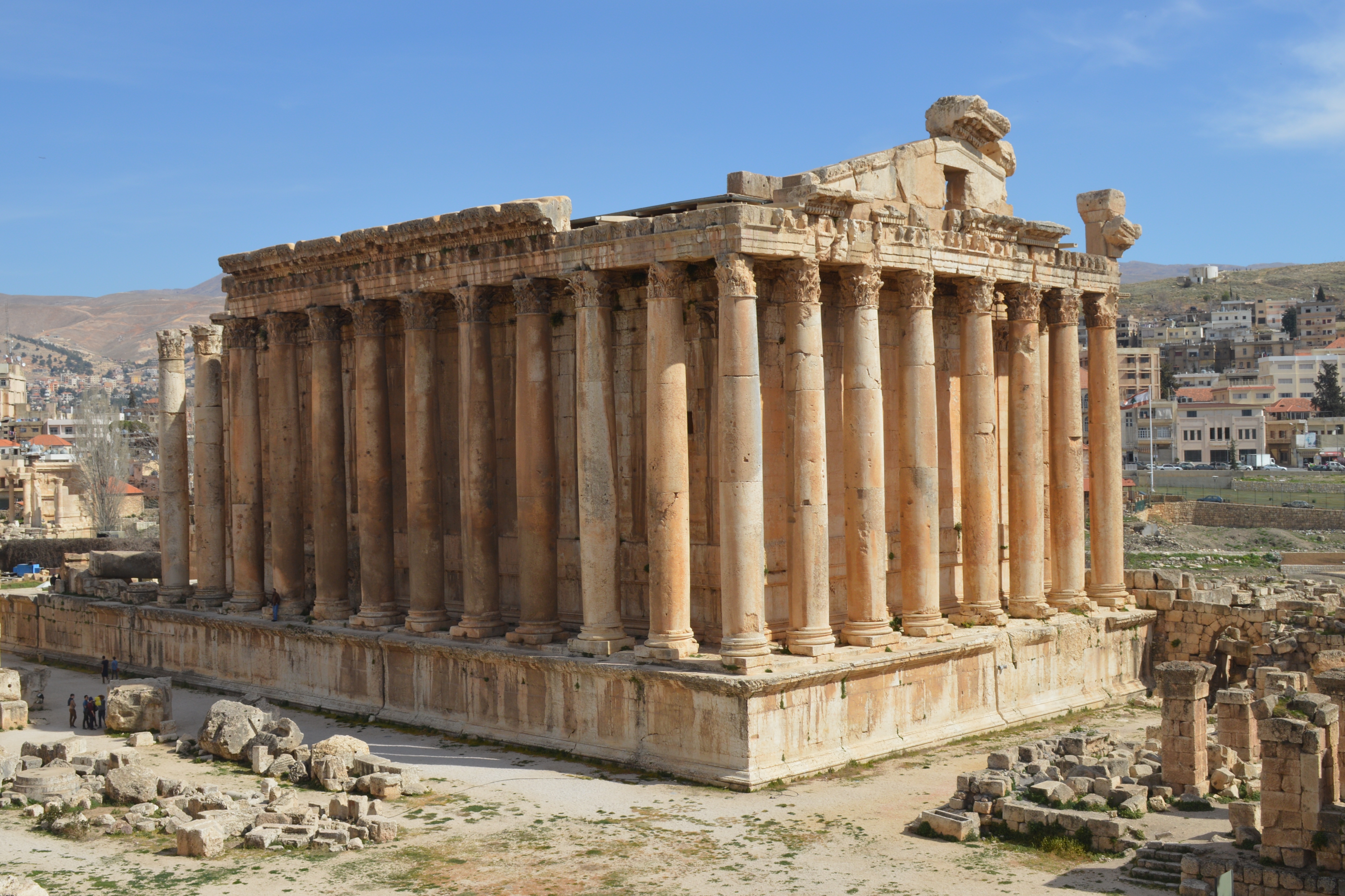
Temple of Bacchus, Baalbek

I arrived in Baalbek in the middle of a warm, sunny March day. Snow still capped the mountains to the west of the town. I quickly made for the Roman remains, which are indeed magnificent. The scale is astounding. The site of the Temple of Jupiter is vast, and must have awed visitors in its day. The smaller, but still immense Temple of Bacchus is much better preserved, and impresses also due to the exquisite detail of its craftmanship. I found it baffling that the Romans chose to build on such a vast scale, bigger by far than anything in Rome, and with such quality, in this of all places? What was it about this region that they felt the need to impress so?

Baalbek also boasts fine buildings of more recent provenance, including tall, square Ottoman-era buildings with high arched windows and balconies. But the greatest gem is the Palmyra Hotel. Built in the 1870s by a Greek merchant from Istanbul, The Palmyra has in its day hosted kings, presidents, writers, artists and musicians. Kaiser Wilhelm II of Germany visited in 1898, when he planned an excavation of the archaeological site. Other heads of state who visited included Ataturk, King Faisal of Iraq, King Abdullah I of Jordan and Charles de Gaulle. One of the staff showed me the room where de Gaulle stayed.


Inside the Palmyra Hotel, Baalbek

Today the hotel is a shadow of what it once was. The rooms are plain, the bathrooms shabby. It is no luxury hotel. But having been left largely alone, not renovated for decades, it preserves the atmosphere, the elegance of another era. In the chilly evenings (the temperature drops significantly in Baalbek in March, given its altitude), I sat in the upstairs vestibule, outside de Gaulle’s room, surrounded by period furniture, enjoying the warmth of the oil fire that an elderly staff member lit for me. Most of the rooms were unoccupied, and few staff remain. I was mostly looked after by two elderly gentlemen who had probably been there for decades. I had initially thought they were one man, for they looked like they might have been brothers. I spoke with one of them in French, and only realised they were two different men when the other, who spoke to me in English, informed me that he could not speak French. Probably the time will come when someone will renovate the place, and turn it into the luxury hotel it could be and which probably its pedigree merits. For myself, I was very happy to have stayed there in its current, slightly shabby but enormously atmospheric state. I don’t think I have ever stayed in a more special hotel.

Baalbek is a predominantly Shia town, although there are also Sunni and Christian minorities. It had been afflicted by war. During the 2006 Israeli invasion of Lebanon, Baalbek, as a Hezbollah stronghold, was bombed by the Israelis, destroying much important infrastructure. Israeli troops carried out a raid on the town, apparently in the belief that two captured Israeli soldiers were being held there.

With an election approaching, the town was filled with party political banners and flags. Hezbollah, the Party of God, is said to be dominant here, but I also saw many flags of Amal, a rival Shia outfit. Amal also formed one of the civil-war militias, but it is now in alliance with Hezbollah. Outside the entrance to the archaeological site, souvenir stalls offered Hezbollah T-shirts, featuring the Hezbollah flag, with a figure holding a rifle in the air. I chatted with a young Hezbollah-supporting shopkeeper. Times were hard, he said. Because of the conflict in Syria, few tourists were coming to Baalbek. He had been anxious about the close proximity of IS terrorists just a few kilometres away. But thankfully there had been no attacks in Baalbek.

Among the mosques in Baalbek is a relatively new Shia one, very much in the style of Hezbollah’s Iranian patron, with a wide entrance arch, and covered with blue and green tiles and Arabic calligraphy. The worrisome security situation is indicated by the metal fence surrounding the mosque, and the iron-girder tank traps. It was the only sign I saw in Baalbek that all was not quite normal. Otherwise, the atmosphere appeared reasonably relaxed. On a warm Sunday afternoon, at a park on the edge of town, people sat outside cafes and smoked hookahs, while children ate candyfloss and took rides in the toy motor cars.

That Sunday morning there was a political rally in the town, for Hezbollah and its allies. Chairs were set up before the Temple of Bacchus, surely the most dramatic backdrop for a rally I had ever seen. It was a polite affair, as people sat quietly and listened to the speeches. Particularly striking was that men and women were all jumbled up, not segregated, and that not all the women present were wearing hijab. I chatted with a couple of men who happily pointed out which parties the different banners belonged to. It all seemed very normal, apart from the backdrop, much like political rallies I have attended in many countries in Europe. The atmosphere was in stark contrast to the march I had seen in Tripoli, with its strict segregation of the sexes, the women all with billowing abayas, their faces covered.

I enjoyed my short stay in Baalbek. Everywhere I went, I was treated kindly, from the delightful staff at the Palmyra Hotel, to the pastry shopkeepers who would not accept payment for their delicious sweet cakes (I think it was normal to buy them by the dozen rather than singly). As in Beirut, I was struck by the resilience of people who have come through repeated wars, and yet carry on, surviving, and even smiling.

Sunday, 22 April 2018

Tripoli, Lebanon

Continuing my journey north along the coast, I arrived in Tripoli, Lebanon’s second city. Tripoli was much less damaged during the civil war than Beirut and cities further south. But the city has continued to be troubled since the end of the war, with repeated outbreaks of violence. Tripoli is an overwhelmingly Sunni Muslim city, with Christian and Alawite minorities. The repeated clashes have mostly involved the Sunni and Alawite communities, especially in two neighbouring districts of the city. The Alawites had long been marginalised and oppressed under Sunni Ottoman rule, but their position was much strengthened during the French mandate in Lebanon. During the civil war, Tripoli’s Alawites aligned with the Syrian occupiers, and fought with them against the Sunni Tawheed militia. Clashes erupted again in 2008 and in 2011, with the onset of the war in neighbouring Syria. As the Alawite-dominated Assad regime in Syria, supported by Shia Iran and the Shia Hezbollah militia from Lebanon, fought insurgencies by groups mainly drawn from Syria’s Sunni majority, there were fears that Syria’s war might spill over into Lebanon.


Citadel of Raymond de Saint-Gilles

Fears about Tripoli’s security have left their mark on the city. Few tourists visit. My host, a local journalist, told me that the Alawite district had been disarmed by the army, and that it was now fully under control. Indeed, I felt quite relaxed as I walked around the city. An election campaign was in full swing. Huge posters of Sunni leaders, including one of the Saudi Crown Prince, looked down on a small square on the edge of the medieval souks. After Friday prayers, a demonstration set off from the Mansouri Great Mosque. Strictly segregated between men and niqab-wearing women, their black banners with white calligraphy looked disturbingly like those of the so-called Islamic State. My host assured me that, while conservative, this group was non-violent and nothing to do with IS.

Like most towns in Lebanon, Tripoli has a rich history, with different rulers all leaving their mark. Crusaders ruled here for nearly 200 years in the 12th and 13th centuries. They built the huge Citadel of Raymond de Saint-Gilles on a hill dominating the old town. It has been rebuilt more than once since then, and above the main entrance is an engraving from the Ottoman Sultan Suleyman the Magnificent, who ordered its restoration in the 16th century. The medieval Souks date from the decades after Tripoli’s conquest by the Egyptian Mamluks in 1289. Like many middle eastern Souks, they are a warren of narrow streets, crowded with little shops, market sellers and eateries. Navigating was difficult. The Souks are rather shabby, and in places dilapidated, but atmospheric. But wandering the alleyways, I would suddenly find myself walking below vaulted ceilings or past the entrances of medieval mosques or madrassas.


Mansouri Great Mosque

Most impressive is the Mansouri Mosque. Built by the Mamluks, its entrance and minaret are thought to be remnants of the earlier cathedral the Crusaders had built on the site. The minaret may have been the bell tower. Stepping through the entrance, out of the bustle of the Souks, you enter the peace of a large courtyard, with a domed fountain in the middle, where worshipers wash their feet before praying. There are several khans in the Souks area. Most interesting is the 16th century Khan as-Saboun, the Soap Khan. From the 18th century, Tripoli became known for its high-quality soap production, the centre of which was here.

Not far from the Souks is a district built during the later Ottoman period. At its centre is the clock tower, which has been renovated with Turkish help in 1992 and again in 2016. Around the square and in the streets fanning out from it are tall 19th century buildings, with ornate balconies.

One of the most beautiful buildings in Tripoli is the 14th century Taynal Mosque, a little distance away from the city centre. Built on the site of an earlier Carmelite church, it preserves part of the nave in the outer prayer hall. Recycled Egyptian columns topped by Roman capitals are incorporated into the structure. The ornate entrance to the main prayer hall, with its alternating black and white stones, typical of Tripoli, and geometric patterns, is particularly lovely.

Sunday, 15 April 2018

Byblos

A short distance north of Beirut, along the coast, is the little town of Byblos, or Jbail in Arabic. There has been a town here for at least 7,000 years, and it is often claimed that Byblos is the oldest continuously-inhabited town in the world. One after another, the great civilisations of the eastern Mediterranean have left their mark here, Phoenician, Egyptian, Persian, Hellenic, Roman, Islamic, Christian. The archaeological site next to the medieval town centre includes remnants of societies and cultures from different periods going back millennia. Some have been moved from one spot to another by archaeologists, to enable the excavation of earlier remains.


Byblos harbour

There are royal tombs cut in vertical shafts. One of them, the 3,000 year old tomb of King Ahiram, contained a sarcophagus, now in the National Museum in Beirut, with an inscription in the ancient Phoenician alphabet. The earlier “Obelisk temple”, which was moved to enable the excavation of an even older temple underneath, contained numerous small gold-plated bronze figurines, now also in the National Museum, that are a symbol of Byblos. Nearby are the sturdy walls of a later Persian fortress. There is a Roman theatre, and the remains of a Roman fountain.

Hard as it might be to imagine, this little town was also once a favoured destination for the international jet set and their yachts. I stayed in a guesthouse attached to the Fishing Club restaurant, which gives on to the pretty little harbour. In the 1960s, the rich, the famous, the powerful and the glamorous of the world came to enjoy the hospitality of its proprietor, Pepe Abed, a tourism pioneer in Lebanon, who also owned nightclubs in Beirut and Tyre. The walls of the restaurant terrace are covered with photos of the famous guests, Brigitte Bardot, Marlon Brando and David Niven among them, as well as Vaclav Havel, Jacques Chirac and Helmut Kohl. Alas, since the end of the civil war, the glitterati have not returned to Byblos. In March, when I was there, the restaurant terrace and the harbour were quiet. No yachts in sight.


Crusader castle, Byblos

Byblos’s population is a predominantly Maronite Christian. The 12th century Church of St John the Baptist was built during the town’s period of Crusader rule. The Crusaders also built the impressive fortress which dominates the archaeological site, much of whose masonry came from the Roman buildings that once stood there. The ends of Roman columns can be seen sticking out from the walls.

In addition to a Shia Muslim population, there is also a small Armenian community. I visited the ‘Aram Bezikian’ museum of the orphans of the Armenian genocide, which was opened in 2015, the year of the centenary of the genocide. Among the survivors who in 1915 were marched across Anatolia and Syria, were large numbers of children separated from their families. The building in Byblos that houses the museum was one of the orphanages established to care for them. I had visited the genocide museum in Yerevan a few months earlier. Though on a smaller scale, a visit to the museum in Byblos is also a moving experience. Leading up to the entrance is a row of statues of skinny children seated on the ground, their food bowls in front of them. Inside, exhibits about the life of the Armenian community in Turkey before the genocide, and about the horror of the genocide itself, recall the museum in Yerevan. Upstairs there are exhibits about the humanitarian efforts to care for the orphans. It is estimated that there are around 150,000 Armenians in Lebanon today. There had been more, but many left during the civil war. A young man I spoke to at the museum in Byblos told me they have their own schools and churches. He could, he said, speak both Arabic and Armenian fluently, as well as English.

Tuesday, 10 April 2018

Resilient Beirut

From the time I started to become aware of world affairs as a teenager in the mid-1970s, Lebanon was racked by the civil war which lasted until 1990. Even since then, devastation has repeatedly returned to the country due to persistent conflicts with Israel. And Syrian forces occupied swathes of the country until 2005. As I was growing up, Beirut seemed to be a byword for wanton destruction and never-ending hopelessness. What I knew of Lebanon was based on television news footage of the destroyed city. Yet my father, who had spent a year in Lebanon after the Second World War, reminisced about Beirut as a beautiful place.

As a young army officer, he had studied Arabic at the British school at Shemlan, in the mountains close to Beirut. It became notorious as the so-called British ‘spy school’. There may have been something in this. He, like many others who studied there, had been an intelligence officer. But the description was probably over dramatic.


Place d'Etoile

In earlier times, Beirut had flourished as one of the great cosmopolitan trading cities of the eastern Mediterranean, along with Alexandria, Smyrna and Istanbul. Like in those other cities, different religions rubbed shoulders, Orthodox and Maronite Christians, Sunni and Shia Muslims, Druze and Jews. Unlike many other such mixed cities, Beirut had not, before the civil war, had defined quarters for different communities. In the city centre, the Mohammed al-Amin Mosque and the Maronite St George Cathedral stand next to each other. Philip Mansel, in his book about the great cities of the Levant, cites the enthusiastic reports of visitors to Beirut in the years before the civil war: “Paradise! Absolute paradise!” It was known as the Paris of the Middle East.

Beirut has largely been rebuilt since the civil war. In the downtown area, new apartment buildings have sprung up, many of them luxurious. The process of rebuilding has not been without controversy. Many accused the company set up by post-civil war Prime Minister Rafiq Hariri, who was assassinated in 2005, to rebuild the city centre of profiting at the expense of the pre-war owners of the land. Much of the modern city that has risen from the ashes gives little impression of the elegant Beirut that earlier visitors had described. The downtown area, around the Place d’Etoile, with its clock tower, has been restored, a kind of declaration that Beirut is back. But it feels a little artificial and soulless. Not here the chaotic hustle and bustle one finds in the livelier districts of the city.

The dilemmas and controversies over Beirut’s post-war reconstruction are evident in the Souks district, not far from the Place d’Etoile. The area, once the commercial heart of the city, had been ravaged by the civil war. Except for a handful of buildings, it was decided to level the whole area and build a new Souks complex, as a shopping and leisure centre. Modern and smart, its architecture may have much merit. But to me it felt rather contrived, out of context, carefully designed, but very different from the bustling, vibrant city one finds away from the downtown area. It brought to my mind the shopping malls I had visited in Dubai a few years earlier.


The Al-Omari mosque

At the entrance to the Souks stands a remnant of the pre-war city, a square archway, with a dome on top. A young woman in a nearby tourism office told me she thought it was the remains of a mosque. Many other religious buildings have fared better. In the redevelopment of the city, mosques and churches were more often preserved and renovated. Close by the Souks is the Al-Omari mosque. Built in the 12th century by the crusaders as the Church of St John the Baptist, it was converted into a mosque the following century by its Muslim, Mamluk rulers. The Romanesque architecture, with the apse at one end, clearly indicates its Christian origins. The Mihrab, which points the direction of prayer for Muslims, is situated halfway along the nave. Having been damaged during the war, its reconstruction was completed in 2004. On the other side of the Place d’Etoile is the Mohammed al-Amin Mosque, inaugurated ten years ago, built in the Ottoman style, with slender pointy minarets surrounding a central dome.

The Mohammed al-Amin Mosque looks onto the Martyrs’ Square, named to commemorate Lebanese Arab nationalists executed there in 1916 by the Ottoman authorities. At the square’s centre is the Martyrs’ monument. The square was on the frontline during the civil war. After the end of the war, the monument was restored, but the marks of the war damage, bullet holes in the metal figures, were deliberately retained. The square had once been a central focal point of the city, a transport hub and meeting place, with cafes and cinemas. Today it feels like an empty hole at the heart of the city. But it has also become the place for political protests, notably the massive demonstrations following the murder of Hariri, which led to the withdrawal of Syrian troops from the country.


The Holiday Inn, Beirut

War-scarred buildings remain in many parts of the city. The 25-story Holiday Inn, a pock-marked skeleton of a building, remains as a monument to the conflict while its owners squabble over what to do with it. Some other buildings have been kept as they are deliberately, as monuments. Most notable is the Barakat building, built in the 1920s by the wealthy Barakat family. During the civil war it found itself on the frontline, a sniper post at a crossroads known as the ‘intersection of death’. Although badly damaged, the building remained standing. In 2003 it was taken over by the municipality and restored. The façade, disfigured by countless bullets, was left alone, shored up by metal supports. But behind it a new building was erected. Now known as the ‘Beit Beirut’, or House of Beirut, it houses exhibitions of photographs commemorating the life of the city, and especially how it was affected by the civil war.


Beit Beirut

Walking the streets to the south of the downtown area, one comes across fine old buildings, once the homes of wealthy commercial families, some of them war damaged, others apparently suffering more from neglect. The Ziade Palace, a 19th century mansion, looked a dark and gloomy place. A couple of ladies sitting outside an open door indicated that it was nevertheless inhabited. Occupied by different militias during the civil war, pillaged and damaged, it has been earmarked for restoration. Many such gems survive in Beirut. But surrounded by modern buildings, their context has often been lost.


Beirut survivors

Something of the former city survives and has been restored in Christian East Beirut. Tiny hole in-in-the wall cafes on the Rue Gouraud might not have changed much. But these are pockets. Nevertheless, modern Beirut has life and character. How much it has been changed by the war, I could not say. But it is a vibrant city, its streets bustling, its traffic chaotic. Areas such as the Hamra district in West Beirut, with their cafes, bars and restaurants, buzz with life. To have come through such trials and such destruction and come back with such verve is evidence of Beirut’s tremendous resilience.

Just north of Hamra, overlooking the seafront, is the American University in Beirut. A private institution founded in the 1860s, it is considered one of the finest universities in the Arab world. It boasts an impressive roll of alumni, including presidents, prime ministers and central bank governors. The university was not spared during the civil war, and in 1982 its president, Malcolm H. Kerr, a US citizen and native of Beirut, was murdered. Today, amid the noise and pollution of the city, the university campus, with its gardens and trees, is an oasis of peace and calm.

I arrived in Beirut without high expectations. I knew there was not much left of the great Levantine pre-civil war city. I was not expecting beauty. But the modern city does have much to be said for it. The divisions that once rent Beirut have been repaired to a remarkable degree. Politics may still be divided along sectarian lines, but the physical barriers that separated people during the civil war are at least no longer visible. Muslims relax in the cafes of Christian East Beirut, and Christians go out on the razzle in the lively bars of Hamra in the Muslim west. No doubt there are strains beneath the surface. Not everyone is happy. A minivan driver asked me whether Beirut was good? Yes, I asserted enthusiastically. No, he replied forcefully, Beirut is shit. Yet I found Beirut, for all its chaos and grubbiness, in many ways refreshing. Despite all the hardship and suffering of the civil war, this great, diverse, vibrant city has reasserted itself. Different from before, for sure, but a great and spirited city still.

The main divisions nowadays seem to be between wealthy and poor. There is a world of difference between the luxury apartment blocks in the downtown area, the smart streets of Verdun district, where I stayed, and the Palestinian refugee camps in the south of the city. I travelled along a main road through the Burj Barajneh camp, on the way to the airport. I couldn’t see much. Photographs show a dense jungle of makeshift concrete buildings, the narrow streets criss-crossed by tangles of wires providing jury-rigged power and telecommunications. The people there have the barest minimum of facilities. Forgotten by the world, their presence in Lebanon is accepted only grudgingly. There is wealth in Beirut. Restaurants and cafes are often startlingly expensive. But many are excluded.

Beirut’s biggest challenge remains the turbulent region it finds itself in, and cannot escape. There are still tensions in the city. The heavy presence of soldiers and armed police in the city centre, the barbed wire and roadblocks that shield the Grand Serail, the restored Ottoman-era palace that is now the government headquarters, demonstrate that. Beneath the veneer of calm and normality, fear still lurks. The implosion of Syria reminded everybody of that. Lebanese fighters have fought on different sides. The war threatened to spill over into Lebanon. Thankfully Lebanese had had enough of sectarian warfare not to go down that path again. And then there is Israel. With the battle-hardened Hezbollah militia better organised and equipped than ever, another war with Israel is an ever-present risk. Destruction can some to Beirut again. In the meantime, life goes on.